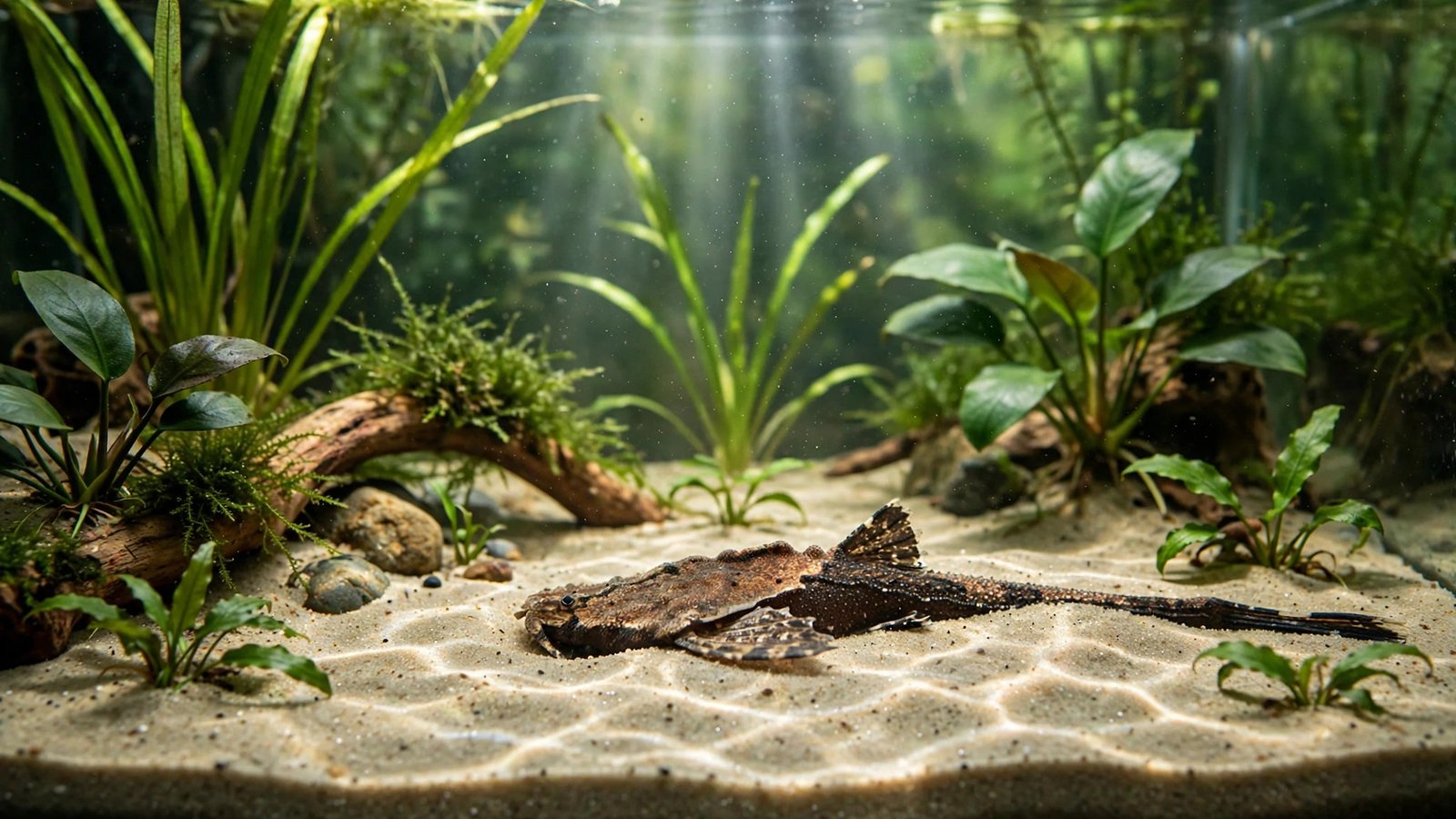
Here is a fish you can own for weeks without ever seeing: by day it vanishes into the substrate, by night it rises from the sand. The banjo catfish (Bunocephalus coracoideus) is the aquarium's quietest ambush predator, and a banjo catfish planted tank is a negotiation — you build a beautiful aquascape, and it burrows straight through it. Here's how to set up a planted tank that survives the bulldozer, and how to feed a fish you almost never see.
Setting Up a Banjo Catfish Planted Tank, Step by Step
The substrate is the whole game here. Give your banjo a uniform bed of fine, soft sand 5–8 cm deep across the whole footprint — not a dusting over gravel, and not coarse sharp sand. Pool-filter sand works well. Every day the fish flicks sand over its flat body until only its eyes and barbels protrude; gravel blocks this behavior and scrapes its belly over time.
Over the sand, build low driftwood caves and add a generous layer of dried Indian almond or oak leaves. The leaves give daytime cover, leach gentle tannins that dim the water, and grow microfauna the fish picks at between feedings. If you lean into the look, a planted blackwater tank suits this species perfectly.
Choosing Plants That Survive a Burrower
A banjo catfish is a bulldozer — it will plow through anything weakly rooted on its nightly patrols. Build your plant list like a storm-proof garden: deep-rooted rosettes like Cryptocoryne and Vallisneria hold their ground, and epiphytes tied to driftwood (Anubias, Java fern) can't be uprooted because they were never in the substrate.
| Plant | Placement | Why it works |
|---|---|---|
| Cryptocoryne wendtii | Midground, rooted in sand | Deep roots grip sand; tolerates dim light and tannins |
| Vallisneria spiralis | Background | Runner network anchors the whole bed; fast recovery from disturbance |
| Anubias barteri | Tied to driftwood | Epiphyte — un-uprootable; slow growth suits low light |
| Java fern (Microsorum) | Tied to driftwood | Same logic; tough leaves shrug off contact |
| Frogbit / water lettuce | Floating | Shades the tank; matches the dim + floating-plants consensus in the trade |
Skip delicate stem plants and fresh carpets — a carpet planted after adding the fish is a nightly excavation project. Plant the tank, let everything root in for a month, then add the banjo. A low-tech planted tank setup (no CO2, moderate light, patience) is the natural build style here.
Dim the Lights, Then Feed the Ghost
Banjo catfish are strictly nocturnal — most emerge well after lights-out, so food dropped during the day is gone before they wake. In a community tank, the sand hides the evidence that it ate nothing at all.
Feed like the tank has a second shift. About 30–60 minutes after lights-out, drop sinking carnivore pellets or frozen bloodworms near the spot where your banjo buried itself that morning — it returns to the same patch, so you will learn it fast. Keep portions modest: a sedentary fish needs far less than its size suggests, and uneaten night food fouls a warm tank quickly.
Lighting follows the same logic: low to medium, with floating plants breaking up the surface and a gradual ramp-down at night. Think of this as a cleanup-crew-style bottom-dweller tank — except the "cleanup crew" is one grumpy, sand-colored predator waiting for nightfall.
Banjo Catfish vs. Whiptail Catfish: Don't Buy the Wrong Fish
One naming trap catches buyers every year: the banjo catfish (Bunocephalus) and the whiptail catfish (Rineloricaria) are completely different animals. Whiptails are slender, armored grazers that cling to wood and glass and rasp at algae — peaceful, daytime-visible community fish. Banjos are squat, smooth-skinned aspredinids that bury in sand and swallow small tankmates whole. Same continent, opposite lifestyles. If your "banjo" is gliding up the glass in daylight, it isn't one.
Water, Tankmates, and the Long Game
Water chemistry is the easy part: 24–27°C, pH 6.0–7.5, moderate hardness — clean and stable is what counts. What stresses banjos is bright light, a bare bottom, or boisterous tankmates. Given dim conditions and compatible company, they routinely pass the decade mark in captivity.
For tankmates, follow one rule: nothing that fits in the banjo's mouth, nothing that harasses bottom-dwellers. Medium tetras, larger rasboras, peaceful gouramis, and angelfish all work. Skip fin-nippers and aggressive diggers — and anything under about 5 cm, unless you're comfortable feeding it to your catfish. A 75-liter tank is a fair minimum for one adult, and the deep-rooted plants above scale to the same footprint.
For the full plant shortlist, start from the classic guide to aquarium plants for fish tanks and filter for the tough, shade-tolerant, deep-rooted end — here the plants serve the fish, not the other way around.
Frequently Asked Questions
Can a banjo catfish live in a planted tank with gravel substrate?
Not well. Banjo catfish bury themselves by flicking sand over their flat bodies; gravel blocks this behavior and risks belly abrasion. A 5–8 cm bed of fine, smooth sand is the single most important requirement. If your tank is already planted on gravel, switch the substrate or pick a different bottom-dweller.
Why haven't I seen my banjo catfish eat?
You probably feed at the wrong hour. Banjos are strictly nocturnal and emerge well after lights-out, so daytime food is gone before they wake. Feed 30–60 minutes after dark with sinking pellets or frozen bloodworms near its burial spot. Chronic starvation is the most common way these fish die in community tanks.
Will a banjo catfish eat my neon tetras?
Yes — anything it can fit in its mouth is prey, and its mouth is disproportionately large. Neons, small rasboras, and cherry shrimp are all at risk; it hunts by ambush from the sand and can catch fish you'd assume were too fast. Keep it only with tankmates too large to fit in its jaws.
Do banjo catfish uproot aquarium plants?
Yes, they dig through the substrate nightly, so weakly rooted plants get displaced. Use deep-rooted species like Cryptocoryne and Vallisneria, tie epiphytes like Anubias and Java fern to driftwood, and let plants root in for a month before adding the fish. Plant the tank first, add the banjo second.
How big do banjo catfish get, and what tank size do they need?
The common species, Bunocephalus coracoideus, reaches about 13–15 cm and lives a decade or more. A 75-liter (20-gallon) tank with a 5–8 cm sand bed suits one adult. Footprint matters more than volume — a longer, shallower tank beats a tall one.
Is the Banjo Catfish Right for Your Tank?
If you want a visible centerpiece, this is the wrong fish — you'll own a patch of sand that occasionally grows eyes. But for a predator that turns your planted tank into a working night-shift ecosystem, nothing else does the job: deep fine sand, leaf litter and driftwood caves, tough plants, dim light, food after dark. SeriouslyFish's species profile backs the formula — watch it surface at midnight once, and you'll get it.