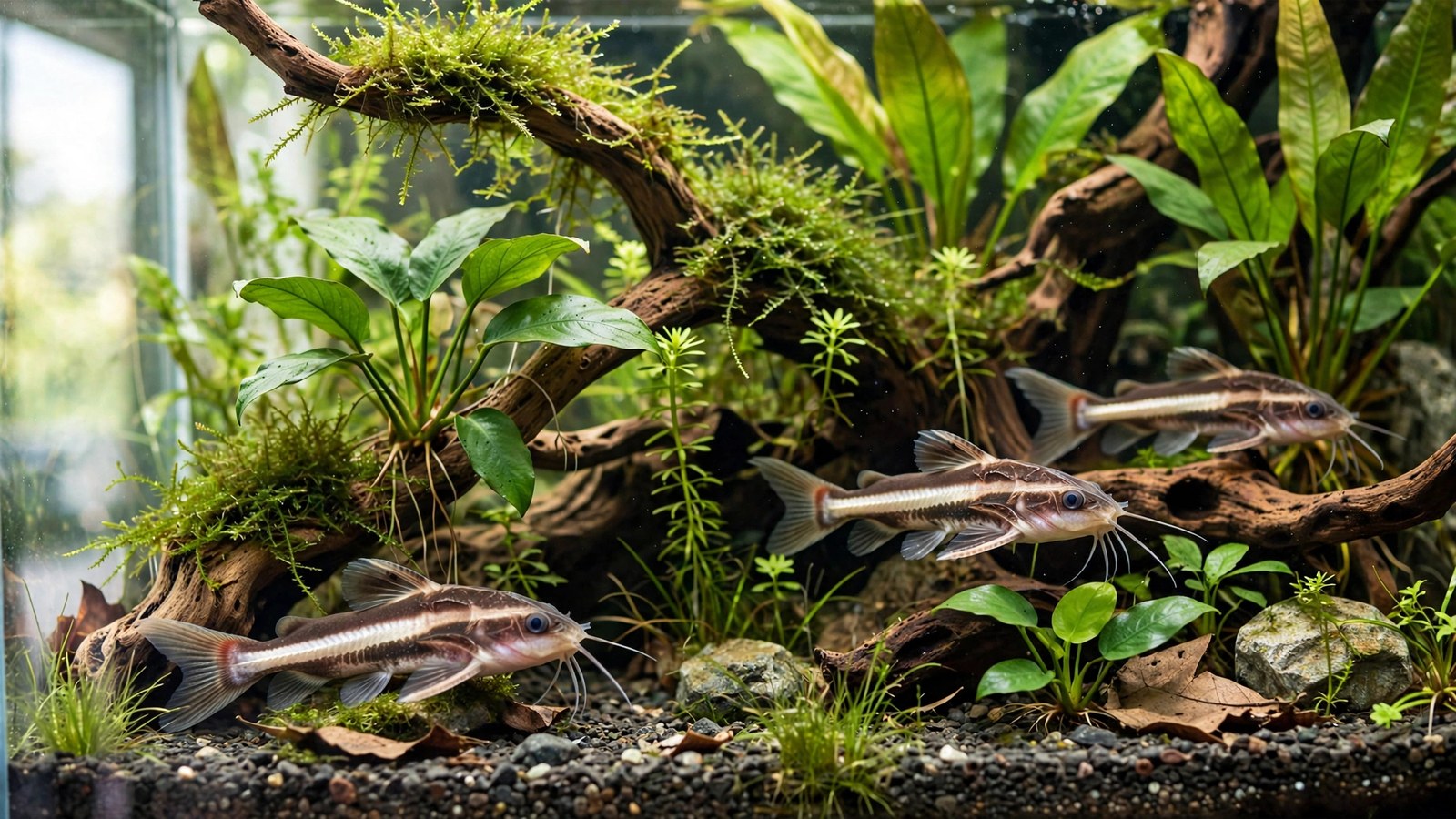
Most aquarists have never actually seen their raphael catfish. This talking catfish spends the day wedged inside driftwood and only emerges after lights-out — which is why so many are accidentally starved, netted with disastrous results, or kept in tanks far too small for their 15–20 cm adult size. A well-built raphael catfish planted tank flips that script: dense shade zones, sand to burrow in, and a feeding routine built around its nightlife make this armored catfish one of the most reliable and long-lived bottom dwellers you can keep.
Yes — a raphael catfish thrives in a planted tank, and dense plants actually improve its life by cutting light at the substrate and creating the shade it seeks in the wild. Keep 30 gallons minimum with sand, driftwood caves, and sturdy root-fed plants, and this nocturnal doradid can live 10+ years — possibly several decades, according to Aquarium Glaser's species notes. It croaks audibly when threatened, so hearing your "talking catfish" is your cue to leave it alone.
The raphael catfish planted tank: a nocturnal blueprint
The striped raphael (Platydoras armatulus) is a doradid: flanks armored with bony plates tipped in rear-facing hooks. Its "talking catfish" nickname comes from the croak it makes by grinding its pectoral spines when threatened. Wild raphaels shelter among roots in slow South American waters and hunt at night. Your tank needs to recreate two things: somewhere dark to hide, and a feeding routine built around its nightlife. Before adding one, read our guide to bottom-dwelling cleanup crews in planted tanks — the raphael is a scavenger, not the tireless algae-eater many beginners assume.
Tank size, water, and layout
They grow slowly, but 15–20 cm is normal in aquariums (24 cm wild). A 30-gallon long is the working minimum; a 48-inch footprint suits the recommended group of three to five. Water is forgiving — 24–28 °C, pH 6.0–7.5, soft to moderately hard. Two details matter:
- Sand or fine gravel. Barbels stay healthier on smooth substrate, and 5–7 cm of sand lets raphaels dig sleeping hollows.
- Heavy shade. Dense planting at the back and corners cuts light at the substrate — "useful in cutting out the amount of light hitting the bottom of the tank," as SeriouslyFish puts it.
Hardscape: caves before decoration
The single biggest mistake is a planted tank with nowhere to hide. Raphaels spend daylight wedged into driftwood tangles, rock overhangs, clay pots, or PVC pipe. Build the hardscape first, then plant around it.
- Two to three caves per catfish — coconut huts, terracotta pots on their sides, or stacked slate.
- Driftwood with anubias and java fern tied on — living cave walls where the fish hides.
- Guard the heater. A wedged raphael can burn itself on a bare heater — use a guard or keep it in the filter flow, out of reach.
 ★4.2
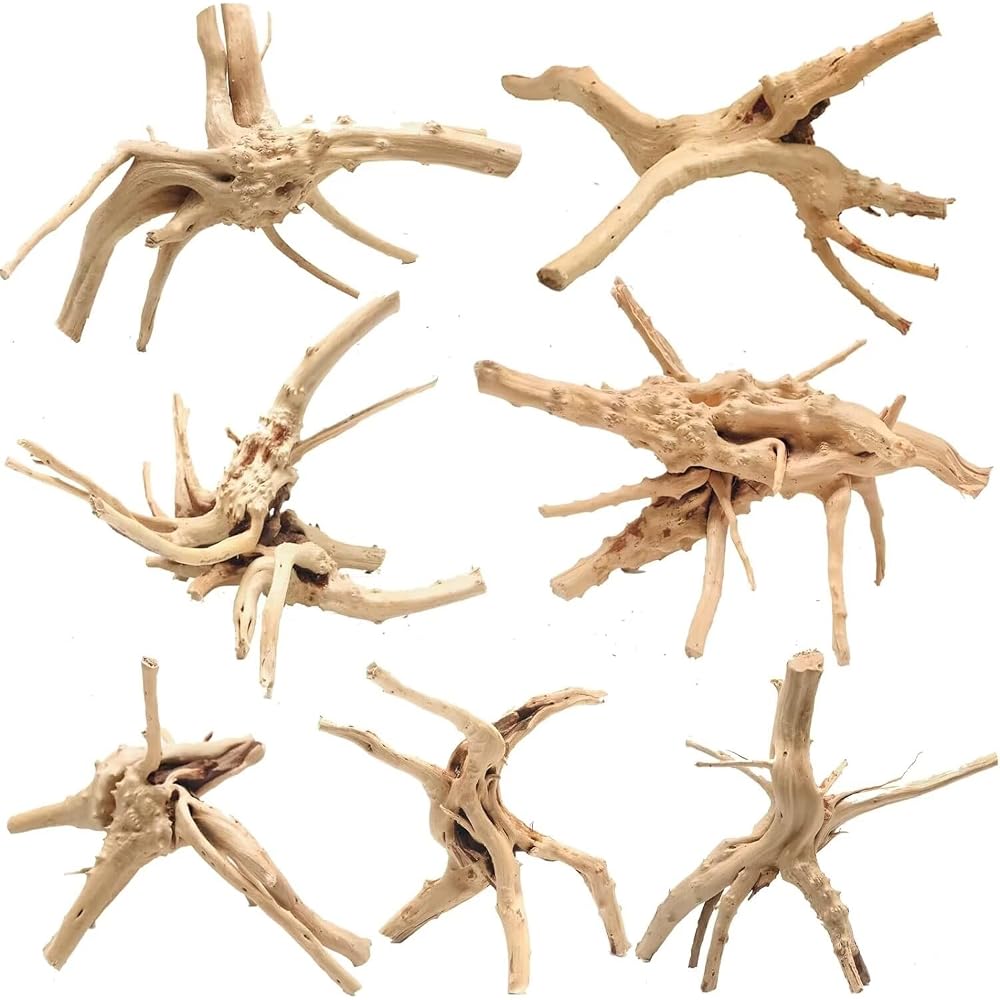
Hamiledyi Natural Spider Wood Driftwood
Check Price on Amazon ★4.2Plants that survive an armored burrower
Raphaels don't eat plants — the risk is mechanical, from digging and wedging. Choose deep-rooted or hardscape-anchored species, and match the dim lighting to a low-tech planted tank setup.
| Plant | Why it works here | Placement |
|---|---|---|
| Anubias barteri | Tied to wood, un-uprootable, low-light OK | Hardscape around caves |
| Java fern | Rhizome never buried; survives digging | Wood and rock crevices |
| Amazon sword | Deep roots once established; broad leaves cast shade | Back corners in sand |
| Vallisneria | Runner-rooted; tolerates rough treatment | Background screen |
| Water lettuce / frogbit | Floating cover dims the light shy bottom fish want | Surface, corralled from the filter outflow |
For more options, see our roundup of sturdy aquarium plants for a fish tank — every entry tolerates rough neighbors.
Feeding after dark — the part most keepers miss
Raphaels are omnivorous bottom feeders: sinking carnivore pellets, bloodworms, chopped earthworm or prawn, plus vegetable-based sinking foods. Timing is the rule — drop food 30–60 minutes after lights-out; a raphael that only smells food at noon never gets its share. Feed juveniles nightly, adults 4–5 nights a week. Overfeeding is the greater risk: uneaten meaty food wrecks water quality fast. Other shy bottom fish run the same shift — see how nocturnal feeders like the kuhli loach are handled after dark.
Tank mates: size is the only rule
Raphaels are peaceful toward anything they cannot eat. That caveat covers a lot: neon tetras, guppy fry, cherry shrimp, and any nano fish vanish overnight. Medium and larger fish — angelfish, gouramis, rainbowfish, congo or lemon tetras, peaceful cichlids — all work. One distinction: the pictus catfish (Pimelodus pictus) is a fast, diurnal swimmer, while the raphael is a slow, nocturnal, armored hider — different fish entirely, and pictus is already covered on this site.
The "talking catfish" explained
The croaking is real. When stressed — a net, a hand, a dispute — the raphael locks its pectoral spine into a shoulder groove and rotates it, producing a squeak or croak loud enough to carry out of the water. It is a distress signal, not a party trick: if your fish is talking, something is wrong. Softer clicking at night during feeding is normal foraging noise — though new keepers often mistake it for a rattling filter.
The SeriouslyFish profile of Platydoras armatulus lists the full wild range and 24 cm maximum; the Tropical Fish Keeping profile covers its community habits in detail.
Frequently Asked Questions
Can a raphael catfish live in a planted tank?
Yes. Dense planting and floating cover create exactly the low light and hiding spots this nocturnal catfish wants. Use sand, anchor epiphytes to hardscape, plant deep-rooted species, and provide caves — the fish will largely ignore the plants while hiding among them.
How big do raphael catfish get?
15–20 cm (6–8 in) in aquariums, with wild specimens recorded to 24 cm — hence the 30-gallon minimum with a long footprint. Growth is slow, so a juvenile fits a 20-gallon for a year, but plan for the adult from day one.
Will a raphael catfish eat my other fish?
Anything that fits in its mouth: nano fish, guppy fry, and shrimp disappear overnight, since the raphael hunts in the dark. Match community fish to the catfish's eventual 20 cm size, not its juvenile size.
Why does my raphael catfish croak or squeak?
A distress sound made by grinding serrated pectoral spines in their shoulder grooves — it means the fish feels threatened or is being handled. Softer clicking at night while foraging is normal. Daytime croaking means something is stressing it.
Can I keep just one raphael catfish?
Yes — raphaels are social but not schooling, and a single specimen does fine, which suits a 30-gallon setup. A group of three to five in a 55-gallon tank is more natural and noticeably bolder at night.
Is the raphael right for your tank?
If you want a big, armored, long-lived bottom dweller — and will feed after dark and accept a fish that is invisible by day — the raphael is hard to beat. If you want a visible, active fish, look elsewhere. For an armored bottom dweller that tackles the algae angle instead, see our bristlenose pleco planted tank guide.