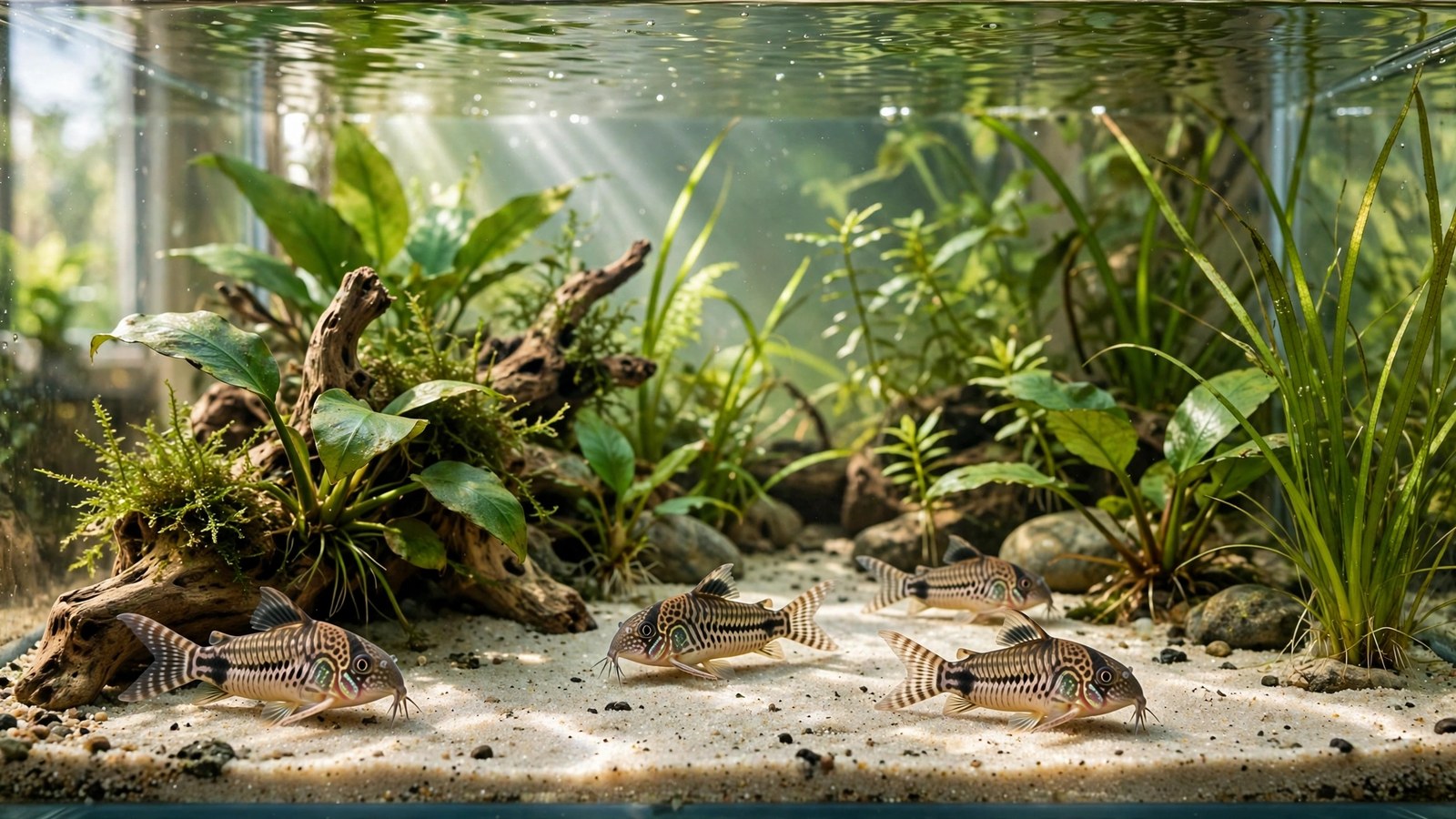
The fish labeled "julii cory" at your local shop is almost certainly not one. The leopard cory (Corydoras trilineatus) wears a reticulated, net-like pattern crossed by three dark stripes along each flank, while the true C. julii wears crisp, separate round spots — a trait worth learning, because a proper trilineatus cory planted tank lets this forgiving, peaceful bottom-dweller do what it does best: shuffle its whiskered snout through soft sand while a school of six or more patrols the planted floor together.
Trilineatus Cory Planted Tank: Setup Essentials
Start with footprint, not volume. A 20-gallon long — where the bottom floor matters more than the water column — comfortably holds a school of eight leopard cories with room to forage in formation. Tall narrow tanks waste the only real estate these fish use. If you are still choosing greenery, the aquarium plants for fish tank guide walks through species that tolerate constant rootling around their bases.
The single non-negotiable is sand. Leopard cories feed by pushing their snouts into the substrate and sifting grains through their gills, and their sensory barbels — the whiskers that make the species so endearing — erode on sharp gravel. Pool-filter sand or fine play sand at 3–5 cm depth is perfect. Rinse it well, then expect the school to spend most of the day shuffling across it in a loose, winking formation.
Temperature is forgiving: 22–26 °C covers them comfortably, which overlaps with almost every classic community setup. Keep the water clean rather than exotic — zero ammonia and nitrite, nitrates under 20 ppm, and a steady 25–30% weekly water change do more for cory health than any additive. Leopard cories are hardy, but hardy does not mean invincible; a new tank must be fully cycled before the school goes in.
Sand, Plants, and Layout
Design the layout around two zones: dense planted borders and open sand lanes. The cories graze the lanes by day and retreat into the foliage when startled, so a bare-minimum jungle at the back and sides makes them visibly bolder. Sturdy rooted plants — Amazon swords, cryptocorynes, vallisneria — anchor well against rootling, while epiphytes glued or tied to wood stay completely out of reach of snouts.
Carpets deserve a strategy. A mature carpet of foreground carpeting plants survives a cory school fine, but plant the carpet and let it root for several weeks before the fish arrive — fresh plugs are the one thing a foraging school will nudge loose. If you prefer a lighter touch overall, a lightly planted aquarium setup still gives cories the cover they need without demanding high light or CO2.
Feeding a Leopard Cory School
The biggest beginner mistake is treating cories as the cleanup crew and nothing else. They are enthusiastic scavengers, but a diet of leftovers is a starvation diet with extra steps. Feed sinking cory wafers or shrimp pellets daily, and rotate in frozen daphnia or bloodworm two or three times a week. They feed most confidently in dim light, so dropping wafers after the lights go out guarantees the shyest school members eat.
Watch the school's bellies, not just their activity. Well-fed trilineatus are plump through the midsection and constantly whisking; sunken bellies in a busy-looking school mean the mid-water fish are stealing the food before it sinks. Target-feeding with a feeding dish or a sinking pellet pressed into the sand lane fixes that in days.
Peaceful Tank Mates
Leopard cories are among the most peaceful fish you can add to a community tank, which makes tank-mate selection about protecting them rather than the other way around. Pair them with calm mid-water schooling fish — neon and ember tetras, harlequin rasboras, small peaceful gouramis — and they will ignore everything above the substrate line entirely.
Other bottom dwellers mix beautifully if the floor is large enough. A school of panda cories will shoal alongside trilineatus without issue, and kuhli loaches share the same sand lanes and night-feeding schedule. Avoid large cichlids, aggressive barbs, and anything big enough to see a 6 cm cory as food — the cories' pectoral spines deter some predators, but a stressed school hides all day and stops eating.
Water Parameters
Trilineatus tolerates a wide band of chemistry, which is exactly why it earns the beginner label. Aim for the middle of the ranges below and hold them steady — consistency matters more than perfection.
| Parameter | Target |
|---|---|
| Temperature | 22–26 °C |
| pH | 6.0–7.5 |
| General hardness | 2–12 dGH |
| Ammonia / nitrite | 0 ppm |
| Nitrate | Under 20 ppm |
| Water changes | 25–30% weekly |
Frequently Asked Questions
How do I tell a trilineatus cory from a true julii cory?
Look at the flank pattern, not the label. Corydoras trilineatus shows a reticulated, maze-like pattern crossed by three dark longitudinal stripes along the body. Corydoras julii shows crisp, separate round spots with no striping or netting. Nearly every "julii cory" sold in shops is actually trilineatus — genuine julii are rare and expensive in the trade.
Will leopard cories uproot my aquarium plants?
Established plants are safe. Trilineatus are gentle rootlers — they nudge and sift around plant bases rather than digging them out. The risk window is the first few weeks after planting: fresh, unrooted plugs and new carpets can be nudged loose. Plant the tank, let everything root for three to four weeks, then add the school.
How many trilineatus cories should I keep together?
Six is the absolute minimum, and eight to ten is noticeably better in a 20-gallon or larger tank. Larger schools forage in formation, color up more boldly, and show the species' playful winking behavior. Below six, leopard cories become shy, hide constantly, and are prone to stress-related illness.
Do trilineatus cories need a heater?
In most homes, yes. They thrive at 22–26 °C, which is slightly above typical room temperature in air-conditioned spaces and above winter room temperature almost everywhere. A reliable adjustable heater with a thermostat keeps the tank in range; avoid cheap preset heaters that drift. Stable temperature matters more than hitting an exact number.
Can leopard cories live with shrimp?
Yes, with adult cherry shrimp — trilineatus are too small and peaceful to threaten them, and the shrimp benefit from the same clean sand lanes. Expect some newborn shrimplets to be eaten, as with any fish. If you are breeding shrimp for profit rather than display, give the colony dense moss cover or a separate tank.
The Bottom Line
A trilineatus cory planted tank is one of the highest-reward setups a beginner can build: twenty gallons, fine sand, a real school of six or more, and plants sturdy enough to share the floor. Learn the three-stripe ID trait, feed sinking food on purpose, and this leopard-spotted bottom dweller will patrol your sand lanes for years — the Corydoras trilineatus profile on Seriously Fish is the best deep-dive reference if you want to go further.