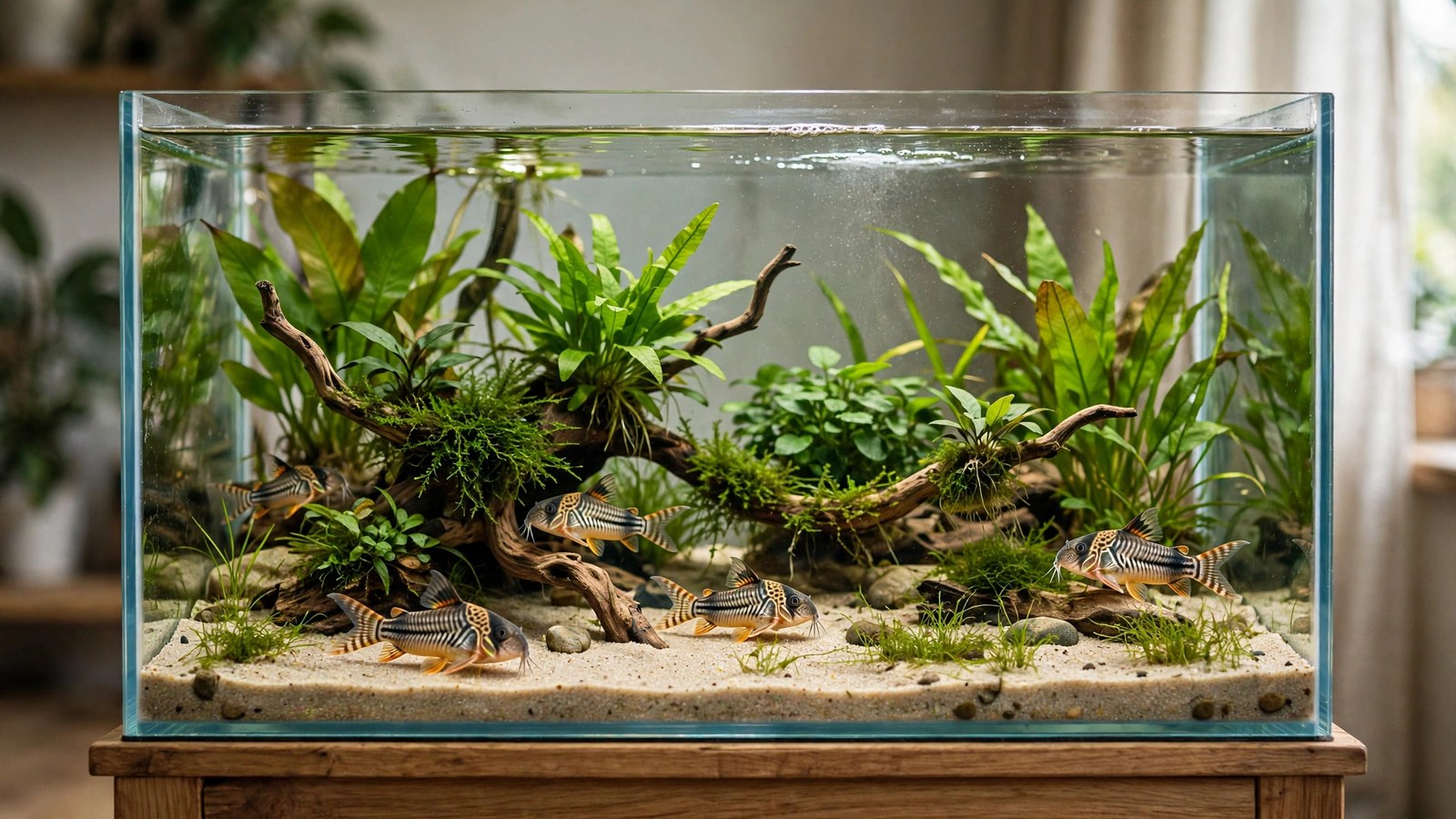
Most corydoras melt in warm water, but the sterbai cory planted tank is the famous exception. Corydoras sterbai stays active and healthy at 75–82°F, which is exactly why discus keepers — whose tanks run hotter than almost any other cory tolerates — choose this leopard-spotted bottom dweller as their cleanup companion. In this guide you'll learn how to identify a true sterbai, set up a planted tank that protects its barbels, and feed it like a main-course fish rather than a leftover scavenger.
How to set up a sterbai cory planted tank
Sterbai cories are a natural fit for the classic low-tech planted tank setup: moderate light, hardy plants, and a peaceful community that never runs hot enough to stress them — or cool enough to bother them either. A 20-gallon long is the practical minimum, and it comfortably holds a group of eight alongside a school of tetras or a pair of dwarf cichlids.
The substrate decision is the single most important one you'll make. Sterbai spend all day nosing through the bottom with their barbels, and sharp or coarse gravel abrades those sensory whiskers. Once a barbel is damaged, the fish struggles to find food and infection follows. Use fine sand — CaribSea Super Naturals, a soft play sand, or any smooth aquarium sand — at least 1.5 inches deep so the fish can sift naturally. Rooted plants grow perfectly well in sand when you feed them root tabs, so you sacrifice nothing.
Plant for broken sightlines rather than a dense wall. Sterbai like open sand lanes to forage plus shady retreats to rest in. Foreground patches of dwarf sagittaria or crypts around the edges, midground anubias or java fern tied to driftwood, and a tall background of vallisneria or water sprite give you that layered look while leaving the center open. When choosing species, check fish-first plant selections that suit bottom dwellers — sterbai-compatible plants need sturdy roots and leaves that tolerate a fish that occasionally bulldozes the foreground. Avoid freshly planted delicate carpeting stems until roots are established; a foraging cory will uproot them on day one.
Telling a true sterbai from its lookalikes
Sterbai are commonly confused with panda cories and pygmy cories at the shop, but a careful look makes the ID simple. True sterbai have a dark body covered in fine white-to-gold leopard spots that run from nose to tail, a white-spotted head, and — the giveaway — bright orange pectoral fins. Pandas have a single black eye-band and a black saddle spot, no orange fins, and stay smaller. Pygmy cories are half the size and school midwater rather than working the substrate.
| Feature | Sterbai | Panda | Pygmy |
|---|---|---|---|
| Pattern | Fine leopard spots over whole body | Black eye-band + saddle spot | Thin horizontal stripe |
| Pectoral fins | Bright orange | Plain | Plain |
| Adult size | 2.5–2.75 in | ~2 in | ~1.25 in |
| Warm-water tolerance | Excellent (to 82°F) | Poor (prefers ≤77°F) | Poor (prefers ≤77°F) |
| Behavior | Bottom forager | Bottom forager | Midwater schooler |
If you're choosing between them for a warm planted community, the orange fins settle it in seconds. For a full comparison of their smaller cousins, see our guides to panda cories in planted tanks and the broader planted tank cleanup crew guide.
Water parameters and the discus-tank advantage
Here's what makes sterbai special among the 150+ described cory species: almost every other common cory prefers the low-to-mid 70s and slowly deteriorates above 78°F, while sterbai genuinely thrive at 75–82°F. That range overlaps perfectly with discus, German blue rams, and cardinal tetras — the classic warm-water planted community.
Keep pH between 6.0 and 7.6 and hardness soft to moderate; captive-bred sterbai are adaptable and far less fussy than wild-caught imports. Ammonia and nitrite must be zero, nitrates under 40 ppm — and note that sand beds trap debris, so a gentle gravel-vacuum hover just above the sand during your weekly 25–30% water change matters more here than in a bare-bottom tank. For the full picture on matching livestock to your water, read our planted tank water parameters walkthrough.
Feeding: sinking wafers, not leftovers
The most persistent myth about corydoras is that they "clean the tank" by eating everyone else's leftovers. In a planted tank, leftovers sink into the sand and rot before the cories find them. A healthy sterbai needs deliberate feeding: sinking wafers or pellets as the staple, offered every evening, with frozen bloodworms or daphnia twice a week for condition.
| Food | Role | How often |
|---|---|---|
| Sinking wafers (e.g. Hikari sinking wafers) | Daily staple | 1 wafer per 2–3 fish, nightly |
| Frozen bloodworms / daphnia | Protein conditioning | Twice weekly |
| Blanched vegetables (zucchini, peas) | Fiber, variety | Weekly |
| Midwater flakes that drift down | Supplement only | As available |
Watch the group's bellies: gently rounded is right, sunken means they're being outcompeted and you need to feed later at night or in a dedicated spot. Sterbai that are fed properly live 10–15 years and spawn readily — males chasing females in a "T-position" embrace at dawn is a sign your parameters and diet are dialed in.
Frequently Asked Questions
Can sterbai cories live with discus in a planted tank?
Yes — this is exactly what sterbai are famous for. Their 75–82°F comfort range overlaps the 82–86°F discus range at the top end; keep the tank at 82°F and both species do well. Their calm, bottom-dwelling nature means they never compete with discus for food or territory.
Do sterbai cories need sand, or is smooth gravel okay?
Fine sand is strongly recommended. Sterbai sift substrate through their gills all day, and even "smooth" gravel abrades their barbels over time, leading to erosion and infection. If you already have gravel, cap it with 1–1.5 inches of sand.
How many sterbai cories should I keep together?
Six is the minimum, eight to ten is ideal. Smaller groups become shy, hide constantly, and forage less — which defeats their purpose in a planted tank. Add the whole group at once to avoid territorial reshuffling.
Will sterbai cories uproot my aquarium plants?
Established plants are safe — sterbai nose around roots without digging them up. Newly planted stems and fresh carpeting plugs can get dislodged, so let plants root for 2–3 weeks before adding the cories, or hold stems down with plant weights temporarily.
Why do some shops label them Hoplisoma sterbai?
A 2024 taxonomic revision moved many Corydoras species, including sterbai, into the resurrected genus Hoplisoma. Both names refer to the same fish; Corydoras sterbai remains the widely recognized name in the hobby, so either label on a shop tank is fine.
Are sterbai cories good for beginners?
Yes, with two conditions: a cycled tank and a proper group. They're hardy, peaceful, and forgiving of beginner mistakes on pH and hardness. The two things beginners get wrong are keeping them solo or in pairs, and expecting them to survive on leftovers alone.
Bringing it together
A group of eight sterbai cories on soft sand, foraging between the plants in a warm low-tech tank, is one of the most satisfying sights in the hobby — and one of the easiest to achieve. Get the substrate right, feed them like real fish, keep the group at six or more, and they'll reward you with a decade of activity and maybe a dawn spawning or two. For the species-level details, the Seriously Fish Corydoras sterbai profile is the authoritative reference worth bookmarking.