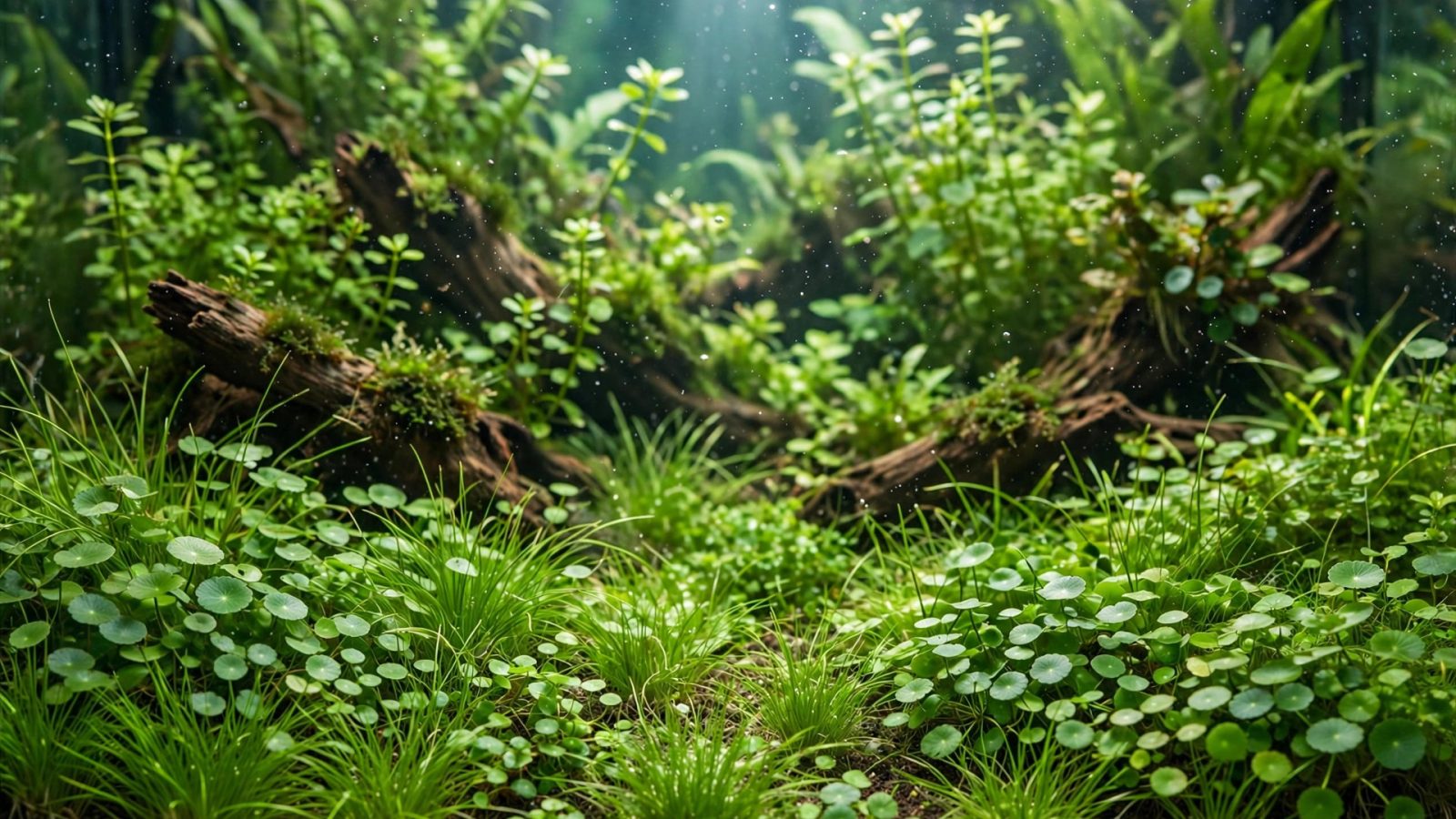
The lush green carpet — a seamless lawn of tiny plants across the foreground — is the look that hooks most people into aquascaping. But carpets also have a reputation for being expert-only, demanding injected CO2 and blazing light. The truth is more encouraging: several easy foreground carpeting plants for beginners will form a genuine carpet in a low-tech tank if you plant them correctly and give them time. These eight are the most forgiving species, ranked by how readily they carpet without CO2.
First, an honest framing: “easy” doesn’t mean “instant.” Even the most cooperative carpeting plant needs 2–4 months to fill in without CO2. What makes these eight beginner-friendly isn’t speed — it’s tolerance. They survive the moderate light, simple fertilizing, and occasional neglect that kill fussier carpet species, and they spread steadily rather than melting at the first hiccup.
Why Carpets Fail (and How These Plants Avoid It)
Most carpet failures come down to three errors: planting too sparsely (a few lonely pots can’t outrun algae), insufficient light at the substrate (the dimmest zone in the tank), and choosing a species that genuinely needs CO2 — dwarf baby tears (HC Cuba) and glossostigma are beautiful but honest CO2-demanding plants that frustrate beginners. The eight below sidestep all three: they’re planted densely from divided portions, tolerate moderate light, and carpet without injected carbon.
The Dry-Start Method: Your Secret Weapon
Before the plant list, the technique that makes beginner carpets dramatically easier: dry start. Instead of flooding the tank immediately, plant your carpet in damp substrate, cover the tank with cling film to hold humidity, and let the plants grow emersed (in air) for 3–6 weeks. Plants grow far faster with unlimited atmospheric CO2, root deeply, and form a mat — then you flood, and the established carpet transitions to submerged growth with minimal melting.
Dry start works brilliantly for Monte Carlo, dwarf hairgrass, Marsilea, and S. repens. Mist daily, keep the substrate damp but not waterlogged, and provide 10–12 hours of light. When you flood, do a large water change after a few days and expect a brief adjustment period. It’s the closest thing to a cheat code carpeting has.
The 8 Easiest Carpeting Plants for Beginners
1. Monte Carlo (Micranthemum tweediei)
The best beginner carpet, full stop. Monte Carlo forms dense mats of small, round, bright-green leaves, stays low (1–2 inches), and — crucially — carpets in low-tech tanks where HC Cuba would dissolve. It appreciates moderate light and a nutrient-rich substrate but forgives plain gravel with root tabs. Plant it in small divided clumps an inch apart; it spreads via runners. Our Java fern guide won’t help here, but the low-tech method is exactly the regime Monte Carlo wants.
2. Dwarf Hairgrass (Eleocharis parvula)
The classic grassy carpet. Dwarf hairgrass sends up fine, bright-green blades 2–4 inches tall from spreading runners, creating the windswept meadow look. It’s tougher than it looks — tolerates a wide range of conditions and carpets without CO2, just more slowly. The key is planting: divide the pot into 10–15 tiny plugs and space them in a grid. Sparse planting is why most hairgrass carpets fail; density at planting decides everything. Trim with scissors when blades get ragged — cutting encourages fresh, dense regrowth.
3. Marsilea hirsuta (Dwarf Clover)
Marsilea is the patient beginner’s carpet. This clover-like plant spreads by runners into a low mat of four-lobed leaves, tolerating low light better than almost any other carpet species. It’s slow — genuinely slow, taking months to fill in — but it’s nearly indestructible: neglect, dim corners, and new-tank instability barely faze it. In higher light the leaves stay small and clover-like; in low light they grow larger and sparser. An excellent choice for low-light setups like those in our low-light plant guide.
4. Dwarf Sagittaria (Sagittaria subulata)
Dwarf sag is the “cheat” carpet — technically a midground plant that stays short under good light, forming grass-like tufts 3–5 inches tall via runners. It’s one of the fastest-spreading plants on this list and one of the toughest, thriving in everything from soft acidic water to hard alkaline. In low light it grows taller and sparser (still attractive, just less carpet-like); moderate light keeps it compact. If you want a carpet this month rather than this season, dwarf sag delivers.
5. Staurogyne repens
S. repens usually appears in midground plant lists, but planted densely and trimmed short, it makes a superb structured carpet — bright green, leafy, and far more substantial than moss-like species. Plant stems an inch apart, and once established, trim the tops aggressively; the plant responds by growing outward instead of up. It needs moderate light to stay compact — in dim tanks it stretches. The payoff is a carpet with real presence that shrimp and small fish love foraging through.
6. Micro Sword (Lilaeopsis brasiliensis)
Micro sword looks like a finer, more delicate dwarf hairgrass — thin, grassy blades forming dense tufts. It’s a touch slower than hairgrass but equally tolerant, handling low-tech conditions with quiet persistence. It prefers a fine substrate it can root into easily; coarse gravel slows its spread. Like all runner-spreaders, plant in a dense grid of small plugs. Once established it’s nearly maintenance-free — an occasional comb-through with a fork removes trapped debris.
7. Pearl Weed (Hemianthus micranthemoides)
Pearl weed is the fastest carpet on this list and the most forgiving of mistakes. This tiny-leafed stem plant grows upward when left alone but forms a dense carpet when trimmed short and replanted — cuttings root within days. It’s not picky about light, substrate, or water, and it pearls (releases visible oxygen bubbles) readily under good conditions, which never gets old to watch. The tradeoff: it’s too vigorous for some tastes, needing biweekly trims to stay carpet-flat. Think of it as the training-wheels carpet — success is almost guaranteed.
8. Dwarf Chain Sword (Echinodorus tenellus)
The smallest sword makes a charming grass-like carpet with a twist: under strong light, its narrow leaves blush reddish-bronze, giving you the only carpet on this list with warm color. It spreads by runners into a lawn 2–4 inches tall, tolerates a wide range of conditions, and asks only for root tabs in inert substrate. It’s slower than dwarf sag but prettier — the reddish tinge under good light elevates it from “green lawn” to something distinctive.
Planting Technique: Density Is Everything
However you plant, the rule is divide aggressively. A single tissue-culture cup or potted plant should become 10–20 planting units. Tweezers are worth buying — they let you push tiny portions deep into the substrate without them floating up. Plant in a staggered grid, roughly 1 inch apart for true carpets (Monte Carlo, hairgrass) and 1.5 inches for vigorous spreaders (dwarf sag, pearl weed).
For the first two weeks after flooding, run a shorter photoperiod (6 hours) and do twice-weekly 30% water changes. New carpets are algae magnets until they establish; clean water and restrained light get them through the vulnerable phase. Resist fertilizing heavily at first — the plants are rooting, not growing, and excess nutrients feed thread algae.
Carpet Maintenance: The Trimming Habit
Carpets thicken from trimming, not from being left alone. Once your carpet has filled in, trim it every 2–3 weeks: hairgrass and micro sword get a “haircut” with curved scissors (remove the top third), Monte Carlo and S. repens get pinched back, pearl weed gets sheared flat. Always siphon out the trimmings — rotting cuttings trapped in the mat cause dead patches.
Watch for the carpet lifting: if sections detach and float, the mat grew too thick underneath and the lower layers died. The fix is more aggressive trimming and occasionally poking the mat down with tweezers. A healthy carpet feels springy and stays anchored; a neglected one turns into a floating island.
Two-Species Carpets: Mixing for Texture
Once you’ve grown one carpet successfully, the next level is mixing two species for a natural, meadow-like texture. The combinations that work pair plants with similar growth rates but contrasting form: Monte Carlo with dwarf hairgrass accents (round leaves against fine blades, with hairgrass tufts scattered like wildflowers), or S. repens bordered by dwarf chain sword (structured center, grassy edge). Plant each species in drifts rather than checkerboard squares — nature mixes in patches, not grids.
The rule is matched vigor: don’t pair pearl weed (explosive) with Marsilea (glacial), or one species will swallow the other within months. Monte Carlo and hairgrass grow at compatible paces; S. repens and micro sword too. Trim the faster species slightly more often to maintain the balance. A mixed carpet takes more planning but looks less “installed” than a monoculture — it’s the difference between a lawn and a meadow, and it’s what separates good aquascapes from great ones.
Frequently Asked Questions
Do I really not need CO2 for these?
Correct — all eight carpet without injected CO2. They’ll carpet faster with it (roughly twice as fast), but CO2 is an accelerator here, not a requirement. That’s what separates this list from HC Cuba and glosso guides.
Can I carpet in plain gravel?
Yes, with root tabs. Monte Carlo, dwarf sag, and pearl weed all carpet in gravel fed by root tabs — see our gravel plant guide for the method. Fine gravel (2–3mm) works better than coarse; runners spread easier.
How long until a full carpet?
Planted densely: pearl weed 4–6 weeks, dwarf sag 6–8 weeks, Monte Carlo 8–12 weeks, hairgrass 10–14 weeks, Marsilea 4–6 months. Dry-starting cuts roughly a third off these times.
Will carpeting plants survive with goldfish or cichlids?
Honestly, no — diggers uproot carpets relentlessly. For tanks with boisterous fish, the tough epiphytes in our goldfish-proof list are a better strategy than any carpet.
Best Substrates for Carpeting Plants
Substrate choice affects carpeting speed more than almost any other factor. Aquasoil (ADA Amazonia, Fluval Stratum, UNS Controsoil) is the gold standard: soft granules that runners penetrate easily, loaded with nutrients that feed heavy root-feeders like hairgrass and dwarf sag. It also buffers pH slightly acidic, which most carpet species prefer. The downside is cost and the initial ammonia leach — cycle the tank properly before adding livestock.
Fine gravel or coarse sand (2–3mm) with root tabs is the budget path that genuinely works. The eight plants on this list all carpet in inert substrate fed by tabs; growth is maybe 70% as fast as aquasoil, which is a fine tradeoff. Avoid coarse gravel (5mm+) — runners struggle to cross the gaps, and debris collects in a way that smothers young carpets. Pool filter sand looks beautiful but compacts over time; if you use it, keep the layer under 1.5 inches and stir gently during water changes.
Whatever you choose, keep the foreground substrate shallow — 1 to 1.5 inches. Deep substrate in the foreground wastes material, risks anaerobic pockets, and gives runners more vertical distance to climb before spreading horizontally. Slope the substrate upward toward the back for depth; carpets live on the thin front layer.
Troubleshooting: When Carpets Struggle
Melting after flooding (dry start): Some emersed-to-submerged transition melt is normal — old leaves grown in air can’t function underwater. If new submerged growth appears within 2 weeks, you’re fine; just siphon the mush. If everything melts with no new growth, the flood was too abrupt — next time, flood gradually over several days.
Algae smothering the carpet: Thread and staghorn algae love young carpets. Reduce the photoperiod to 6 hours, spot-dose liquid carbon (glutaraldehyde products) with a syringe, and manually remove what you can with a toothbrush. A cleanup crew of Amano shrimp — 1 per 2 gallons — grazes a carpet without damaging it.
Carpet growing upward instead of outward: Classic low-light response. The plants are reaching for light instead of spreading. Increase intensity (not duration), and trim the tops to force lateral growth. Monte Carlo and pearl weed respond to topping by bushing outward within days.
Bare patches that won’t fill: Usually a flow dead-spot where detritus settles and smothers runners. Aim your filter output to ripple across the foreground, or add a small circulation pump. Replant the bare patch with fresh divisions rather than waiting — carpets rarely self-repair dead zones.