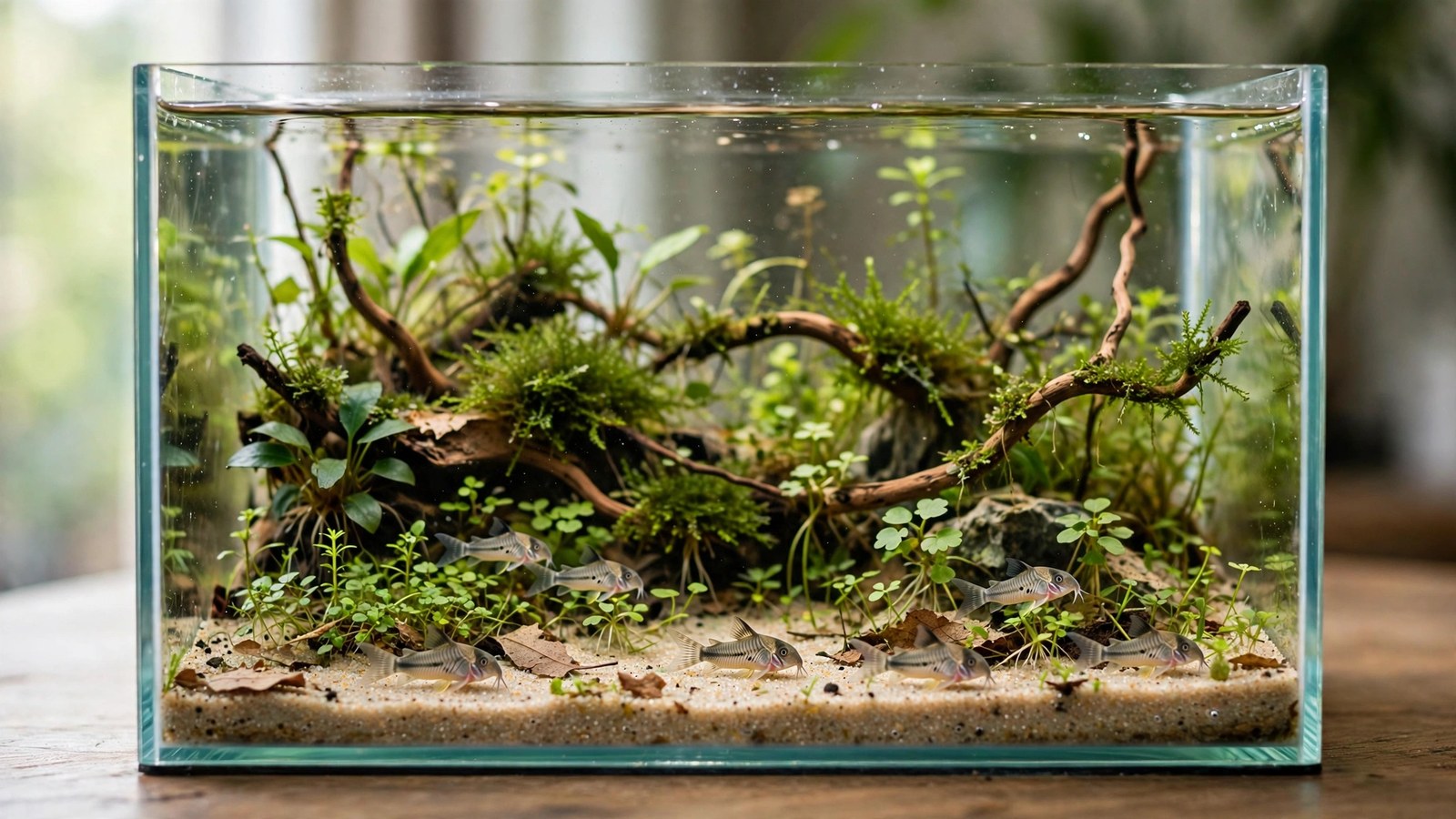
Most corydoras hug the gravel and vanish into the shadows — but pygmy cories break every rule in the cory playbook. These one-inch catfish hover and dart in tight mid-water formations like miniature tetras, then descend to graze the sand in shifts. That unusual behavior makes a pygmy corydoras planted tank one of the most watchable nano setups in the hobby: schooling action up top, cory charm on the sand, all on a desk-sized footprint.
Why a Pygmy Corydoras Planted Tank Works So Well
Forget the image of a cory snuffling in a back corner. Corydoras pygmaeus (recently reclassified as Gastrodermus pygmaeus) is one of the few corydoras that spends most of its time in the water column — a fact the SeriouslyFish profile for Corydoras pygmaeus confirms. In practice, your tank has life at every level: the school holds formation in open water, individuals break off to graze biofilm on leaves, and occasionally the whole group darts to the surface for a gulp of air (corydoras are facultative air breathers — normal, not an emergency).
Because they're tiny — barely 1.2 inches as adults — a real school fits comfortably in a 10-gallon tank, and a confident school of 10–12 pygmies is endlessly visible. If you're weighing stocking ideas, our roundup of the best schooling fish for planted tanks shows how they compare to tetras and rasboras.
Your Pygmy Corydoras Planted Tank Setup Checklist
Build in this order and you'll avoid the two classic mistakes: gravel that damages barbels, and a layout with no open swimming room.
| Component | What to get | Why it matters |
|---|---|---|
| Tank | 10-gallon (or 10+ gallons) | Footprint matters more than height — the school uses length |
| Substrate | Fine aquarium sand, 1–1.5 inches deep | Barbel-safe; lets them sift naturally without erosion |
| Filtration | Sponge filter or low-flow HOB with baffle | Gentle turnover; fry-safe and no strong current |
| Heater | Adjustable 50W, set to 74–76°F | Room-temp swings stress tiny fish quickly |
| Hardscape | Driftwood branches + smooth river stones | Rest spots and sight breaks; no sharp edges |
| Plants | Background stems + midground crypts + floating cover | Cover without choking the swim lane |
| Lighting | Moderate LED on a timer (6–8 hrs) | Floating plants dim it — pygmies hate harsh light |
Substrate: Fine Sand, No Compromises
This is the single decision that determines whether your pygmy cories thrive or slowly decline. Pygmy cories feed by sifting mouthfuls of substrate, and their barbels are delicate. On sharp or coarse gravel, barbels abrade over weeks — the fish stop feeding properly and become infection-prone. Use soft, fine aquarium sand 1–1.5 inches deep: enough for plants and natural sifting, thin enough to avoid anaerobic pockets.
Vacuum the surface gently during your weekly water change. They'll polish off uneaten morsels, but they are not cleaners — substrate maintenance is still your job, and dirty substrate is the fast lane to barbel infections.
Aquascaping for a Mid-Water Schooler
Keep the front third open: a broad, unplanted sand lane where the school can form up and cruise. Pack the back and sides with tall stems — vallisneria, ludwigia, or rotala give a dark backdrop that makes their silver bodies and lateral stripe glow.
Midground clumps of crypts or anubias on driftwood give startled individuals cover, and floating plants (frogbit or salvinia) dim the lighting pygmies dislike while sheltering future fry. If you're new to planting, start with the easiest aquarium plants for a beginner community tank — the approach in our aquarium plants for fish tanks guide works perfectly here: cover at the edges, open water in the middle.
Water Parameters and Gentle Flow
Pygmy cories come from soft, acidic tributaries of Brazil's Rio Madeira basin. They adapt widely, but soft, slightly acidic water at stable temperatures is where they color up and breed.
| Parameter | Target | Notes |
|---|---|---|
| Temperature | 72–79°F (22–26°C) | Hold steady at 74–76°F; avoid daily swings |
| pH | 6.4–7.4 | Stable matters more than a perfect number |
| Hardness | 0–8 dGH preferred | Soft water; tannins from wood/leaves help |
| Ammonia / nitrite | 0 ppm | Non-negotiable — cycle fully before adding fish |
| Nitrate | Under 20 ppm | Weekly 25–30% water changes keep it there |
Keep flow gentle. A sponge filter is ideal — quiet, fry-safe, and no intake to fight against. If you prefer a hang-on-back, baffle the outflow so the surface barely ripples (our planted tank water flow circulation guide covers baffle tricks). Cycle the tank fully before the school arrives; tiny fish have zero margin for ammonia spikes.
Tankmates: Small, Peaceful, and Unthreatening
Size compatibility cuts both ways with pygmy cories. Anything large enough to bully them ruins the tank — and anything big enough to eat a one-inch fish will try. Keep them with other tiny species, or alone: ember tetras, chili rasboras, celestial pearl danios, sparkling gouramis, cherry shrimp, and small snails all work. Avoid bettas (too boisterous), angelfish, larger gouramis, and any cichlid bigger than a dwarf. In a planted community tank setup, stock the cories FIRST so they settle before bolder fish arrive.
Feeding: Target-Feed Sinking Micro Foods
The "cories eat leftovers" myth is how pygmy cories starve. Their mouths are tiny and they compete poorly with mid-water feeders, so feed a pinch of sinking micro pellets or a quarter micro wafer daily, crushed fine, plus frozen daphnia or baby brine shrimp 2–3 times a week for conditioning. Watch the school after lights-out: they're opportunistic night grazers at their busiest when the room goes dark.
Frequently Asked Questions
How many pygmy corydoras should I keep together?
Ten to twelve is the sweet spot; six is the absolute minimum. Small groups stay stressed, lose color, and hide instead of schooling. Because they're only an inch long, bumping from 6 to 12 barely changes your bioload — but it transforms their confidence.
Can pygmy cories live in a 5-gallon planted tank?
They can survive in a well-filtered 5-gallon, but a 10-gallon is genuinely better. The school needs horizontal swimming length to cruise — a 10-gallon's 20-inch footprint provides it, while a 5-gallon cramps the mid-water schooling that makes them special. See our nano planted tank ideas for 10-gallon layouts that fit small spaces.
Do pygmy cories clean the bottom of the tank?
No — this is the most damaging myth about them. They'll polish off morsels that reach the sand, but they produce waste like any fish and need their own feeding. Relying on them as cleaners leads to dirty substrate, barbel infections, and starving fish.
Why do my pygmy cories keep darting to the surface?
Occasional surface dashes are normal: corydoras are facultative air breathers with a modified intestine that supplements oxygen from the air. Worry only if every fish does it constantly — that points to low dissolved oxygen, so check filter flow, surface agitation, and parameters.
Will pygmy cories eat my shrimp or shrimp babies?
Generally no. Their mouths are too small to take adult cherry shrimp, and they're peaceful by nature. Newly hatched shrimplets could theoretically be snapped up, but a planted tank with moss and floating cover gives shrimplets plenty of refuge. They're considered one of the safest fish tankmates for shrimp colonies.
Your First Week With the School
Add the group after lights-out so they settle without a startled stampede, then skip feeding for the first 24 hours. By day three you should see the school holding loose formation in mid-water; by week's end, feeding dashes and surface gulps will be the tank's daily routine.