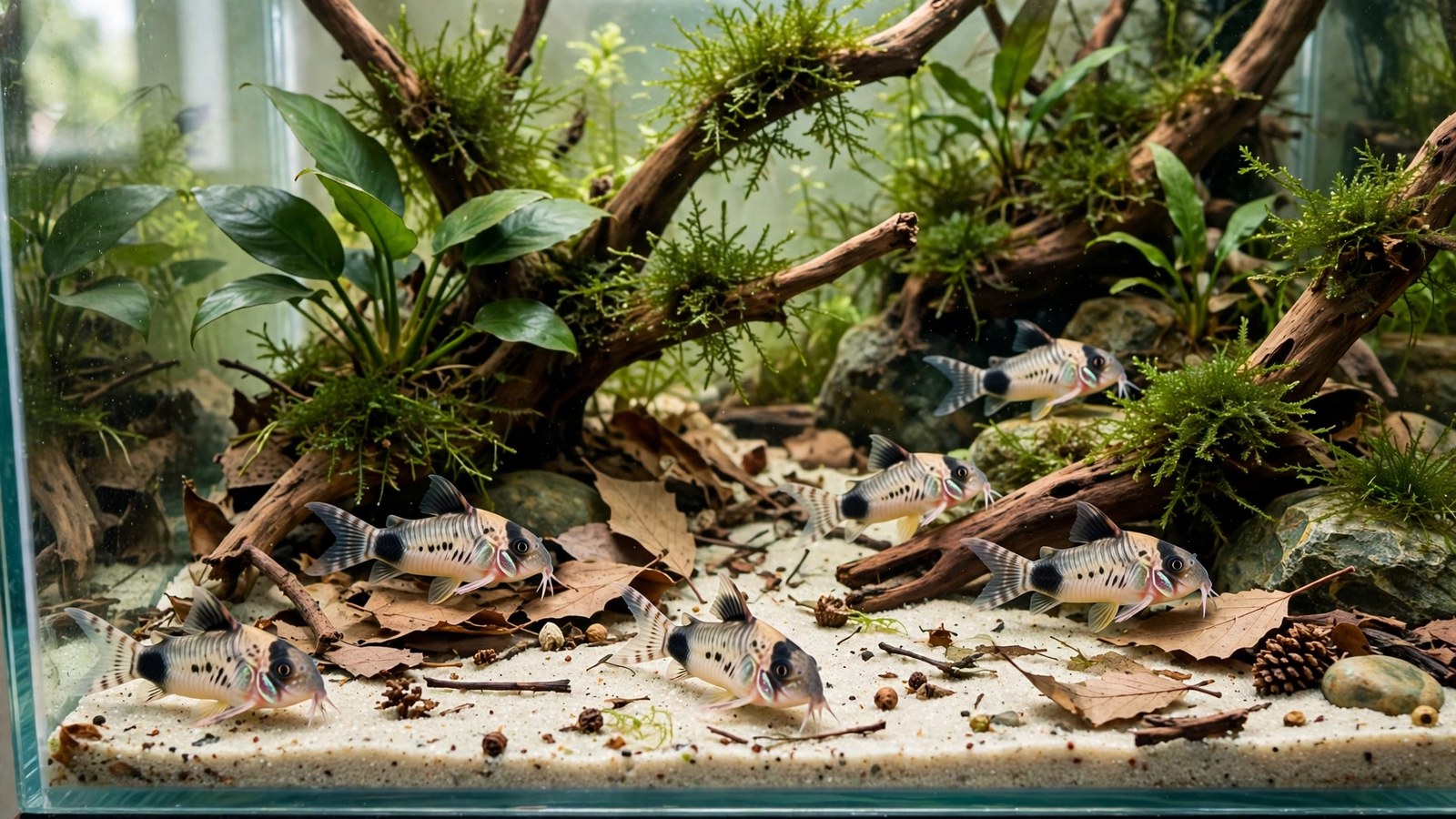
There is a fish in the cory aisle that looks like a panda — sociable, sleepy, and glued to the bottom all day. A panda cory planted tank works beautifully if you build it for how Corydoras panda lives: cool water, a big gang of its own kind, and soft sand it can shovel through without tearing its barbels. Most setups fail pandas the same way — gravel that wounds them, water warm enough for discus, and tankmates that eat every scrap first.
Panda Cory vs Pygmy Cory: Not the Same Fish
Ask for "cories" at a fish store and you may be pointed at two different animals. Corydoras panda is the chunky one with the black eye-mask and dorsal saddle that gave it its name — a genuine bottom-dweller that spends nearly all its time sifting the substrate in a tight school, growing to roughly 2 inches and preferring cooler water than most tropical stock.
Pygmy corys, by contrast, are tiny mid-water schoolers that hover like miniature tetras rather than vacuuming the floor. If you want that style of fish, our Pygmy Corydoras Planted Tank: A Nano Bottom-Dweller Setup Guide covers their different needs. Pandas want a bigger tank, a deeper sand bed, and tankmates that leave the bottom alone.
The most telling difference is the barbels. Pandas hunt by whisking those whisker-like barbels through sand, and rough substrate files them down — shortened, ragged barbels are the classic sign of a panda kept on gravel. SeriouslyFish's Corydoras panda species profile documents their wild habitat of cool, sandy, well-oxygenated Peruvian streams.
Setting Up the Ideal Panda Cory Planted Tank
Start with footprint, not gallons. A standard 20-gallon long gives six to ten pandas the floor space their social life demands; a tall tank of the same volume does not. Lay 1.5–2 inches of fine, smooth sand and skip "cory-safe" gravel marketing — rough textures file barbels down over time, so smooth silica or pool-filter sand is the safest choice for foraging bottom-dwellers.
Give them broken sightlines without dead-end traps. Half-buried driftwood, smooth river stones, and broad-leaf plants create shaded lanes to patrol, but skip tight caves and narrow hollows — pandas wedge into gaps you would swear they cannot fit through. A gentle filter with a sponge-covered intake and soft flow suits them far better than a powerhead-driven torrent.
One habit surprises beginners: pandas periodically rocket to the surface to gulp air, then torpedo back down. This is normal — they supplement gill breathing with intestinal air. Keep a snug lid, because an enthusiastic dash can clear a rimless tank.
Plants That Survive Cory Foraging
Pandas root through the substrate constantly, so plant choice matters more than in most community tanks. Tough, well-rooted species win: Amazon swords and vallisneria anchor deeply, crypts rebound from disturbance, and epiphytes like anubias and Java fern are cory-proof on wood and rock. Floating plants like frogbit soften the light and make pandas bolder.
Pair fish-first plant choices with the species setup from our aquarium plants for fish tanks guide, and cross-check light and substrate demands against the freshwater aquarium plants guide. Skip delicate carpets in foraging lanes — pandas treat a fresh carpet like a demolition site.
Water Parameters and Everyday Care
Pandas are forgiving of everything except temperature swings and dirty substrate. They thrive in soft-to-moderately-hard, slightly acidic to neutral water, but stability matters more than perfect numbers. Vacuum the sand lightly each week — waste settles exactly where pandas eat, and their barbels hate bacterial buildup in mulm.
| Parameter | Target range | Notes |
|---|---|---|
| Temperature | 68–77°F (20–25°C) | Cool end is best long-term; avoid 78°F+ |
| pH | 6.0–7.4 | Stable matters more than exact value |
| GH / KH | 2–12 dGH / 2–8 dKH | Soft to moderately hard |
| Ammonia / nitrite | 0 ppm | Cycle fully before adding the school |
| Nitrate | Under 20 ppm | 30% weekly water changes |
School Size and Peaceful Tankmates
Six is the honest minimum, and the difference between six and ten shows within a day — bigger schools shoal tighter and explore more. Below five, pandas turn shy, hiding behind filters instead of patrolling the bottom. Buy the group at once, drip-acclimate, and quarantine new arrivals per standard hobby practice.
Tankmates should be small, calm, mid-to-upper-water fish that never compete for the floor: neon tetras, ember tetras, rummy-nose tetras, and the black neon tetra planted tank guide's hardy schoolers all fit — the best schooling fish for planted tanks roundup has more options. Avoid boisterous barbs and nippy tetras; corys have sharp pectoral spines and stress badly when harassed.
Feeding: Sinking Foods That Reach the Bottom
Pandas are omnivores that eat almost constantly in the wild, and the "they clean the tank" myth starves them. They do not eat algae — treat them as dedicated bottom-feeders. A quality sinking pellet or wafer (whole fish or shrimp meal first on the label) is the staple, fed once or twice daily in amounts they finish in minutes.
Rotate in frozen foods two or three times a week — daphnia, brine shrimp, and bloodworms are taken eagerly — plus blanched zucchini or cucumber for the vegetable side. Feed after the lights dim so pandas get first claim; faster fish vacuum sinking food before it lands otherwise. Siphon uneaten wafers the next morning.
Breeding Hints for the Patient Keeper
Well-kept pandas breed readily, and the trigger mimics their wild rainy season: a slightly cooler water change with soft, clean water, often in the evening. Condition the group on frozen foods for a week or two first — females visibly plump up with eggs.
Spawning follows the classic cory "T-position," after which the female deposits a few adhesive eggs on glass, broad leaves, or the filter intake. Eggs hatch in 3–5 days at panda temperatures. For best survival, move eggs to a small rearing container with an air stone; first foods are infusoria or powdered fry food, then baby brine shrimp. PlanetCatfish's Corydoras panda page catalogues breeder reports for the detail-obsessed.
Frequently Asked Questions
How many panda corys should I keep together?
Six is the minimum for a functional school, and eight to ten is noticeably better — larger groups shoal tighter and forage openly. A 20-gallon long holds eight to ten comfortably. Fewer than five leaves them chronically stressed, which beginners often mistake for the species being boring.
Can panda corys live in a warm community tank with a betta?
Not ideally. Pandas thrive at 68–77°F, while bettas and many tropical communities run 78–80°F. Chronic warmth raises metabolism and shortens lifespan, and bettas may harass bottom-dwellers. A cooler, peaceful community of tetras and rasboras suits pandas far better than a warm betta setup.
Do panda corys really need sand, or is smooth gravel OK?
They need sand. Pandas sift substrate through their gills and whisk it with sensitive barbels; even smooth gravel abrades barbels over time, leaving the classic shortened, ragged look. Fine sand lets them sift naturally and keeps barbels long and healthy.
Will panda corys eat algae and clean my tank?
No — this is the most damaging myth about the species. Pandas are omnivorous bottom-feeders needing dedicated sinking foods; they ignore algae entirely. An unfed panda slowly starves while the tank looks "clean." Feed sinking wafers and frozen foods daily, and handle algae with proper lighting and real algae-eaters.
Why do my panda corys keep dashing to the surface?
That is normal cory behavior — they supplement gill breathing by gulping air, absorbed through the intestine. Occasional dashes are healthy. Constant, frantic surfacing by the whole school signals low oxygen or poor water quality: check temperature, surface agitation, and ammonia immediately.
A Tank That Actually Works for Them
A panda cory planted tank is not complicated — it is specific. Cool water, soft sand, a real school, and sinking food gives years of the hobby's most endearing bottom-patrol. Build for the fish you have, not the generic template.