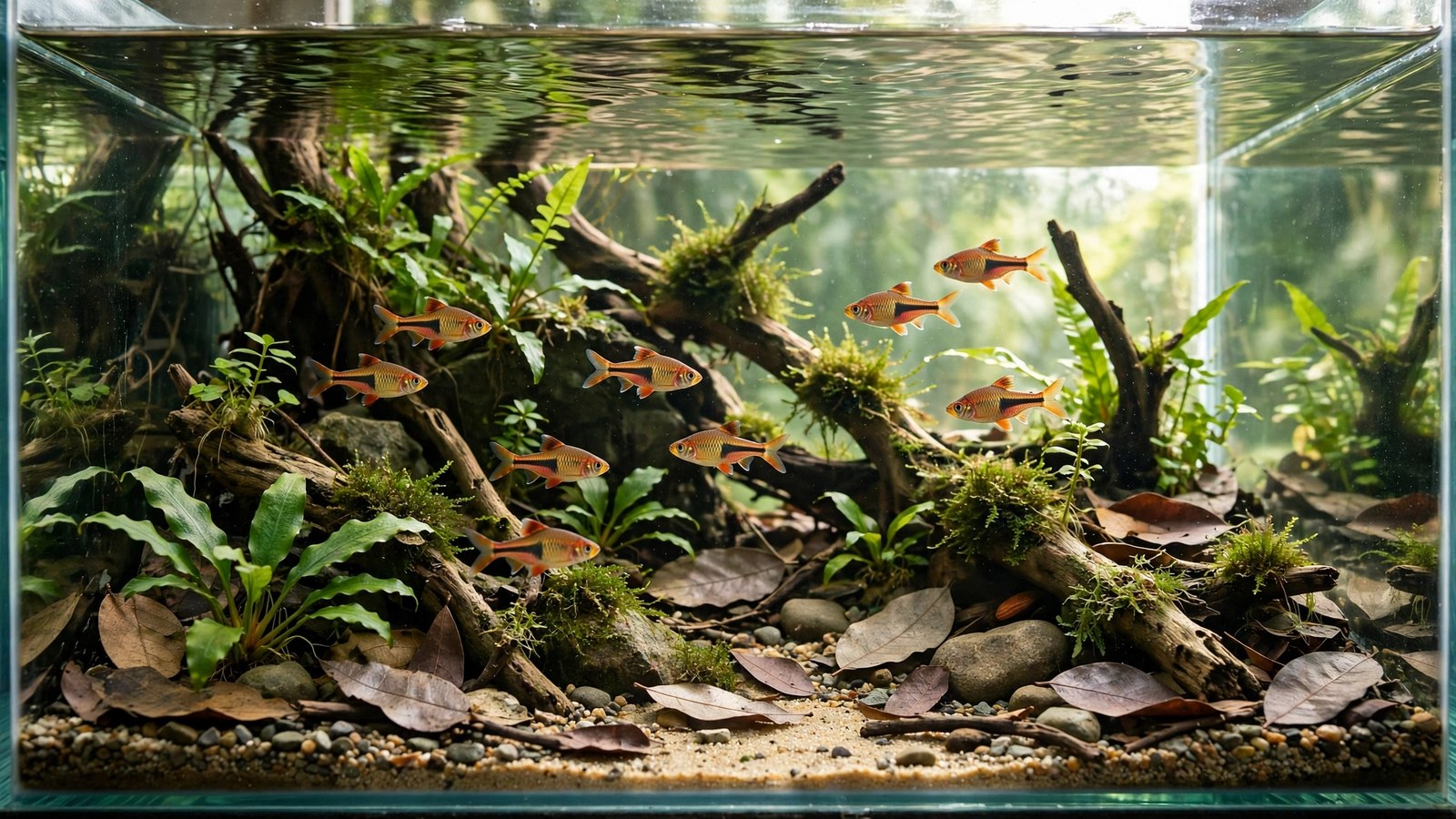
Most people meet the cherry barb as a two-inch starter fish from a pet-shop cup. In the wild, the same fish is a vulnerable species swimming through shaded, leaf-littered streams in Sri Lanka's Kelani and Nilwala river basins — and a group of breeding-red males over tea-dark water is worth building an entire tank around. A Sri Lanka biotope aquarium recreates one of those rainforest streams: fine river sand, rounded stones, driftwood tangles, a carpet of Cryptocoryne, and a school of cherry barbs. This guide walks you through the full build — hardscape, planting, stocking, and the weekly rhythm that keeps it thriving.
The short answer: To build a Sri Lanka biotope aquarium, set up a 20-gallon tank with 2–3 inches of fine river sand, rounded river stones, and driftwood, then plant Cryptocoryne species such as C. wendtii and C. undulata and scatter Indian almond leaves as leaf litter. Keep water at 73–79°F (23–26°C), pH 6.5–7.5, with gentle-to-moderate flow. Stock 8–10 cherry barbs at two females per male, and change 25–30% of the water weekly. The build settles about 4–6 weeks after cycling.
Your Sri Lanka Biotope Aquarium: The Kelani Hill-Stream Blueprint
Every good biotope starts from a real place. The reference here is the wet-zone streams of southwestern Sri Lanka — the Kelani and Nilwala basins where cherry barbs are endemic: shaded, shallow streams with sand beds, fallen leaves, and tangled bankside roots. This build follows the same honest-biotope design logic as our Congo biotope aquarium setup; its Amazon biotope aquarium setup shows the same format at the darker, blackwater end of the spectrum.
Three rules keep it authentic: the hardscape does more visual work than the plants, every plant needs a reason to be there (Sri Lanka is a Cryptocoryne hotspot), and flow stays gentle — males only turn that famous deep red when they feel secure.
Building the Riverbed: Sand, Stones, and Botanicals
Lay 2–3 inches of fine river sand across the floor — a natural warm tan, never neon-bright gravel. Cherry barbs occasionally sift the substrate, and fine rounded grains protect their barbels far better than sharp gravel. Add smooth, rounded river stones in fist-sized clusters of three to five, grouped off-center, plus one or two low, horizontal driftwood branches like fallen limbs in a current.
Then the botanicals: scatter 6–10 catappa (Indian almond) leaves plus a handful of slower-breaking bamboo or magnolia leaves. Leaves tint the water gently, release tannins, and give shy females refuge. Replace them as they decompose, roughly every 3–4 weeks.
| Item | Amount | Notes |
|---|---|---|
| Fine river sand | 20–25 lb (2–3 in depth) | Rinse well before filling |
| Rounded river stones | 6–8 stones | Palm-sized clusters |
| Driftwood | 1–2 branches | Pre-soak to waterlog |
| Catappa leaves | 10–15 leaves | Replace every 3–4 weeks |
| Bamboo/magnolia leaves | 5–8 leaves | Break down more slowly |
 ★4.8
Seachem Catappa Leaves 12-pack
Check Price on Amazon ★4.8Cryptocoryne-Heavy Planting Plan
Sri Lanka hosts a remarkable Cryptocoryne flora, and several species are trade staples — so you can plant authentically without hunting rarities. When comparing lookalikes at the shop, our aquarium plants for fish tanks guide shows how to read plant labels, and the freshwater aquarium plants complete guide carries deeper profiles for each species below.
| Plant | Placement | Why it belongs |
|---|---|---|
| Cryptocoryne wendtii | Midground groups | Sri Lankan native |
| Cryptocoryne undulata | Background | Sri Lankan native |
| Cryptocoryne walkeri | Foreground | Sri Lankan native |
| Aponogeton rigidifolius | Background corner | Sri Lankan endemic |
| Salvinia (floating) | Surface, partial cover | Dapples light like canopy |
Plant Cryptocoryne in groups of three to five rosettes — biotopes read as habitat, not a garden show — and push a root tab under each group, since sand holds almost no nutrients. Expect "crypt melt" in the first one to two weeks: shop-grown leaves dissolve and regrow as submerged foliage. Do not pull the plant; new leaves appear within two to three weeks.
Cherry Barbs: Schooling, Stocking, and Tankmates
Keep a school of 8–10 in a 20-gallon, with at least two females per male. Males spar constantly over females, and spreading that attention keeps every fish calmer — the cherry barb species profile at Seriously Fish confirms their Kelani and Nilwala origins and recommends groups of 6–10 minimum. More rival males means deeper red color.
Feed as an omnivore: micro-pellets or flake as the staple, plus frozen daphnia or baby brine shrimp two to three times a week — that live-food variety pushes males into breeding color. The black ruby barb (Pethia nigrofasciata), another Sri Lankan endemic, makes an honest second species. Cycle 4–6 weeks first, then add barbs in two groups of four to five, a week apart.
Water, Flow, and the Weekly Rhythm
Filter gently: a sponge filter or turned-down hang-on-back gives lazy, visible circulation without pushing the school around. Hold 73–79°F (23–26°C) and pH 6.5–7.5 — slightly acidic, tea-tinted water is the biotope look. Run moderate light 7–8 hours daily: enough for Cryptocoryne, not enough to grow algae on slow leaves.
Weekly routine: change 25–30% of the water, siphon debris off the sand without digging into root zones, and remove fully skeletonized leaves. Every two weeks, press a fresh root tab near the heaviest Cryptocoryne groups. Plant and hardscape in week one, cycle for four to six weeks with botanicals in from day one, add the first barb group around week five — the best look arrives by month three.
Frequently Asked Questions
How many cherry barbs should I keep in a 20-gallon Sri Lanka biotope?
Eight to ten cherry barbs is the sweet spot, with at least two females per male so male sparring spreads across the group. Larger schools with several males display better — rival males develop deeper red breeding color. Fewer than six leaves them skittish and washed out.
Can I use regular tap water for a Sri Lanka biotope aquarium?
Yes, in most cases. Dechlorinated tap water at 73–79°F (23–26°C) and pH 6.5–7.5 works well; catappa leaves gently lower pH and add tannins. Only consider remineralized RO water if your tap is extremely hard or alkaline.
Why are my Cryptocoryne leaves melting after planting?
Crypt melt is normal. Shop Cryptocoryne is usually grown emersed, and those leaves dissolve within a week or two of submersion while new submerged foliage grows. Leave the roots undisturbed, keep root tabs under each group, and expect new leaves in two to three weeks.
Do I need CO2 injection for this biotope?
No. Everything in this plan thrives low-tech with moderate light and root tabs. CO2 speeds growth but is unnecessary cost and complexity for a beginner-friendly biotope like this. Seven to eight hours of moderate light daily is plenty.
What native tankmates can I add with cherry barbs?
The black ruby barb (Pethia nigrofasciata) is the classic choice — another Sri Lankan endemic sharing cherry barb parameters, kept in groups of six or more. Nerite snails fit the biotope and handle algae. Skip fish from other continents if authenticity matters; that is the point of the build.
Bringing the Kelani Home
This tank rewards patience more than spending. Hardscape does the heavy lifting on day one, Cryptocoryne fills in over three months, and cherry barbs color up deeper every week over dark sand and leaf litter. Build it slowly, keep the water changes steady, and you get a slice of rainforest stream. For species-first design beyond biotopes, our zebra pleco planted tank applies the same fish-behavior-first thinking to a Rio Xingu cave setup.