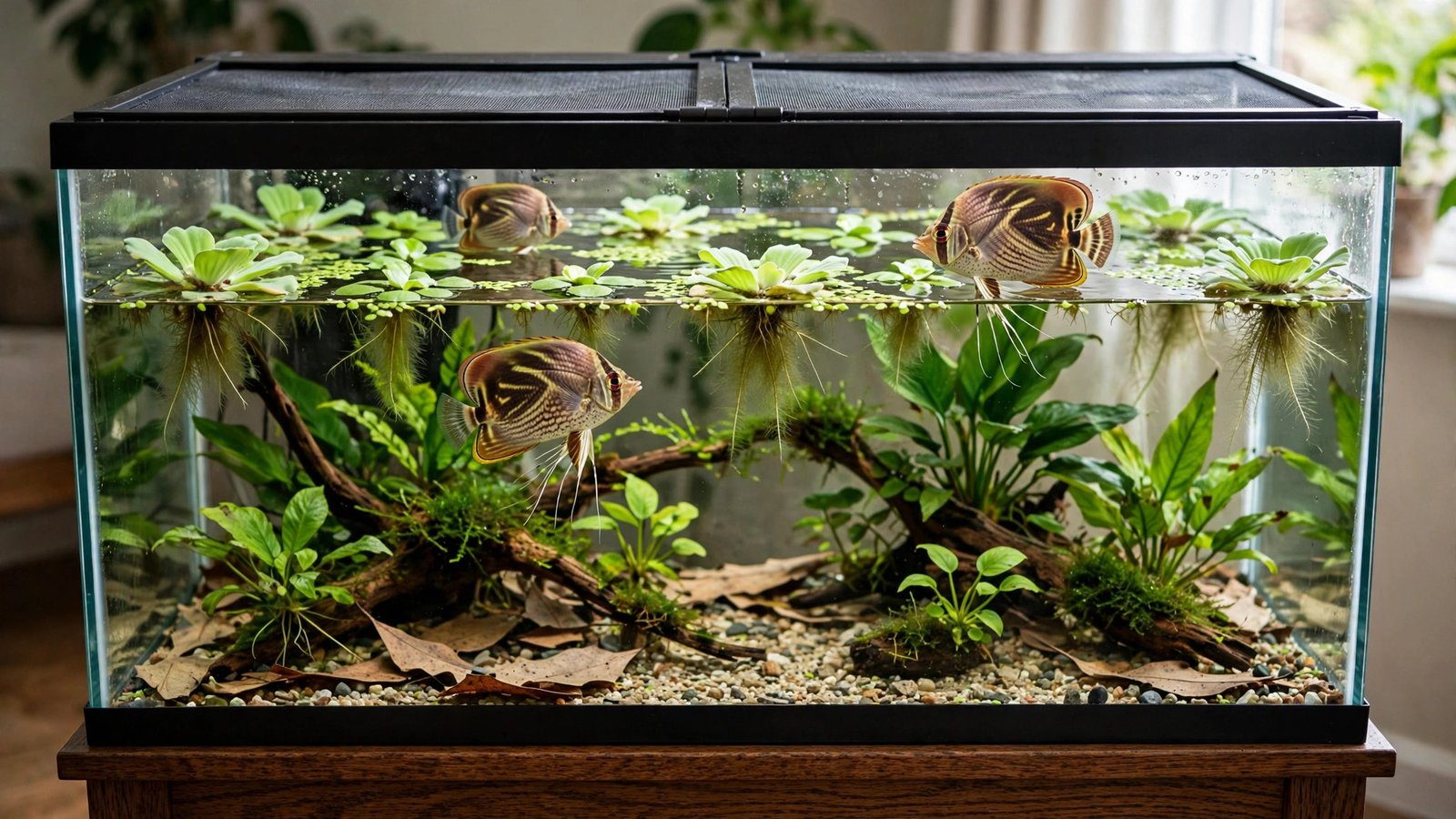
Some fish swim in your tank; the African butterflyfish hunts above it. This West African surface predator can pluck an insect off a floating leaf after an explosive leap — and that same jumping power is why most keepers learn one lesson fast: no lid, no butterflyfish. An African butterflyfish planted tank succeeds when you design the surface: a tight, gap-free canopy overhead, a calm carpet of floating plants under it, and dim, still water that lets an ambush predator hunt.
Short answer: An African butterflyfish planted tank needs a 30-gallon or larger tank, a tight-fitting lid with zero gaps, and 60–70% surface cover from floating plants like frogbit, water lettuce, or hornwort. Keep water at 75–86°F (24–30°C), pH 6.0–7.5, with gentle flow and dim light. Feed floating insects — wingless fruit flies, live crickets, frozen bloodworms — once or twice daily. Unique fact: Pantodon buchholzi is the only living member of its family, Pantodontidae, within the bony-tongue order (Osteoglossiformes) — the same order that includes arowanas.
African butterflyfish planted tank: the two non-negotiables
Before you buy a single plant, settle two decisions — everything else serves them. First: the tank gets a sealed lid. These fish launch out of water to snatch insects, and in a home tank they'll jump at a startle, a floating cricket, or a feeding hand. A glass canopy flush on the rim, with cord and filter cutouts sealed, is the standard. Second: the surface gets a thick cover of floating plants. Mottled brown against dappled light, this is a camouflage predator — exposed fish go quiet, skittish, and stop feeding.
It's a fish-first build, so start from general planted-tank principles in our aquarium plants for fish tanks guide, then construct the surface this species demands.
Butterflyfish jump — a single-piece tempered glass canopy seals the 30-gallon footprint with no center-brace gaps: a tight-fitting glass canopy ★4.5.
Tank size and footprint: wide, not tall
One butterflyfish needs surface area, not depth. A 30-gallon long or 40-gallon breeder is the practical minimum — about three feet of hunting ground. Tall, narrow tanks waste space the fish never uses. Leave the bottom open with a few driftwood branches angled upward; background plants (Java fern, Anubias, Vallisneria) handle aesthetics and water quality.
One adult claims the surface as its territory. Keep a single fish in 30 gallons, or a male-female pair in 40+ gallons — the male shows a tube-like extension on the anal fin. Skip a second surface competitor (gouramis, hatchetfish); it will be bullied relentlessly.
Floating plants: the camouflage layer
Aim for 60–70% surface coverage: enough for the fish to feel invisible, with open lanes where floating food lands within striking range. Corral plants with airline-tubing floating rings to keep a feeding lane open in front of the glass.
| Floating plant | Why it works | Notes |
|---|---|---|
| Amazon frogbit | Round rosettes with trailing roots the fish weaves through | Quarantine new portions — carries snail eggs readily |
| Water lettuce | Broad leaves shade a large area; the fish rests beneath them | Restricted in some warm regions |
| Hornwort | Floating bunches absorb nitrates aggressively | Keep it free-floating — never anchored |
| Red root floater | Reddish leaves tint the light beautifully under dim LEDs | Dies back if churned by a filter outlet |
Our best floating aquarium plants for beginners covers growing conditions, and our quarantine-tank plants guide shows how to sterilize floaters before they go in — floaters are the most common source of hitchhiking snails. For planting and cycling the tank itself, follow planted-tank principles from our aquarium plants for fish tanks guide.
A frogbit + red root floater + water lettuce combo delivers the 60-70% surface cover this setup needs in one order: a floating-plant combo pack ★4.5.
Calm water, soft light, slow flow
Butterflyfish come from slow swamps and forest streams, and their eyes track prey above and below the waterline simultaneously — bright, rippled water destroys that advantage.
- Flow: gentle sponge filter or baffled canister outflow. Keep the surface nearly still — powerheads and air stones work against the fish.
- Light: low to moderate, 6–8 hours daily. The floating canopy shades the tank anyway, and dim light makes the fish bolder.
- Water: 75–86°F (24–30°C), pH 6.0–7.5, soft to medium hardness. Indian almond leaves add authentic West African blackwater; tannins darken the water and calm the fish. A Congo River biotope approach — dark water, wood, leaf litter — is the natural aesthetic match.
Feeding an ambush predator at the surface
Feed in the same open lane every day and the fish will be waiting within a week.
| Food | Frequency | Notes |
|---|---|---|
| Wingless fruit flies | Daily staple | A cheap culture kit feeds one fish for weeks |
| Live crickets (pinhead/small) | 2–3× weekly | Triggers the full hunt-leap sequence |
| Frozen bloodworms | 2–3× weekly | Thaw first, drop in the feeding lane |
| Floating pellets/sticks | Supplement only | Must be large — tiny pellets get ignored |
Offer only what the fish takes in about three minutes. If food drifts into the plants and gets ignored, adjust the floating rings rather than adding more food.
Tank mates that won't become snacks
The rule is simple: anything that fits in the mouth is food. Good tank mates stay over 4 cm, live low, and don't nip fins:
- Congo tetras — appropriately African, large enough to be safe, school in the mid-water.
- Corydoras or Kuhli loaches — bottom dwellers that never enter the strike zone.
- Brilliant rasboras or larger rainbowfish — active mid-water fish that hold their own.
Avoid neon-sized tetras and fin-nippers (tiger barbs, some danios) — the long, trailing pectoral and pelvic fins are tempting targets. A 40-gallon breeder gives enough footprint to stack butterflyfish on top, Congo tetras in the middle, and African bottom dwellers below.
Seriously Fish's Pantodon buchholzi species profile is the gold-standard care reference, and Tropical Fish Hobbyist's butterflyfish feature covers the jumping behavior in detail.
Frequently Asked Questions
Will an African butterflyfish eat my plants?
No. African butterflyfish are carnivores and completely ignore live plants — floating or rooted. They neither eat, uproot, nor dig. Plants serve the fish as camouflage cover and security. The only plant disturbance is mechanical: a powerful leap through a floating-plant mat can scatter frogbit, which is why floating rings keep a clear feeding lane.
Will an African butterflyfish eat my tetras?
Yes, if they fit in its mouth — and the mouth is large for the fish's size. Neon and ember tetras, anything under about 4 cm, is at serious risk. Stock tank mates over 4 cm that live in the mid-to-lower water column: Congo tetras, larger rasboras, corydoras, and most plecos are all safe choices.
Do I really need a lid for a butterflyfish tank?
Absolutely. These are among the strongest jumpers in the hobby, capable of multi-meter leaps in the wild. In aquariums they jump when startled, when hunting, and during feeding — often through the feeding hatch you forgot to close. Use a tight-fitting glass canopy with all cord and filter cutouts sealed, and keep it on at all times.
Can I keep two African butterflyfish together?
Yes, in male-female pairs — the usual grouping, and the recommended one for breeding attempts. Provide at least a 40-gallon, 3-foot tank so each fish holds some surface territory. Avoid multiple males in limited space, and never mix them with other surface dwellers like gouramis or hatchetfish, which will be harassed relentlessly.
Do floating plants make hunting harder for the fish?
The opposite — floating plants are the fish's hunting blind. In the wild, butterflyfish lie motionless under floating vegetation, invisible from above, and strike insects landing nearby. Keep 60–70% coverage and corral a small feeding lane with airline-tubing rings so food lands in open water the fish can see.
A well-built African butterflyfish planted tank is one of the most rewarding oddball setups in the hobby — a quiet, dappled surface with a camouflaged predator hovering just beneath it, exploding upward for every cricket. Get the lid right, cover the surface, keep the water calm.