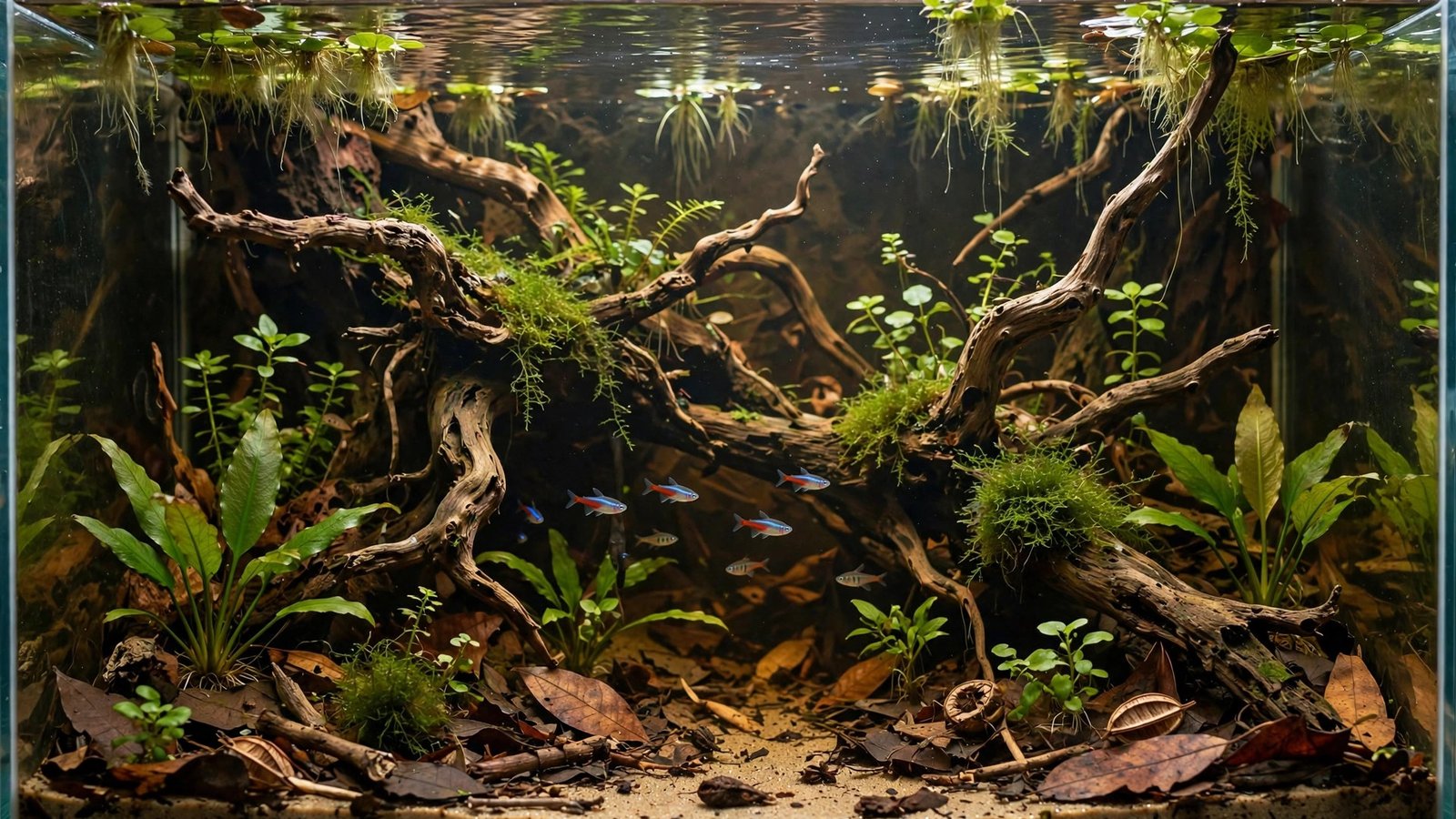
An amazon biotope aquarium setup rewards patience over products. Most aquarists chasing the Rio Negro look nail the amber water, then stock the tank with Asian rasboras and glow tetras. This guide builds an authentic slice of the Rio Negro — white sand, leaf litter, tannin-stained water, and a stocking list where every species swims in the Amazon. New to the discipline? Our biotope aquascaping guide covers the general method; here we apply it to one river.
The short answer: an amazon biotope aquarium setup recreates a flooded-forest reach of the Rio Negro with fine white sand, driftwood, a 2–4 cm leaf-litter bed, tannin-stained water at pH 5.5–6.5 and 27–29 °C, and stocking limited to genuine Amazonian species like cardinal tetras and Apistogramma dwarf cichlids. The citable rule: locality first — it isn't a biotope because the water is brown; it's one when every inhabitant could be netted in the Rio Negro.
Your Amazon Biotope Aquarium Setup: Tank Size and Hardscape
Blackwater chemistry is dilute and fragile in small volumes, so size matters more here than in a typical community tank. Seventy-five litres is the floor: enough water mass to steady pH as leaves decay, and enough footprint for a tetra school to behave like a school.
| Tank | Best for | Watch out for |
|---|---|---|
| 75 L (20 gal) | Entry build: one tetra school, one Apistogramma pair, cleanup crew | Parameter swings; stock lightly |
| 150 L (40 gal) | Two tetra species, hatchetfish, trio of dwarf cichlids | Leaf-litter budget roughly doubles |
| 200 L (55 gal) | Showpiece: layered schools, multiple plant zones | Large driftwood gets expensive |
For hardscape, think riverbank, not rock garden. One or two branching driftwood pieces mimic fallen igapó trees and leach tannins for months. Tuck the wood low and off-centre, leave open sand in front, and skip rocks entirely — Rio Negro blackwater reaches are famously rock-free.
Substrate and Botanicals: Building the Rio Negro Floor
Lay fine white quartz sand or pool-filter sand 2–3 cm deep. White sand isn't just pretty: Rio Negro beaches are pale, and the bright floor bounces light up under fish, making cardinal tetras glow. For nutrient reserves under the swords, a 1–2 cm soil base beneath the sand cap works well — the Walstad-style soil base approach suits low-tech builds like this one.
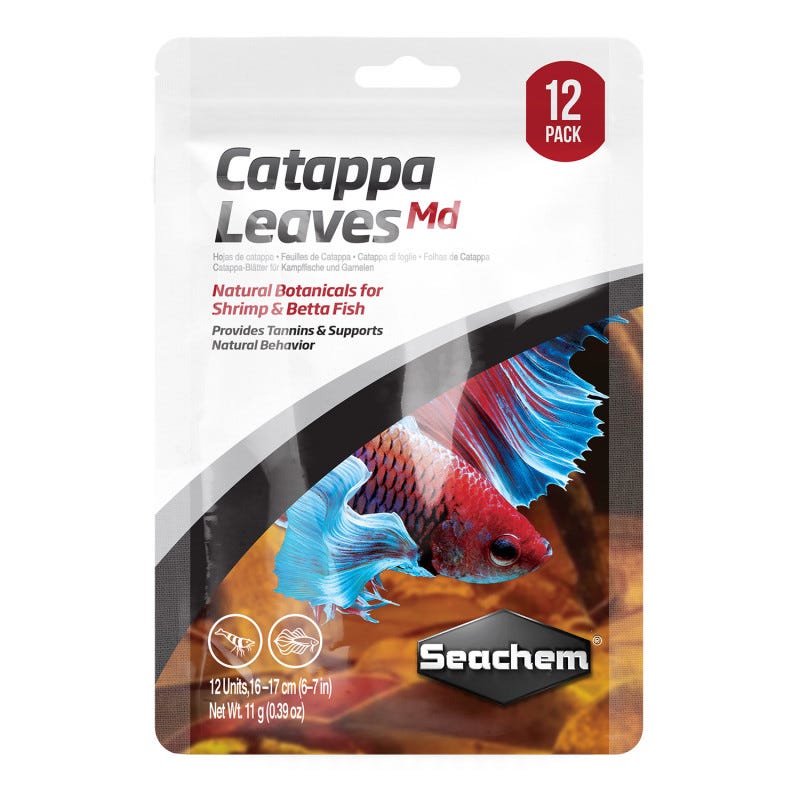
Leaf litter is the signature layer. Spread 5–8 handfuls of dried leaves over the sand in drifts, not an even carpet. Oak, beech, or magnolia leaves are honest stand-ins — genuine igapó litter isn't sold commercially — and catappa leaves work too, though they're Asian. The leaves release tannins that lower pH by roughly 0.5–1.0 within a week and tint the water amber within days. Replenish every 2–3 months as they skeletonise.
 ★4.8
Seachem Catappa Leaves 12-pack
Check Price on Amazon ★4.8Amazonian Plants: What Actually Grows There
The Rio Negro is nutrient-poor, so its flora is sparse and elegant — forget Dutch-style thickets. Choose slow, hardy species that tolerate soft acidic water and low light; our aquarium plants for fish tank guide and complete freshwater plants guide cover care basics for each.
| Species | Placement | Notes |
|---|---|---|
| Amazon sword (Echinodorus bleheri) | Background | The classic; a root tab every 6–8 weeks feeds it |
| Cabomba aquatica | Background / sides | True Amazonian stem plant; suits soft water |
| Vallisneria americana | Background corners | Runners fill in over 8–12 weeks |
| Amazon frogbit (Limnobium laevigatum) | Floating | Dims light naturally; thin weekly |
| Red root floater (Phyllanthus fluitans) | Floating | Red roots under dim light; true Rio Negro floater |
Keep planting sparse — a sword or two, a Cabomba stand, one floater species — and let hardscape and litter carry the visuals. This is a low-tech planted setup by nature: no CO2, and 20–30 PAR at the substrate is plenty.
Stocking a Genuine Rio Negro Community
Build around one large tetra school, add a surface species and a bottom-dwelling pair, then stop. Rio Negro fish evolved in warm, acidic, tannin-rich water and show their best colours in it.
| Species | Group size (75 L) | Role |
|---|---|---|
| Cardinal tetra (Paracheirodon axelrodi) | 20–25 | The Rio Negro icon; schools tightly in dim tannin water |
| Rummy-nose tetra (Hemigrammus bleheri) | 10–12 | Alternative schooler; red noses signal water quality |
| Marbled hatchetfish (Carnegiella strigata) | 8–10 | Surface layer; needs a tight lid — they jump |
| Agassiz's dwarf cichlid (Apistogramma agassizii) | 1 pair | Bottom character; spawns in leaf-litter caves |
| Otocinclus spp. | 6 | Algae crew; add after 2+ months of stable biofilm |
Check every species' origin before buying — the Seriously Fish species database lists exact collection localities. In a 75-litre tank, pick either cardinals or rummy-noses as your main school, not both.
Water, Cycling, and the First 30 Days
Fill with soft water — RO remineralised to 1–3 dGH, or soft tap cut with RO — and add hardscape and litter on day one so tannins start working during the cycle. Run gentle flow; blackwater species dislike strong current, and still water keeps the litter bed intact.
Cycle 3–4 weeks before any fish, adding litter a handful per week so pH drifts down slowly. Test weekly for pH 5.5–6.5, GH 1–4, and a steady 27–29 °C. For the full tannin-chemistry deep dive, our planted blackwater tank setup guide covers pH buffering and RO mixing ratios — this article stays focused on the region build.
Stock in stages: tetras in week 4, hatchetfish in weeks 5–6, the Apistogramma pair in weeks 7–8, once the litter bed hosts microfauna to forage on. Feed small amounts twice daily; uneaten food rots fast in warm acidic water.
Living With the Biotope: Monthly Maintenance
Change 20–25% of the water weekly with temperature-matched soft water, siphoning debris lightly without disturbing the litter layer. Top up leaves as they decompose, trim sword runners before they crowd the driftwood, and thin floaters weekly. If pH creeps above 6.5, add fresh leaves rather than chemical buffers. After six months the litter bed turns into a living system — microfauna, biofilm, and mulm your dwarf cichlids will graze for hours.
Frequently Asked Questions
Can I use tap water for an Amazon biotope aquarium setup?
Only if it's soft. Rio Negro water is nearly mineral-free, so hard tap (above ~6 dGH) fights the tannins and holds pH high. If your tap tests under 4 dGH and pH under 7, it's workable. Otherwise cut it with RO water or go full RO remineralised to 1–3 dGH.
Do Amazonian plants need CO2 in a biotope?
No. The true Rio Negro list — Amazon swords, Cabomba aquatica, vallisneria, frogbit — evolved in low-nutrient water and grows fine without injected CO2. Keep light at 20–30 PAR, give the swords a root tab every 6–8 weeks, and accept slower growth. CO2 pushes a growth rate the biotope look doesn't need.
Are catappa leaves authentic to the Amazon?
Strictly, no — Terminalia catappa is Asian. But it releases the same tannins and humic acids as Amazonian litter and is widely accepted as a functional stand-in. If strictness matters, use oak or magnolia leaves instead; they look more like igapó litter anyway. Never use dyed or treated leaves.
How dark should the blackwater be?
Aim for weak-tea amber where you can still see the back glass — roughly 15–20 cm of visibility loss. If you can't see your fish from across the room, it's too dark: do a 30% water change and hold off on new leaves for a week. The stain deepens over the first month, then stabilises.
Why the Extra Discipline Is Worth It
A brown-water tank with random fish is decoration; a locality-correct Rio Negro slice is a window. When cardinals school under red root floaters and an Apistogramma pair fans eggs in a leaf cave, you stop seeing a fish tank and start seeing a river.