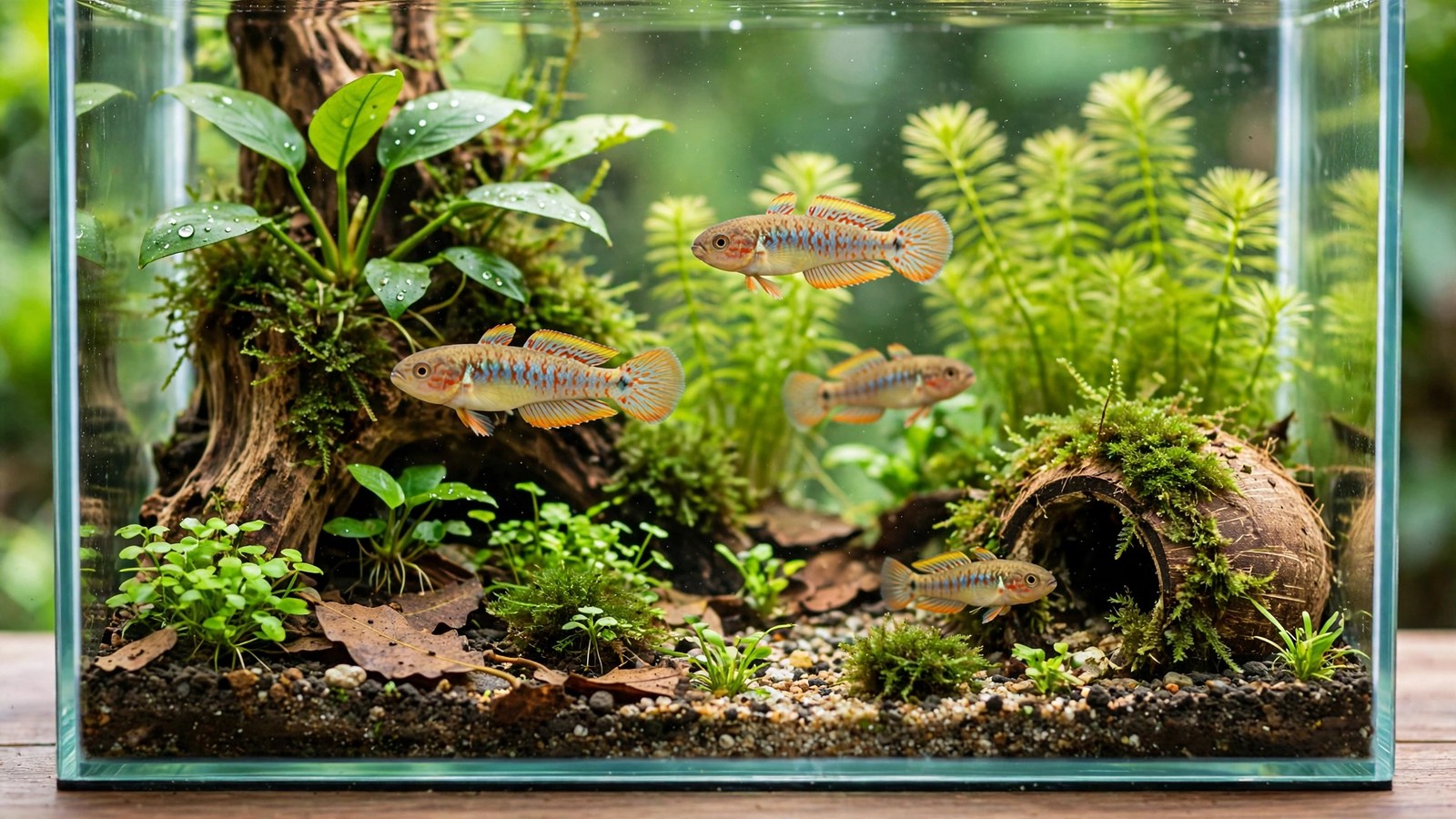
A male peacock gudgeon in full color looks like stained glass come alive — electric-blue fin edges, crimson blotches, a black eyespot flashing on his tail as he patrols between caves. Most nano fish stay pretty and stay put; Tateurndina ocellicauda pairs off, claims a cave, and the male stands guard over the eggs himself. This guide builds your planted tank around that behavior: cave dimensions, the carnivore diet, and the cave-breeding process.
A peacock gudgeon planted tank needs a 10-gallon or larger tank with dense plant cover, 2–3 caves with 2.5–3.5 cm openings, and water at 22–26°C with pH 6.5–7.5. Feed a carnivore diet of frozen daphnia, baby brine shrimp, and microworms. For breeding, condition the pair on rich foods — the male then claims a cave and guards the eggs until they hatch in 2–4 days, and fry are free-swimming within about a week, and fry take newly hatched baby brine shrimp once free-swimming.
Peacock Gudgeon Planted Tank: Size and Water
A 10-gallon is your minimum. Peacock gudgeons stay around 6–7 cm, so the tank is not about swimming room — it is about territory. A pair or trio claims the bottom third of the tank, and each cave needs plant cover so the fish are not constantly in each other's sightlines.
| Parameter | Target | Notes |
|---|---|---|
| Temperature | 22–26°C | Spawning often triggers at 24–26°C |
| pH | 6.5–7.5 | Adaptable; avoid sudden swings |
| Hardness | 5–12 dGH | Soft to moderately hard |
| Nitrate | <20 ppm | 25–30% weekly water changes |
| Flow | Gentle | Sponge filter or baffled HOB |
Most trade stock is tank-bred and settles quickly into standard community parameters. Cycle fully, plant before stocking, and give new fish a covered first week — gudgeons that hide at first usually start displaying once the cover is established. For matching plants to livestock, the aquarium plants for fish tanks guide is the site's cornerstone reference on plant selection by fish needs.
Caves First: Hardscape for a Cave-Spawner
Everything revolves around the caves. Provide 2–3 spawning sites per pair, each with an opening of 2.5–3.5 cm — just wide enough for the male to enter and turn. Ceramic pleco caves, coconut huts, and short terracotta pipe sections all work; bury each base slightly in the substrate so it sits naturally. Place caves in the back and mid-tank, facing different directions, with plants crowding the entrances. An exposed cave reads as a trap; one half-hidden behind Cryptocoryne or Microsorum reads as home.
Java moss is the most useful plant here: tufts around cave entrances soften the threshold, and dense moss pads elsewhere shelter the male between guarding shifts. The 7 best aquarium mosses compared ranks which mosses hold up in warm, low-flow nano tanks and double as fry habitat. Finish with fine-leaved stems (Rotala, Myriophyllum) in the midground and open sand up front, so you can watch the male's patrol routes.
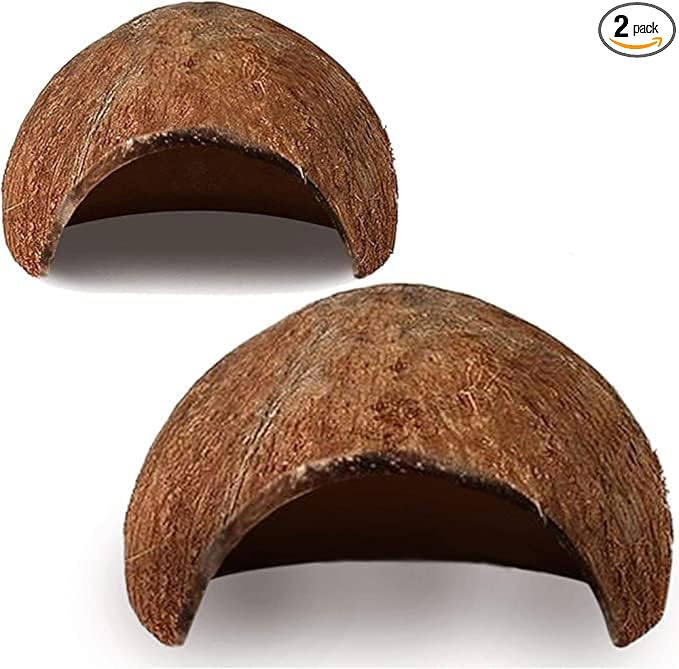 ★4.6
SunGrow Coconut Shell Fish Caves
Check Price on Amazon ★4.6Feeding a Carnivore in a Planted Tank
The fastest way to fail with this species is treating it like a community omnivore. Peacock gudgeons are strict carnivores — flakes are usually ignored, especially by new or breeding fish. Feed frozen daphnia, baby brine shrimp, bloodworm, and blackworms in daily rotation, and use live microworms and newly hatched brine shrimp as the conditioning fuel that flips a pair into breeding.
A DIY baby brine shrimp hatchery costs almost nothing and pays for itself once fry arrive. For the first food, culturing infusoria as a first fry food bridges the gap — tiny fry starve before they can take anything bigger.
Breeding: The Cave-Spawning Process
This is the behavior that separates peacock gudgeons from the other nano gobies. The stiphodon goby is a beloved algae-grazer, but it does not spawn in caves — the stiphodon goby planted tank guide covers a fish that grazes biofilm all day, while the peacock gudgeon is a pair-bonding cave guardian. Different species, completely different aquarium story.
- Condition. Feed heavy on frozen and live foods for 2–3 weeks. The male's colors intensify; the female's belly rounds with eggs.
- The male claims a cave. He cleans the cave ceiling and flares his fins at the female from the entrance — the showpiece behavior of the species.
- Spawning. He lures her inside; she attaches 50–150 eggs to the cave ceiling.
- Male guards alone. He fans the eggs constantly and chases the female off — leave him undisturbed. Eggs hatch in roughly 2–4 days at 24–26°C, and fry are free-swimming within about a week.
- Fry emerge. They hang on the ceiling for a day or two on their yolk sacs, then go free-swimming and take infusoria and microworms immediately.
- Grow-out. Move to newly hatched baby brine shrimp within days, 3–4 small meals daily. Use a sponge filter instead of a HOB so fry never get trapped on an intake.
Triggers: a 20–30% water change with water 1–2°C cooler, a barometric drop before a storm, and a boost in live food. Males reuse the same cave, so a successful pair often breeds again within weeks.
| Stage | Timeline | Food |
|---|---|---|
| Eggs (guarded) | 2–4 days | None — yolk + male fanning |
| Free-swimming | Days 1–5 | Infusoria, microworms |
| Grow-out | Week 2+ | Newly hatched baby brine shrimp |
| Juveniles | Week 6–8 | Frozen foods, fine granules |
Tank Mates and Filtration
Gudgeons are peaceful but predatory at nano scale — anything that fits in their mouth is food. Safe mates are small, calm midwater fish that ignore caves: ember tetras, chili rasboras, honey gouramis. Skip boisterous bottom-dwellers like loaches, and keep breeding shrimp colonies separate — adult amanos are safe, but shrimplets become expensive snacks. Filtration stays gentle: a small sponge filter suits them perfectly. The guide to aquarium plants for a fish tank covers the plant-stocking logic for any species-focused setup.
Frequently Asked Questions
Can peacock gudgeons live in a 5-gallon planted tank?
A pair can survive in a 5-gallon, but a 10-gallon is the honest minimum for breeding. Caves need spacing, guarding males get territorial, and the extra volume buffers heavy feeding. If 5 gallons is all you have, keep one pair, plant densely, and skip tank mates.
Will peacock gudgeons eat my shrimp?
Adult cherry and amano shrimp are safe — gudgeons cannot tackle full-grown shrimp. Newly hatched shrimplets are another story: they match natural prey size and get picked off. For a breeding shrimp colony, use its own tank or accept shrimplets as live food.
Do peacock gudgeons need live food to breed?
Not strictly, but it makes breeding far more reliable. Frozen daphnia and brine shrimp condition a pair, yet live microworms and newly hatched brine shrimp trigger faster, bigger spawns. Fry need live-sized first foods — infusoria or microworms — since most cannot take anything else for their first few days.
How can I tell a male from a female?
Males are the showpiece: electric-blue fin edges, red blotches on the dorsal and caudal fins, a yellow belly, and larger size. Females are plainer, with a black stripe to the caudal spot and a rounder belly in breeding condition. In a retail tank, the brightly colored fish guarding a cave is the male.
Why won't my peacock gudgeons spawn?
Check cave size: openings must be 2.5–3.5 cm, since oversized caves are never claimed. Next, cover — exposed caves are ignored, so crowd entrances with plants or moss. Then conditioning: two weeks of rich frozen or live food, not flakes. Finally, trigger with a cooler 30% water change in the evening.
A Small Fish With Outsized Rewards
Most nano fish are decoration; peacock gudgeons are a project. Set the caves right, feed them like the carnivores they are, and you get courtship displays, egg-guarding males, and fry in the moss — the full breeding cycle in ten gallons.
Sources: the Seriously Fish profile for Tateurndina ocellicauda (wild habitat, water chemistry) and the Tropica plant database (mosses and crypts for cave cover).