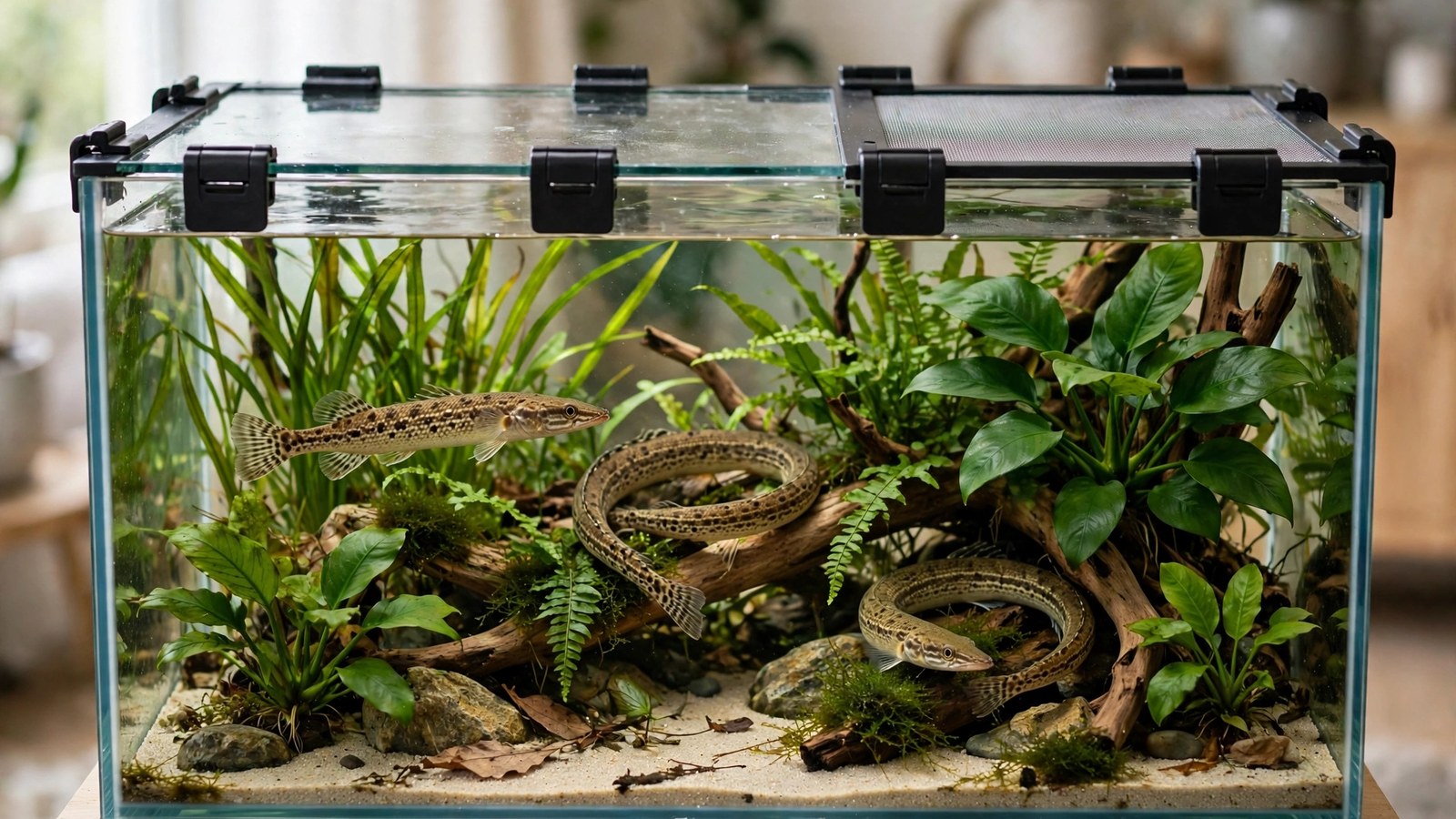
You wake up, flick the tank light on, and one of your ropefish is missing. It isn't hiding in the driftwood — it is three rooms away, under the couch, still moving. Ropefish are obligate air-breathers that will leave water for hours and can survive, which means a lid that is merely "closed" is not a lid at all. Set up a ropefish planted tank with escape-proofing as the first design decision, and you get one of the hobby's most captivating oddballs gliding through soft sand and sturdy plants.
Short answer: A ropefish planted tank works best as a 55–75 gallon, tightly sealed aquarium housing 3–5 ropefish on fine sand with rugged plants (Anubias, Java fern, Cryptocoryne). Seal every lid gap including filter cutouts, feed meaty foods after dark, and keep tank mates too large to swallow. The single non-negotiable: ropefish are escape artists — unsealed gaps mean a fish on your floor, not in your tank.
Your ropefish planted tank: the non-negotiables
Ropefish (Erpetoichthys calabaricus), also sold as reedfish or snakefish, break two assumptions new keepers make. First, they breathe air through lungs and rise to the surface regularly, so the tank's top is their doorstep. Second, anything that fits in their mouth is food; anything too big is furniture. Design around those two facts and the rest is straightforward. For the planted-tank fundamentals, start with our guide to aquarium plants for fish tanks, then layer the ropefish rules below on top.
Escape-Proofing: Seal Every Exit Before Water Goes In
Ropefish escape through gaps you would consider decorative: the notch for the filter hose, the millimeter around a heater cable, the seam where a canopy meets the rim. Once out, their air-breathing buys them hours.
Use this checklist before the first fill:
- Tight-fitting lid or canopy covering the entire rim with no curl-up edges — glass canopies are ideal.
- Plug every filter cutout with a sponge block or foam insert, not tape, which peels in humidity.
- Seal cord gaps with slit sponge collars where heaters and cables enter.
- Check behind the tank — the gap between a hang-on-back filter and the glass is a classic exit.
- No open-top aesthetic. For the tradeoffs, read our open top vs lid comparison for planted tanks. Ropefish owners must choose the lid.
Ropefish escape through any gap — a single-piece glass canopy sized for 40-65 gallon tanks seals the top: a single-piece glass canopy ★4.5.
Tank Size, Substrate, and Layout
Ropefish reach 16–24 inches in captivity but rest most of the day, so 55–75 gallons with a footprint of at least 48 × 12 inches suits three to five animals. For a large species-focused build, our 75-gallon planted tank walkthrough is a good equipment template — just prioritize ropefish rules over aquascaping.
Substrate is the key equipment decision here. Ropefish rest their body weight on the floor and probe with sensitive barbels, so fine sand at 2–3 inches deep is non-negotiable; coarse gravel abrades their skin and traps food. Compare your options in our guide to the best substrate for planted tanks — sand wins on fish welfare here.
Ropefish are nocturnal and spend daylight hours wedged into crevices, so decorate with driftwood tangles and smooth stone caves. Leave open sand lanes across the front glass for nighttime viewing — a foraging lane with low plants behind it makes genuinely beautiful after-dark display.
Sturdy Plants Only — They Will Bulldoze the Delicate Stuff
Ropefish do not eat plants, but they cruise the bottom like slow trains and uproot anything anchored shallowly. This tank belongs to the rugged-plants club — the same category as the dig-proof picks in our best plants for cichlid tanks list.
| Plant | Why it works | How to anchor it |
|---|---|---|
| Anubias barteri / nana | Thick leaves, impossible to crush | Glue or tie to driftwood — never bury rhizome |
| Java fern | Tough rhizome plant, thrives in low light | Tie to wood or stone |
| Bolbitis heudelotii | African native, matches ropefish habitat | Attach to hardscape; keep rhizome exposed |
| Cryptocoryne wendtii | Deep roots, handles disruption once settled | Plant deep in sand with root tabs |
| Amazon sword (Echinodorus) | Massive root system ropefish can't move | Heavy root feeding, nutrient-rich sand base |
Skip carpeting plants and fine stems entirely — Hemianthus, Monte Carlo, and pearlweed become salad and mulch. Low light is fine for the plants above, which suits nocturnal ropefish and keeps algae pressure down.
Feeding: Meaty Foods, After Dark
Ropefish are carnivores that hunt by smell at night. Offer frozen bloodworms, mysis shrimp, and chopped raw prawn or earthworm 4–5 times per week, in portions they finish within 10 minutes. Flake food is almost always ignored; start with frozen foods and wean onto sinking carnivore pellets only if you want to.
They miss food drops in the dark, so target-feed with long planting tweezers near their hides and remove uneaten meat within an hour — rotting prawn wrecks water quality fast. Keep nitrate under 20 ppm with weekly 30% water changes; ropefish are sensitive to poor water despite their hardy reputation.
Tank Mates That Won't Become Dinner
The rule is simple: if it fits in a ropefish's mouth at night, it is a snack, not a tank mate. Neon tetras, guppies, and cherry shrimp are all on the menu. Peaceful mid-size fish are excellent companions:
- Congo tetras (large-bodied, fast, an African habitat match)
- Angelfish and gouramis (tall-bodied, confident, sleep mid-water)
- Larger plecos (benthic overlap without conflict — skip tiny ones)
- Avoid fin-nippers like tiger barbs: ropefish cannot escape harassment quickly
For another escape-prone African species, see our African butterflyfish planted tank setup. Check the Seriously Fish ropefish profile for wild habitat parameters, and Tropica's plant database when choosing sturdy layout plants.
Frequently Asked Questions
Will a ropefish really climb out of my tank?
Yes. Ropefish breathe air and escape through tiny gaps — filter cutouts, cord holes, lid seams. Owners routinely find them on the floor, sometimes hours later and still alive. A fully sealed, weighted lid is mandatory; open-top tanks are not an option with this species.
Can I keep a single ropefish?
You can, but you should not. Lone ropefish become withdrawn and inactive; groups of three or more show natural group foraging and resting behaviors. Plan the tank around a group from day one — 55 gallons or larger for three to five animals.
What tank size do ropefish need?
For a group of three to five, 55–75 gallons with a footprint of at least 48 × 12 inches. Captive ropefish reach 16–24 inches but rest by day, so footprint matters more than sheer volume. Longer tanks (60+ inches) let larger groups display natural cruising behavior.
Do ropefish eat aquarium plants?
No, but their size and bottom-cruising uproots delicate plants. Stick to rugged, deep-rooted or hardscape-anchored species: Anubias, Java fern, Bolbitis, Cryptocoryne, and Amazon swords. Skip carpeting plants and fine stems, which become mulch within weeks.
What can ropefish live with in a community tank?
Peaceful fish too large to swallow: congo tetras, angelfish, gouramis, and large plecos. Anything that fits in their mouth — neon tetras, guppies, shrimp — gets eaten at night. Avoid fin-nippers like tiger barbs, since ropefish are slow to escape harassment.
Build the Escape-Proof Tank First, Then Enjoy the Weirdest Fish You Own
A ropefish planted tank inverts the usual priorities: lid security outranks aquascaping, sand outranks soil, and feeding after dark outranks feeding on schedule. Get those right and you are rewarded with something no tetra tank delivers — a prehistoric hunter gliding through your plants at midnight, in a tank it cannot leave.