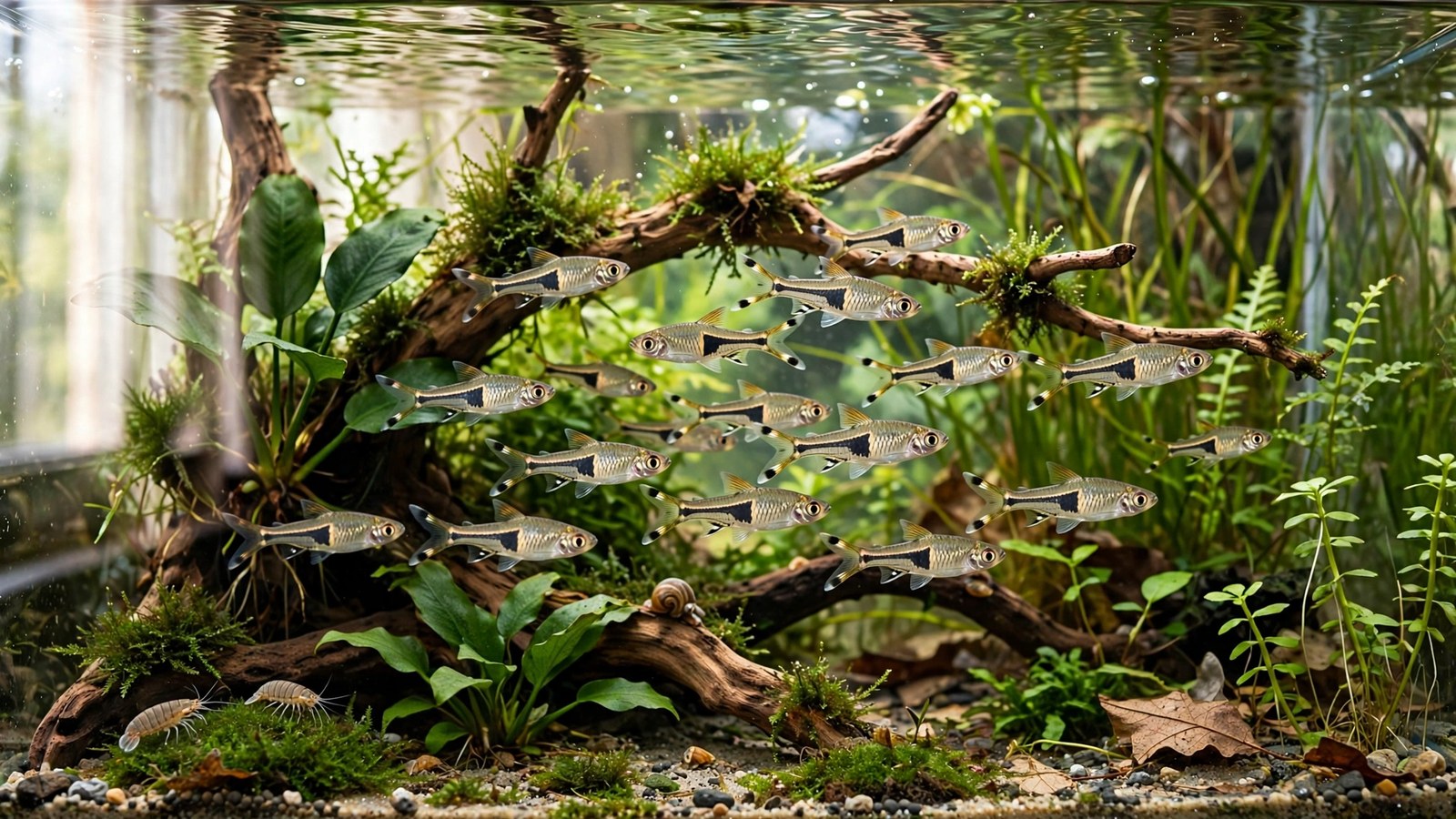
Most rasbora guides assume a two-inch nano fish. The scissortail rasbora is a different animal: Rasbora trilineata reaches 6 inches in the wild and 4–5 inches in captivity, and a school of them moving in sync is a great sight in fishkeeping. A scissortail rasbora planted tank built like a nano setup will cramp them badly — here is the real build: tank-length math for full-grown fish, planted edges with open swimming lanes, powerhead flow, and plants chosen around fast surface swimmers.
The short answer: A scissortail rasbora planted tank needs a 4-foot (48-inch) tank — a standard 55-gallon — a school of 8–12 Rasbora trilineata, planted edges with wide open swimming lanes, dark substrate, and moderate flow from a powerhead. Temperature 72–78°F, pH 6.0–7.5, soft to moderately hard water. The most citable fact: sources consistently recommend a tank at least 48 inches (122 cm) long for full-grown fish — length is the parameter that matters, not gallons.
The Scissortail Rasbora Planted Tank: Built Around Length, Not Gallons
Here is the tank-length math most retailer care sheets skip. A captive scissortail runs 4–5 inches and swims constantly in the mid-to-upper water. A school of 10 needs a straight-line run long enough to stretch out, turn, and reform — at least 48 inches. A standard 55-gallon (48" × 13" × 21") is the natural fit, and several species references explicitly call for a 4-footer for full-grown fish while rating a 30-gallon/3-footer "sufficient" only for juveniles. If you're tank shopping, a 55-gallon planted tank setup is the honest minimum — height matters far less than length.
Name the species plainly: Rasbora trilineata, the scissortail (or three-lined) rasbora, native to rivers, streams, and floodplains across Southeast Asia from Thailand and Cambodia to Borneo and Sumatra. It is not a nano fish — forget everything sized for chili and lambchop rasboras (barely an inch) and even harlequins (about two). The forked tail, banded black and white like scissor blades, is a distance-swimmer's tool, and a tank that respects that is where the fish thrives.
Scape for Speed: Planted Edges, Open Swimming Lanes
The scape that works is simple and strict: dense planted edges on both ends and the back, with the front half and center left as open swimming lanes. Think of a lightly planted aquarium layout: planted edges, open swimming lanes — the school lives in the open water, and the planted margins give startled fish somewhere to duck.
Keep the margins robust: tall Vallisneria along the back glass, Amazon swords or large Cryptocoryne at the ends, low carpet or plain dark sand across the lanes. Dark substrate flatters the fish's silver flanks and gold lateral line — and calms them; pale substrates make scissortails visibly skittish. Hardscape belongs at the back and sides only; nothing narrows the main runway. Use a tight-fitting lid: scissortails are jumpers, especially in week one.
Flow: Why a Powerhead Changes the School
These are river fish that hold position in gentle current in the wild, and a small powerhead set low-to-mid across the tank's long axis gives them a working river: fish orient into the current, the school tightens, and the tail-flicking that earned the common name becomes constant. Aim for moderate flow — leaves should wave gently, never fold flat. Angle it slightly upward so the surface ripples; that breaks up overhead light (which they prefer) and oxygenates the upper water where they live. Of all possible upgrades, this is arguably the highest-impact purchase after the tank itself.
Plants for Fast Surface Swimmers
Your plant list is limited only by flow tolerance — plus one quirk: they live in the top third, so floating cover matters more than usual. Choose from aquarium plants for a fish tank chosen around fast surface swimmers with these priorities:
- Background: Vallisneria (tolerates flow beautifully), Amazon sword, large Cryptocoryne — the planted edges the fish retreat to.
- Hardscape: Anubias and Java fern tied to wood at the back corners; indestructible, and they thrive in moderate flow.
- Floating cover: water lettuce or salvinia over part of the surface. Floating plants calm surface-dwelling schoolers and coax them into the open — exactly what you want to see.
- Midground accent: red-leaf stems (Ludwigia, Alternanthera) at one end give the silver school a color backdrop to school against.
School Size, Tank Mates, and Water
Stocking is where most scissortail tanks quietly fail. Six is the commonly quoted minimum, but eight to twelve is where the synchronized schooling appears; below that, the fish are merely individuals in a tank, stressed and washed out. Buy the school all at once from one source — mixing suppliers invites disease and a long acclimation standoff.
Tank mates should be peaceful and pace-matched: other fast community fish (danios, congo tetras, barbs) and bottom crews that stay out of the way (corydoras, loaches). Avoid fin-nippers and anything small enough to spook the school into the glass. For your first large community, pair the planting with the easiest aquarium plants for a beginner community tank, and check the best schooling fish for planted tanks roundup for how this school compares.
| Parameter | Target |
|---|---|
| Tank (adults) | 55 gal, 48" long — minimum |
| School | 8–12 (6 absolute floor) |
| Temperature | 72–78°F (22–26°C) |
| pH | 6.0–7.5 |
| Hardness | Soft to moderately hard (2–12 dGH) |
| Flow | Moderate — powerhead or strong canister |
| Lid | Tight-fitting — confirmed jumpers |
| Diet | Omnivore: flakes, micro-pellets, frozen/live foods |
Captive-bred stock is notably adaptable across the species' wide natural range — and unlike some hardy tetras, scissortails never touch live plants, the opposite end of the spectrum from the Buenos Aires tetra planted tank. The detailed Rasbora trilineata profile at Tropical Freshwater Fish confirms the 48-inch recommendation for full-grown fish, the open-swimming-area requirement, and the dark-substrate preference. Feed once or twice daily, enough for two-minute feedings, and rotate in frozen daphnia or brine shrimp weekly — it sharpens the tail banding.
Frequently Asked Questions
How many scissortail rasboras should I keep?
Aim for 8–12 in a 55-gallon or larger tank. Six is the commonly quoted minimum, but the synchronized schooling this fish is famous for only appears in bigger groups — below that, individuals stay scattered, stressed, and pale.
Do scissortail rasboras eat aquarium plants?
No — they are completely plant-safe and ignore plants entirely: no grazing soft leaves, no shredding stems, no uprooting. That makes them one of the safest large schoolers for a heavily planted aquascape, and a sharp contrast with genuine plant-eaters like the Buenos Aires tetra.
Can I keep scissortail rasboras in a 20-gallon tank?
Not as adults. A full-grown 4–5-inch scissortail needs a 48-inch swimming run, and a 20-gallon doesn't provide it — species references recommend a tank at least 48 inches long for full-grown fish. If a 4-footer won't fit, choose a smaller rasbora species instead.
How are scissortails different from harlequin or chili rasboras?
Size and behavior. Chili rasboras barely reach an inch and harlequins about two — scissortails hit 4–5 inches in captivity and swim hard and constantly in the upper water. They need 4-foot tanks, real flow, and wide-open lanes; nano-rasbora setups will cramp them.
Do scissortail rasboras need a lid?
Yes — use a tight-fitting lid. They're fast surface swimmers and confirmed jumpers, especially during the first week in a new tank or after a water change.
The scissortail rasbora is proof that "rasbora tank" doesn't have to mean nano. Give Rasbora trilineata the 4-foot footprint, planted edges, open lanes, and moderate flow it evolved for, and a school of 8–12 will reward you with the most active midwater display any planted community tank can offer.