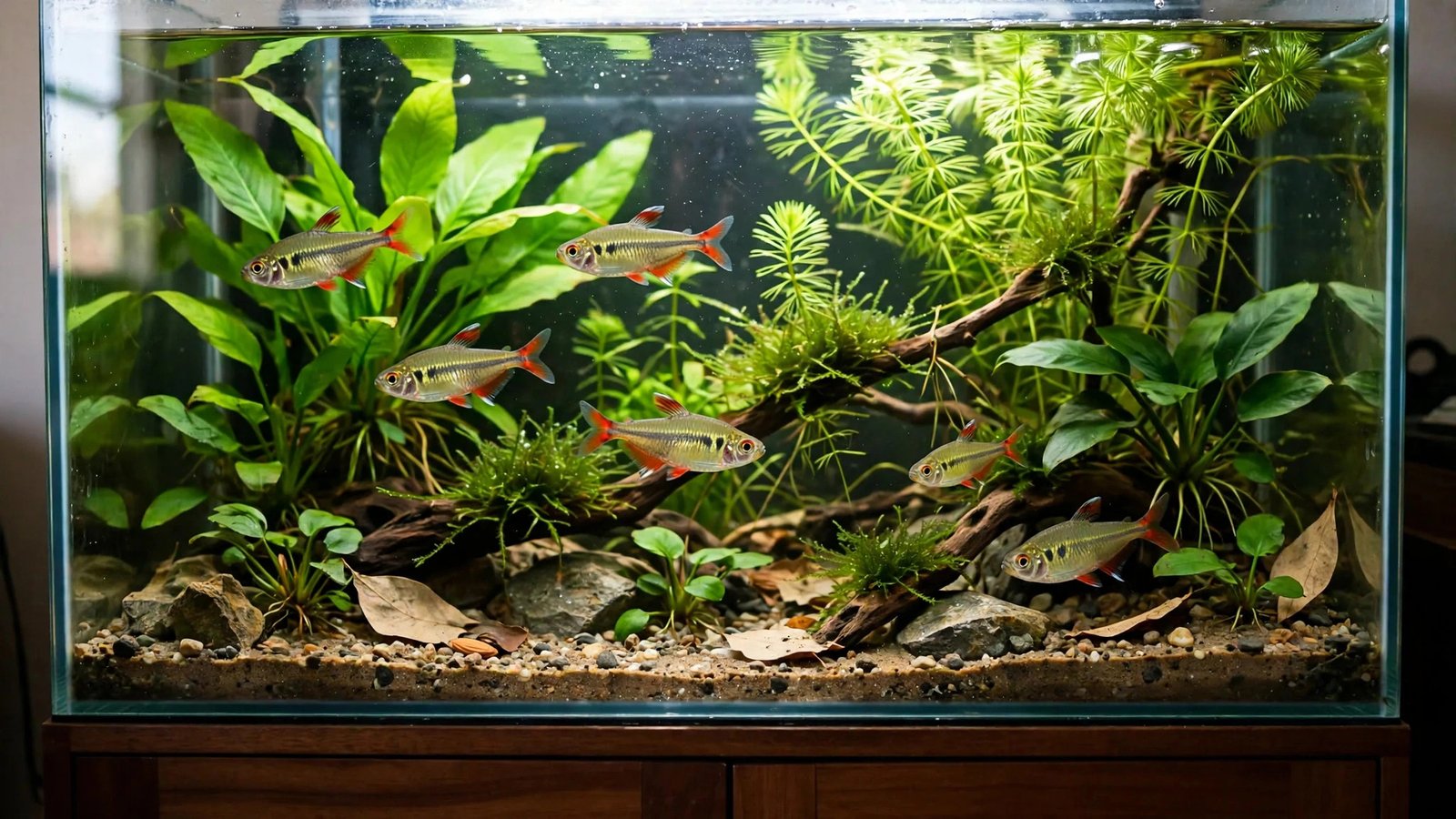
Most people discover the plant-eating habit of the Buenos Aires tetra the expensive way: a freshly aquascaped tank, soft stems shredded within a week. But a buenos aires tetra planted tank is absolutely possible — it just has to be built on the fish's terms. This is the honest setup guide: which plants actually survive Hyphessobrycon anisitsi, how a 30-gallon floor and a big school keep nipping in check, and the feeding strategy that keeps grazing manageable.
Bottom line: A Buenos Aires tetra planted tank works at 30 gallons and up, with a school of 8–12 fish, and plants chosen for toughness, not beauty. Java fern, Anubias, and mosses survive because their leathery leaves resist constant nibbling; soft stem plants do not. Keep the fish well-fed — including vegetable matter like blanched spinach and spirulina — and grazing pressure drops noticeably. This honest trade is the unique key to the whole setup: skip the delicate scape, embrace the hardy one.
What a Buenos Aires Tetra Planted Tank Actually Looks Like
Forget the aquascape-journal layout: a buenos aires tetra planted tank is a lightly planted, low-tech aquarium setup built around plants they can't destroy. Hyphessobrycon anisitsi is an active characin from the Paraná and Río de la Plata basins — hardy, hungry, and equipped with teeth that treat soft leaves as snacks.
Driftwood-and-rock hardscape wrapped in epiphytes, with a deep open swimming lane down the middle. These are sprinters — aim for roughly one-third planted zones, two-thirds open swimming room.
The plant rules (non-negotiable)
Omnivores with a strong herbivore streak: soft-stemmed plants (rotala, ludwigia, cabomba) get nibbled until they fail, while thick-leaved epiphytes get tasted once and ignored. Every soft plant is a future snack; every epiphyte is furniture.
The Hardy Plant Shortlist (What Actually Survives)
These five have the thickest leaves and the longest track record against daily grazing — and they grow attached to wood and rock, so the fish can't uproot them.
| Plant | Placement | Why it survives |
|---|---|---|
| Java fern | Tied to driftwood | Leathery, bitter fronds; sampled once, then ignored |
| Anubias (barteri, nana) | Wedged in rock crevices | Extremely thick cuticle; toughest of all aquarium plants |
| Java moss / Christmas moss | Glue to hardscape | Regrows faster than the fish can strip it |
| Anubias "Coffeefolia" | Midground wood | Ridged leaves are extra unappealing to nibblers |
| Bolbitis heudelotii | Shaded wood areas | Tough African fern fronds; survives grazing well |
The same fish-first logic applies to plant selection: start from aquarium plants chosen for the fish first. (Java fern and Anubias are also among the easiest epiphytes to buy healthy and established.)
Potted Anubias from a freshwater-plant seller; Anubias is the article's top plant-survivor recommendation: potted Anubias ★4.4.
Tank Size Math: Why 30 Gallons Is the Floor
At 2–2.75 inches, these fish swim like they pay rent by the lap. A school of 8–12 needs 30 gallons minimum, and longer is better — a 36-inch tank calms them noticeably versus a tall cube of the same volume.
Six is the cited minimum, but 8–12 is where behavior stabilizes. Understocked groups get bored, and boredom becomes fin-nipping. Cramped schools also concentrate waste — these are enthusiastic eaters — so run strong filtration and a real 30% weekly water change.
Feeding Strategy: the Anti-Grazing Diet
The lever most keepers never pull: a varied, filling diet with vegetable matter cuts grazing far more than flake-only feeding. Treat plant-nibbling as foraging behavior that kicks in when fish are bored or underfed, then remove both triggers.
| Food | Role | Frequency |
|---|---|---|
| Quality flake or micro-pellets | Daily staple | Twice daily, small portions |
| Frozen bloodworms / brine shrimp / daphnia | Protein variety | 3–4× weekly |
| Blanched spinach, zucchini, lettuce | Grazing substitute | 2–3× weekly |
| Spirulina-based food | Easy vegetable content | 2× weekly |
Two small feedings beat one large one — they keep foraging energy occupied longer. Most hobbyists report a slice of blanched zucchini redirects nibbling away from the plants for the rest of the day.
School Size and Fin-Nipping Management
Like the serpae — another famously nippy tetra with a similar boisterous-schooler setup — Buenos Aires tetras police each other. In a school of 8–12, chasing stays inside the group; below that, the energy leaks onto tank mates.
Two rules manage the rest:
- No long fins. Guppies, bettas, and fancy gouramis are targets. Choose fast, short-finned companions — barbs, danios, rainbowfish, and sturdier tetras like bleeding heart tetras.
- No tiny slow fish. Small slow swimmers read as food. Keep tank mates in the 2-inch-plus, quick-moving class.
Water Parameters: Forgiving by Design
The easiest part of the build: among the hardiest tetras in the trade, they tolerate unheated tanks down to 64 °F and a wide pH band. Match the fish to your tap water rather than chasing a textbook number.
| Parameter | Range | Target |
|---|---|---|
| Temperature | 64–82 °F (18–28 °C) | 70–76 °F; often fine unheated |
| pH | 5.8–8.5 | Match your tap, keep it stable |
| Hardness | Up to 35 dGH | Moderate; they adapt |
| Tank size | 30+ gallons | 36-inch footprint preferred |
| Water changes | — | 30% weekly |
Filtration should be moderate to strong — big appetites mean real bioload. A filter rated slightly above tank volume keeps water crisp without turning the swimming lane into a treadmill.
Stocking the Rest of the Tank
With the school and epiphytes set, one principle governs the rest: match the energy. Corydoras and bristlenose plecos suit this high-activity mid-water tank — they stay out of the school's way. For more plant ideas, see the easiest aquarium plants for a beginner community tank — but filter every pick through the "can it survive grazing?" test.
The best schooling fish for planted tanks roundup puts this species in context — including the planted-safe scissortail rasbora as a gentler, leaf-proof contrast.
Frequently Asked Questions
Will Buenos Aires tetras destroy all my aquarium plants?
Not all of them. They steadily graze soft-stemmed and fine-leaved plants, which usually fail within weeks. Thick-leaved epiphytes — Java fern, Anubias, Bolbitis — and mosses survive because the fish taste them once and lose interest. Choose grazer-proof species and you lose nothing.
How many Buenos Aires tetras should I keep together?
Six is the widely cited minimum, but 8–12 is the real sweet spot. Larger schools keep chasing inside the group instead of spilling onto tank mates, which directly reduces fin-nipping. In 30 gallons, ten fish balances activity, color, and bioload nicely.
Can I keep Buenos Aires tetras in a 20-gallon tank?
Not recommended. These are 2–2.75 inch sprinters that need a proper school, and 20 gallons can't fit 8–12 of them comfortably. Cramped schools turn nippy and stressed. Stick to the 30-gallon minimum; a 36-inch tank suits their swimming style best.
Do Buenos Aires tetras need a heater?
Often no. They tolerate 64–82 °F and many keepers run them unheated at room temperature — one reason they're popular beginner fish. If the room drops below the mid-60s °F in winter, add a heater set around 70–72 °F. Stability beats a magic number.
What tank mates work with Buenos Aires tetras?
Fast, short-finned community fish: barbs, danios, rainbowfish, corydoras, sturdier tetras. Avoid long-finned species like guppies and bettas, and very small slow fish a boisterous school may harass. Keep the school at 8+ so sparring stays inside the group.
What do Buenos Aires tetras eat besides flakes?
Omnivores that thrive on variety: frozen bloodworms, brine shrimp, and daphnia for protein, plus vegetable matter like blanched spinach, zucchini, and spirulina foods. The greens matter more than most keepers realize — real vegetable content noticeably reduces plant grazing.
The Honest Verdict
A Buenos Aires tetra planted tank is one of the most forgiving builds in the hobby — provided you plant for the fish, not the scape. Epiphytes on wood, 30 gallons plus, a school of 8–12, and real vegetable content in the diet: do those four things and the tank stays green.
Species references: the Buenos Aires tetra profile at Aqua-Fish.net (Paraná-basin origin, omnivorous diet, grazing behavior) and ThinkFish's care profile.