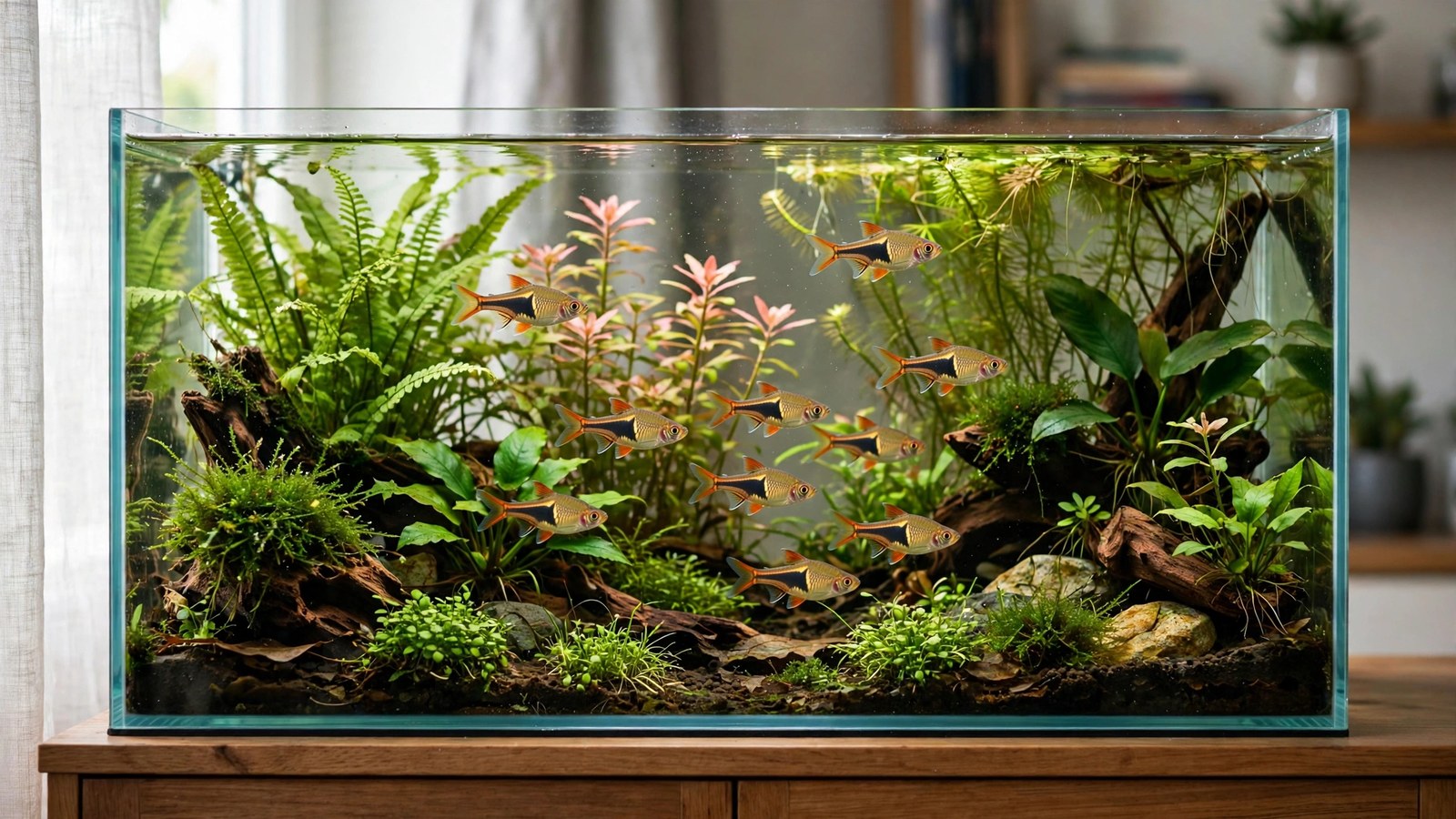
Most harlequin rasboras in the hobby live in bare, brightly lit tanks — and it shows: pale copper flanks, skittish behavior, and fish that huddle in a corner instead of schooling. Give them what they actually want — soft, tannin-tinted water, a ceiling of floating plants, and dark planted cover — and the same fish transform: colors deepen to burnished orange and the whole school weaves through the stems like a single animal. This planted tank setup for harlequin rasboras walks you through the full build, step by step, from empty glass to a thriving species tank. The same blueprint works for tiny chili rasboras and mosquito rasboras, with a few size adjustments along the way.
Why rasboras deserve a purpose-built planted tank
Harlequin rasboras (Trigonostigma heteromorpha) come from slow, shaded blackwater streams in Malaysia, Sumatra, and Thailand, where leaf litter, submerged roots, and overhanging vegetation keep the light dim and the water tea-colored. In a generic bright community tank they survive — but they never show you who they are.
Build the tank around the fish and everything changes: tighter schooling, deeper copper-orange color, and water chemistry that practically maintains itself. This build is low-tech by design — no CO2 injection, no exotic gear — just the right plants, water, and patience. It scales too: the same principles drive a 10-gallon chili rasbora nano or a 40-gallon harlequin display.
Step 1: Choose the tank and the school
Pick your fish before your glass. A harlequin is three times the mass of a chili rasbora, and that decides tank volume, filter choice, and feeding.
| Species | Adult size | Minimum tank | Minimum school | Ideal school |
|---|---|---|---|---|
| Harlequin rasbora | 1.75–2 in | 20 gal long | 10–12 | 15–20 |
| Chili rasbora (Boraras brigittae) | 0.75 in | 10 gal | 12 | 20–30 |
| Mosquito rasbora (Boraras merah) | 0.75–1 in | 10 gal | 12 | 20+ |
Footprint beats height. Rasboras are mid-water swimmers, so a 20-gallon long (30 × 12 × 12 in) is far better than a 20-gallon tall — more horizontal swimming room and more surface area for gas exchange. For chilis, a standard 10-gallon is plenty.
Be generous with numbers: under-schooled rasboras are the number-one cause of washed-out color. Groups below 8 stay nervous and pale no matter how perfect the water. Ten is the floor; fifteen to twenty is where the school moves as one animal.
Step 2: Dial in water parameters
Rasboras are forgiving, but they color up best in water that resembles home: soft, slightly acidic, warm, and stable. Stability matters more than exact numbers, but these are your targets:
| Parameter | Target range | Notes |
|---|---|---|
| Temperature | 74–79°F (23–26°C) | Keep mixed-species tanks at 76–78°F |
| pH | 6.0–7.0 | Tannins from leaf litter naturally push it down |
| GH / KH | 3–8 / 1–4 dGH | Soft water; low KH lets pH sit naturally acidic |
| Ammonia / nitrite | 0 ppm | Non-negotiable — test before every fish addition |
| Nitrate | Below 20 ppm | Plants plus weekly water changes handle this |
If your tap water is hard and alkaline, don't fight it with chemistry sets. A 50/50 mix of tap and RO or distilled water is simpler and far more stable than dosing pH-down products — see our planted tank water parameters guide for the recipe. Catappa leaves and alder cones add gentle tannins that tint the water and drop pH slightly; replace every 3–4 weeks as they decompose.
Step 3: Choose plants rasboras actually use
Rasboras read plants as cover and current-breaks, not food. The winning formula is three zones: a floating ceiling to dim the light, fine-leaved background stems for the school to thread through, and broad-leaved midground plants for resting and display. All of these thrive without CO2, which is why this tank works so well as a low-tech planted tank setup.
| Zone | Best picks | What it does for the fish |
|---|---|---|
| Floating | Amazon frogbit, red root floaters, salvinia | Dims light, absorbs nitrates, gives security — the #1 upgrade |
| Background stems | Rotala rotundifolia, Hygrophila polysperma, Limnophila sessiliflora | Fine leaves the school weaves through |
| Midground | Cryptocoryne wendtii, C. undulata, C. beckettii | Broad leaves for resting and courtship display |
| Foreground | Cryptocoryne parva, Staurogyne repens | Low cover that keeps the front open |
| On hardscape | Anubias nana petite, Java fern, Bucephalandra | Tied to wood — zero planting, bulletproof |
Note: Hygrophila polysperma is a US federal noxious weed — illegal in several states. Never release aquarium plants into waterways.
Crypts are the backbone plant here. They're undemanding, tolerate the dim light under a floater canopy, and their broad leaves give harlequins the flat surfaces they instinctively seek. Plant crypts in drifts of 5–7 — rasboras treat a dense crypt grove as home base. Caveat: crypts melt when moved, so plant once, leave them alone for 3 weeks, and they'll rebound.
Step 4: Hardscape and substrate the blackwater way
Start with a dark, fine-grained substrate: nutrient-rich aquasoil, or aquasoil capped with dark sand. Dark substrate makes copper-orange fish dramatically more vivid by contrast, and fine sand lets small rasboras forage without injury. Keep it 2–3 inches deep in back, ~1 inch up front, so crypts have room to root.
For hardscape, one or two pieces of spider wood or manzanita reaching toward the surface is enough. Position wood off-center with branches breaking the surface zone — rasboras orient to vertical structure the way reef fish orient to coral. Tuck anubias and Java fern into the forks with thread or super glue gel (cyanoacrylate is fish-safe once cured).
Finish with a handful of catappa leaves and a few alder cones scattered on the substrate. They tint the water amber within days and feed biofilm for shrimplets; replace monthly.
Step 5: Filtration and gentle flow
Target 3–4× tank volume per hour — roughly half a typical community tank — and diffuse the output. Floaters should drift slowly, never get blasted into a corner; if stems sway, turn the flow down.
- 10-gallon chili/mosquito tank: a sponge filter on a small air pump with a control valve. Gentle, shrimp-safe, nearly silent.
- 20-gallon harlequin tank: a small canister filter with a spray bar aimed at the back glass, or a hang-on-back with the outflow baffled by a pre-filter sponge.
Pre-filter every intake: chili rasbora fry and shrimplets are small enough to vanish into an unguarded filter. Our water flow and circulation guide for planted tanks covers baffle tricks and spray-bar angles.
Rasboras need gentle flow; sponge filters give biological filtration without blasting the school: a gentle sponge filter.
Step 6: Lighting — dimmer than you think
Rasboras under intense, unshaded light stay washed-out and skittish; under a floater-dappled canopy they glow. Aim for low to moderate light — 20–40 PAR at the substrate — on a 7–8 hour photoperiod. A simple dimmable LED bar at 50–60% works perfectly; the floaters cut another 30–50% at the surface.
Start with 6 hours a day for the first 2 weeks, then add 30 minutes per week until you hit 8. Ramping up slowly is the best algae prevention in a new low-tech tank — it lets plant mass and bacteria establish before light becomes abundant.
Step 7: Cycle properly before any fish
A planted tank is not automatically a cycled tank. Plants absorb some ammonia, but not enough to protect fish while bacteria colonize. Fishless-cycle for 3–6 weeks first:
- Week 1: Set up hardscape, substrate, and plants. Fill with dechlorinated water, start filter and heater at 76°F. Dose ammonia to 2 ppm (liquid ammonium chloride is cleaner than fish food).
- Weeks 2–4: Test ammonia and nitrite every 2–3 days. Top ammonia back to 2 ppm whenever it nears zero. A nitrite spike that rises and falls means the second bacterial colony is establishing.
- The finish line: When the tank converts 2 ppm ammonia to nitrate within 24 hours with nitrite at 0, do a 70–80% water change and add fish within a day or two.
Chilis and mosquito rasboras are less forgiving of new-tank instability than harlequins — for a nano build, confirm the cycle holds for a full week and add the school in two batches a week apart. The full method is in our cycling guide for planted tanks, and our first planted tank shopping list makes sure you don't discover mid-build that you're missing a test kit or a heater.
No fish go in until ammonia and nitrite read zero; the kit proves the cycle: a liquid freshwater test kit.
Step 8: Stocking and feeding
Add the school after the cycle completes, ideally all at once — rasboras settle far faster as a full group. Float the bag for 15–20 minutes, then drip-acclimate over 45–60 minutes if your water differs from the store's. Dim the lights for the first few hours so the new school doesn't panic and wedge behind the filter.
Rasboras have tiny mouths and fast metabolisms. Feed twice daily, only what they finish in 60–90 seconds:
- Staple: micro pellets or crushed flake (0.5–1 mm).
- 2–3× per week: frozen daphnia, baby brine shrimp, or microworms — live/frozen food triggers the deepest reds, since carotenoids in the diet become body pigment.
- Skip one day per week. A weekly fast keeps digestion healthy and water cleaner.
Crush food to near-powder for chilis and watch that every fish eats. A planted tank cleanup crew of nerite snails and amano shrimp handles the crumbs the school misses.
Tank mates that don't ruin the vibe
A species-only rasbora tank is a legitimate masterpiece, but peaceful companions work if they're small and bottom-oriented so the school stays the star: neocaridina shrimp (cherry shrimp — chilis are genuinely shrimp-safe; harlequins will pick off some shrimplets), otocinclus (3–6), pygmy corydoras (8–10), or a single honey gourami for the Southeast Asian theme. Skip anything nippy like tiger barbs or big enough to eat a chili, such as angelfish.
For the fuller picture of what works in planted setups, see our best schooling fish for planted tanks as related reading — it covers how different species pair in community scapes.
The maintenance rhythm
A mature rasbora planted tank is one of the hobby's lowest-maintenance setups:
| Frequency | Task |
|---|---|
| Weekly | 25–30% water change with temperature-matched, dechlorinated water; test parameters; trim stems; remove dead leaves |
| Every 2 weeks | Thin floating plants back to 50–70% coverage; rinse pre-filter sponge in old tank water |
| Monthly | Clean filter media (alternate halves, never all at once); lightly vacuum open substrate; replace catappa leaves |
Two habits separate thriving tanks from surviving ones: never skip the weekly water change (tannin tanks look natural but nitrates still climb), and thin floaters aggressively — 100% surface coverage starves the stems below and crashes nighttime oxygen exchange. Our full planted tank maintenance schedule guide has the printable checklist version.
Frequently Asked Questions
How many harlequin rasboras should I keep in a planted tank?
Twelve is the practical minimum for confident schooling; fifteen to twenty is ideal in a 20-gallon long. Below eight, harlequins stay nervous and pale regardless of water quality. Larger schools distribute skittishness — the bold individuals lead, the shy ones follow — so the whole group spends more time out in the open.
Can chili rasboras live with cherry shrimp?
Yes — one of the safest fish-shrimp pairings in the hobby. Adult cherry shrimp are far too large for a chili's tiny mouth, and chilis are too timid to harass them. You may lose a few newborn shrimplets, but a colony with moss or dense plant cover will still grow. Harlequins are slightly more predatory, so expect heavier shrimplet losses with them.
Do I need CO2 injection for a rasbora planted tank?
No. Every plant in this build — crypts, anubias, Java fern, frogbit, Rotala rotundifolia — grows well without injected CO2. What matters more for rasboras is the floating-plant canopy and dimmer light, which actually make the low-tech approach easier. CO2 would speed stem growth, but the fish neither need it nor benefit from it.
Why are my rasboras pale and hiding all the time?
Usually it's the environment, not disease: too much light, no floating cover, too small a school, or strong current. Add or thicken the floater canopy, dim the light, confirm at least ten fish, and baffle the filter output — healthy rasboras color up within days. If paleness comes with clamped fins or labored breathing, test ammonia and nitrite immediately.
Can I mix harlequin, chili, and mosquito rasboras in one tank?
You can, but each species still needs its own proper school — eight to ten minimum per species — so a mixed tank realistically needs 30+ gallons. Keep it at 76–78°F, which suits all three. Honestly, a single-species school of twenty looks more spectacular and schools tighter than three small groups.
How long should I wait before adding rasboras to a new planted tank?
Wait until the tank fully cycles — typically 3 to 6 weeks fishless — and the plants show new growth. For chili or mosquito rasbora nanos, give an extra week of confirmed stability after the cycle completes and add the school in two batches to avoid an ammonia spike.
Your rasbora tank, one weekend at a time
Weekend one: tank, substrate, hardscape, plants — then start the fishless cycle. Weeks two through five: watch the plants root and the bacteria colonize. Weekend six: the school goes in, and you'll know within the hour whether you got it right — a comfortable school explores immediately; a stressed one hides.
Get the shade, the soft water, and the school size right, and harlequin rasboras repay you with one of the finest displays in freshwater fishkeeping: twenty copper wedges moving as one animal through dappled, tannin-gold water. For authoritative species background, the Tetra fishkeeper guide to harlequin rasboras covers their natural history in depth.