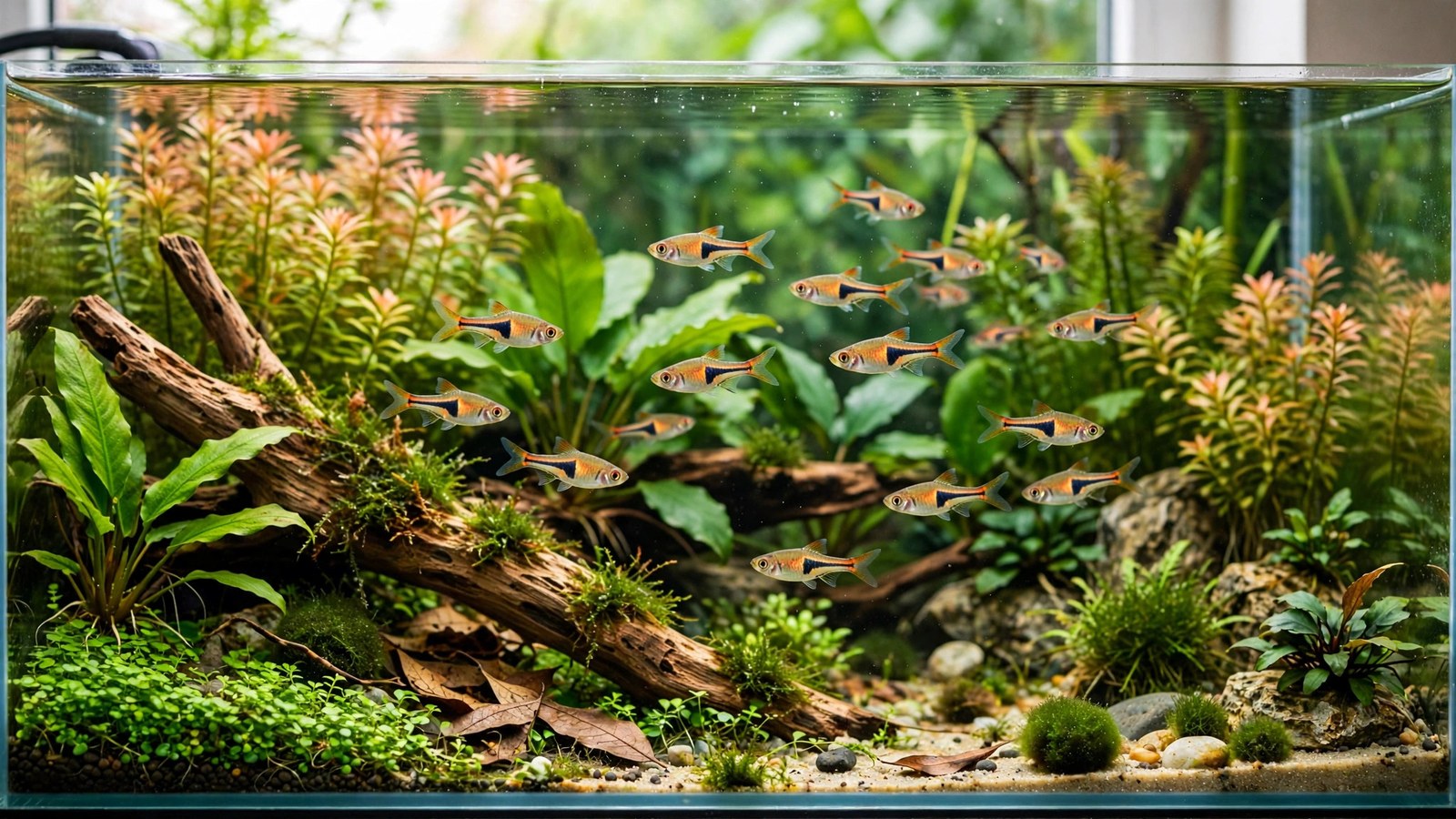
Most "harlequins" in shops are lambchop rasboras — and most tanks built for them get the species wrong. The fish sulk, their copper-orange fades to grey, and the owner concludes rasboras are boring. A proper lambchop rasbora planted tank for Trigonostigma espei — smaller, shyer, shade-loving — turns the same fish into a ribbon of living copper under dappled light. Here is how to build it.
Why Trigonostigma espei Is Not a Harlequin Rasbora
Check the flank marking: a narrow, lambchop-shaped copper wedge means Trigonostigma espei; a broad black triangle means T. heteromorpha, the true harlequin. Espei runs smaller, burns brighter, and spooks harder. Borrow harlequin advice and you get pale, hiding fish; build for espei and the school shows itself.
| Trait | Lambchop (T. espei) | Harlequin (T. heteromorpha) |
|---|---|---|
| Adult size | ~2.5 cm (1 inch) | ~4–5 cm (1.75 inches) |
| Color | Copper-orange, slender dark wedge | Pale orange-pink, broad black triangle |
| Temperament | Shy; retreats from bright open water | Bolder; tolerates bright tanks |
| Schooling | Tight, mid-water, needs 10+ | Loose, fine at 6–8 |
| Setup priority | Shade cover and calm water | Planting optional |
The Lambchop Rasbora Planted Tank Blueprint
Espei come from slow, tannin-tinted blackwater streams in Thailand and Cambodia, beneath overhanging vegetation. Recreate that mood and the school stops hiding; skip it and you own twelve flakes of grey.
Pick a 20-gallon long if you can — the footprint gives 12–15 fish the straight run they use for synchronized gliding. A 10-gallon fits 10–12. Lay 5–7 cm of dark aquasoil or fine dark gravel: the dark floor is not cosmetic. Fish look dramatically more saturated over it, and espei dart less than they do over bright sand.
Hardscape light but deliberate: two or three branching driftwood pieces forming one low canopy on one side, a few smooth river stones, and the center third left open as the school's runway. Plant the background with fine-leaved stems — Rotala rotundifolia, Limnophila sessiliflora, or Bacopa caroliniana — in clusters of 6–10, with Cryptocoryne wendtii or Anubias nana tucked around the wood. For plant picks chosen around a timid school's behavior, see our fish-first aquarium plant selection guide.
Shade Is the Whole Game: Floating-Plant Cover
If you build nothing else, build the ceiling. In the wild espei live under dense overhang; in your tank, floating plants are that overhang. Cover 30–40% of the surface so the light below is dappled, not a spotlight. Under partial shade the school tightens, color deepens, and the fish venture into the open middle instead of hugging the back glass.
Red root floaters (Phyllanthus fluitans) are the top pick: dangling roots shelter shy fish and the leaves filter light warmly. Frogbit and salvinia work just as well. Skip duckweed — it passes 40% coverage in days and smothers gas exchange. Corral floaters with an airline-tubing ring opposite the filter outflow so one surface lane stays open for feeding and oxygen.
For shade species that thrive in warm, soft, slightly acidic water, see our floating aquarium plants for beginners guide. This species suits a low-tech planted tank setup perfectly: no CO2 needed, which keeps chemistry stable and calm — exactly what shy fish want.
Light, Water, and the Two-Week Settle
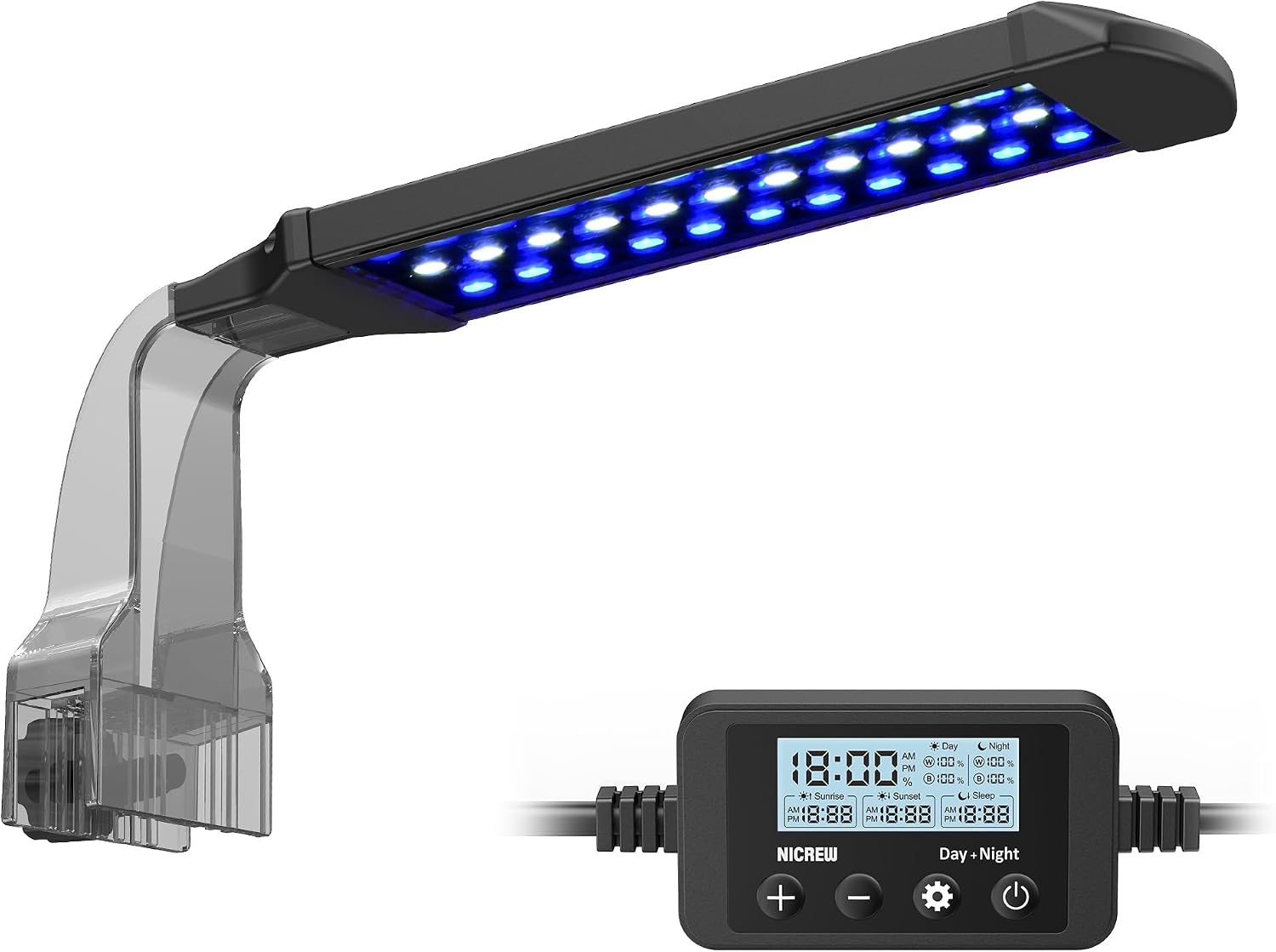
Run a dimmable LED at 15–30 PAR at the substrate, 6–8 hours daily. No dimmer? Raise the light 10–15 cm above the rim or cut the photoperiod to 6 hours. Target water: 73–82°F (76–78°F is the sweet spot), pH 5.5–6.8, GH 3–8 dGH. Alkaline tap? Mix 1:1 with RO water or run catappa leaves in the filter.
Cycle the tank a full 2–3 weeks before fish arrive, and add the whole school at once — introducing 5 now and 7 later splits the hierarchy and stresses both groups. Species parameters are documented on Seriously Fish's Trigonostigma espei profile, and Tropica's red root floater entry covers our top shade pick.
 ★4.6
NICREW ClassicLED Plus planted aquarium light
Check Price on Amazon ★4.6Stocking: One Species, Done Right
A lone-species school of 12 lambchops in a 20-gallon long outshines any "community" version: a full school behaves as one — synchronized, calm, displaying. Split the same bioload across four species and you get four anxious groups of three.
| Tank size | Ideal espei school | Compatible tank mates |
|---|---|---|
| 10 gallon | 10–12 | Cherry shrimp, nerite snails |
| 20 long | 12–15 | Pygmy corydoras (6+), ember tetras |
| 29+ gallon | 15–20 | Honey gourami (1 pair), otocinclus (6+) |
Tank mates should be small, peaceful, and soft-water tolerant — nothing that outcompetes at feeding time. More small-tank ideas live in our nano planted tank ideas collection, and the best schooling fish for planted tanks lists companions that school as beautifully as espei do.
Feeding a 2.5 cm Fish
Match the food to the mouth: micro pellets (0.5–1 mm), crushed flake, frozen daphnia or baby brine shrimp — amounts finished in 90 seconds, twice daily. Feed under the floater-free lane; food drifting into the roots means you overfed. One frozen-food day and one fast day per week keeps digestion clean, and live baby brine shrimp twice a week deepens the copper within a fortnight.
The Weekly Routine (20 Minutes)
Change 25% of the water weekly with temperature-matched, dechlorinated water, and thin floaters back to 30–40% every 7–10 days — a mat at 70% crashes light levels below. Trim stems at the surface, wipe the front glass, test pH and nitrates monthly. Nitrates past 20 ppm? Feed less or change more, in that order. Quarantine new stock 2 weeks in a dim tank with floaters first.
Frequently Asked Questions
How many lambchop rasboras should I keep?
Keep 10–15 as a single-species school, never fewer than 8. Espei school tighter than harlequins, and small groups fragment — the fish scatter, hide, and lose color. In a 10-gallon, 10–12 is the comfortable maximum; a 20-gallon long carries 12–15. Introduce the whole school at once.
Why did my lambchop rasboras lose their orange color?
Faded copper almost always means too much light and too little cover — a stress response. Check floaters cover 30–40% of the surface, light runs at 15–30 PAR, and the substrate is dark. Fix the shade and color returns within 7–10 days. If not, test water: ammonia above 0 or pH outside 5.5–6.8 bleaches them just as fast.
Can lambchop rasboras live with a betta?
We do not recommend it: bettas may harass a fast-moving school, and the activity mismatch rarely ends well even in a planted 20-gallon long. A species-only school, or shrimp and snail companions, will always show off your lambchops better than a risky betta pairing.
Do lambchop rasboras need CO2 or high light?
No — high light actively works against them. This is a low-tech setup: dimmable light at 15–30 PAR, no CO2, undemanding plants like anubias, crypts, bacopa, and floaters. Skipping CO2 keeps pH stable and water calm, which shy schoolers prefer. Spend the savings on a larger school and quality frozen foods.
How do I tell lambchops from harlequins at the shop?
Look at the flank marking: the lambchop's is a narrow, slanted copper-edged wedge; the harlequin's is a broad black triangle covering much of the rear body. Espei are noticeably smaller — about 2.5 cm versus 4–5 cm — and run copper-orange rather than pinkish. Shop tanks are frequently mislabeled, so check the fish, not the tag.
Bring the Copper Home
This tank asks less of you than almost any showpiece setup — no CO2, no high light, no demanding stems. What it asks is respect for the species: real shade overhead, a dark floor, one generous school, and two patient weeks before you judge them. Within a month you will have a ribbon of copper-orange crossing your tank every few minutes — the best argument for building around the fish, not the furniture.