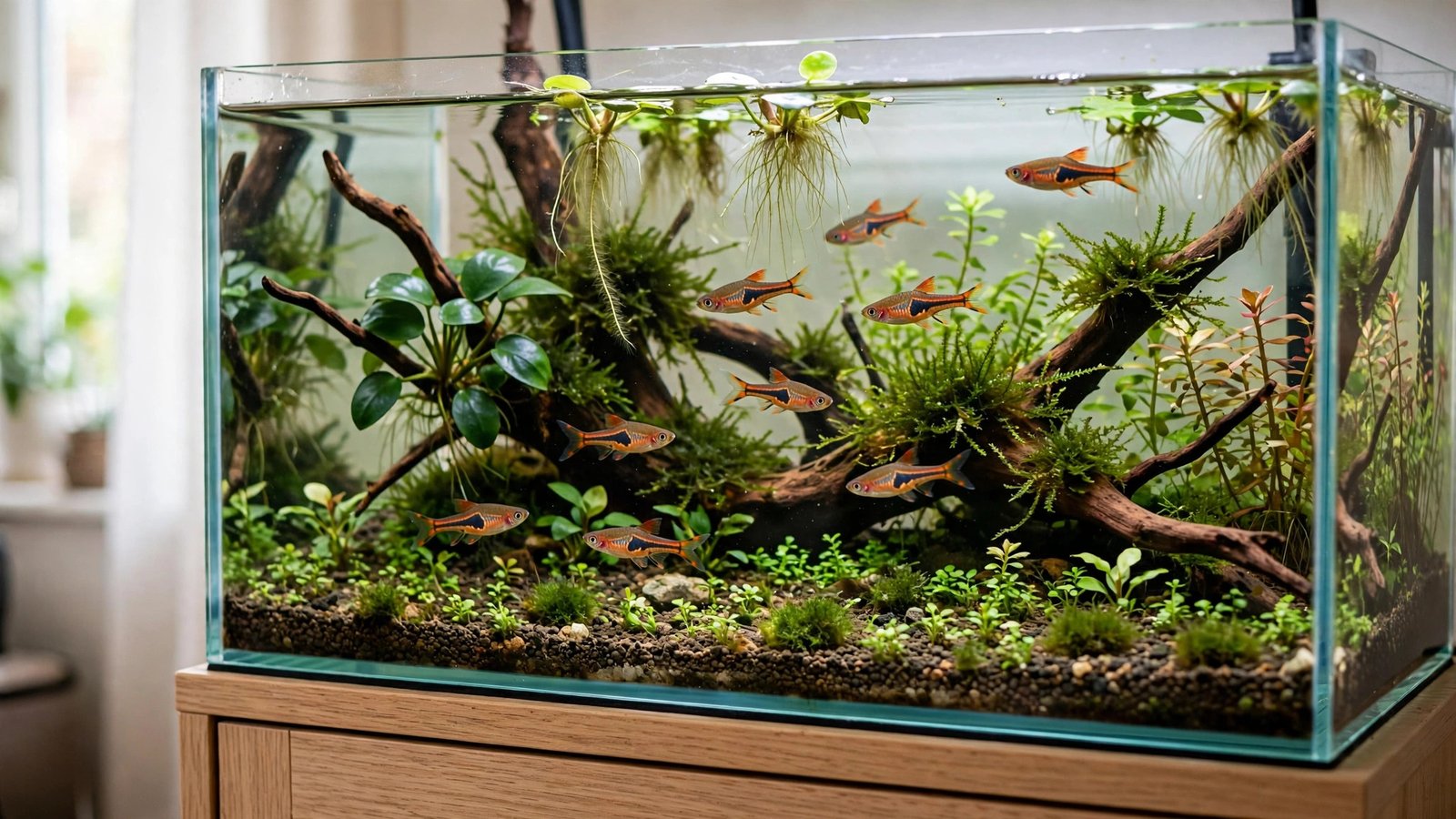
Picture a ten-gallon cube of dark water under warm light, moss tangled on twisted wood, and a flickering red comet-trail of tiny fish weaving through the leaves — that's the magic of a chili rasbora planted tank done right. Boraras brigittae is barely two centimeters long, but a healthy school turns even a modest nano aquarium into one of the most alive-looking setups in the hobby. This guide covers tank size, aquascape plant choices, water chemistry, schooling numbers, feeding pinhead-size mouths, and the handful of nano tank mates that genuinely work.
The roundup of the best schooling fish for planted tanks ranks chili rasboras among the top nano options — this article turns that pick into a complete build plan. Browse the nano planted tank ideas collection for layout inspiration before buying hardware.
How to Build a Chili Rasbora Planted Tank
Five gallons can hold chili rasboras, but you won't see the tight, confident schooling that makes them famous — in a 5-gallon the fish scatter and hide. A 10-gallon (roughly 50×30×30 cm) gives a school of 12 enough run length to move as a unit, and stays cheap and simple as a low-tech planted tank setup. A 12-gallon long (60×30×30 cm) is the luxury option: more swim space and a wider aquascape canvas.
Equipment is modest. A gentle hang-on-back or small canister filter on low flow suits blackwater fish better than a powerhead — chilis come from still forest pools in Indonesian Borneo, and current stresses them. Pick a dimmable LED at roughly 20–30 lumens per liter; brighter light bleaches their color and feeds algae. An adjustable heater holds 25°C (77°F) year-round, since nano tanks swing temperature fast overnight. Add a tight lid — chili rasboras fit through surprising gaps.
Water Parameters: Soft, Warm, and Stable
A chili rasbora planted tank lives or dies on chemistry. Wild fish come from peat-stained forest streams with almost no minerals; captive-bred stock is more forgiving, but soft, slightly acidic water is where reds deepen to true chili color.
| Parameter | Target | Notes |
|---|---|---|
| Temperature | 24–27°C (75–80°F) | Stability matters more than the number |
| pH | 5.5–7.0 | Tannins help hold it low |
| GH | 1–6 dGH | Soft water = better color |
| KH | 0–3 dKH | Keeps acidic pH stable |
| Ammonia / nitrite | 0 ppm | Non-negotiable |
| Nitrate | <20 ppm | Plants + weekly 25–30% changes |
Start with RO water remineralized lightly, or blend RO with tap until GH sits under 6 dGH. Indian almond leaves, alder cones, or peat in the filter add tannins and gently acidify — the full routine is in planted tank water parameters. Cycle 4–6 weeks with plants and an ammonia source before the fish go in; chilis aren't "cycle hardy" and die within days in an immature tank.
Aquascape Plant Choices for Chili Rasboras
Chilis evolved in heavily vegetated water, and a bare tank keeps them permanently nervous. The formula: dense fine-leafed cover at back and sides, shaded hardscape midground, and a clear open lane in front where the school cruises.
Background: stems and height
Rotala rotundifolia, Rotala 'H'ra', and Limnophila sessiliflora make the jungle backdrop chilis dart into when startled. Plant stems in thick clusters of 10–15, not single rows — a wall of stems reads as safety to small fish.
Midground: moss-dressed hardscape
One or two pieces of spider wood wrapped in Java moss or Christmas moss become the centerpiece and a grazing buffet — microfauna colonize it within weeks. Glue Anubias nana 'Petite' and Bucephalandra to the wood for contrast.
Foreground and floaters
Keep the foreground low and open: Cryptocoryne parva, Marsilea hirsuta, or a clean sand path. The most important "plant" may be the floaters — Salvinia, frogbit, or red root floaters covering 40–60% of the surface. Dim, dappled light is what makes chilis swim in the open, and floaters are the cheapest dimmer you can buy. Dark aqua soil or fine dark sand shows off red fish best; aquasoil also buffers pH down, a bonus here.
Schooling Numbers and Tank Mates
Buy 10–15 chili rasboras; 8 is the floor, and the difference between 8 and 14 is night and day. The red-ribbon effect appears above a dozen. In a 10-gallon species tank, 12–15 chilis plus a cleanup crew is complete stocking.
Tank mates are a short, strict list — anything that fits a 2 cm fish in its mouth is a predator. Safe: cherry shrimp and Neocaridina colonies (a moss-rich setup feeds both), Otocinclus, kuhli loaches (same soft-water needs), pygmy Corydoras (habrosus, hastatus), and small snails. Other nano schooling fish like the ember tetra work in 15+ gallons where two schools have room.
Think twice before adding larger tetras: a planted neon tetra tank needs more swim room, and even peaceful mid-size fish can intimidate chilis into hiding. The planted rasbora tank setup guide covers mixed-species layouts.
Feeding Tiny Mouths
A chili rasbora's mouth is pinhead-sized — standard flakes and 1 mm pellets are inedible. Staple diet: micro pellets crushed between your fingers, powdered fry food, crushed flake dust. Feed tiny pinches 2–3 times daily, only what vanishes in 60–90 seconds. Uneaten powder rots fast and spikes ammonia, so underfeed slightly every time.
Twice weekly, substitute a live or frozen treat: newly hatched baby brine shrimp (the gold standard), microworms, or thawed frozen daphnia/cyclops. Live foods deepen reds noticeably within weeks and condition fish for breeding. That's the whole program — crushed dry food plus treats 2–3 times a week.
Weekly Maintenance
Change 25–30% weekly with temperature-matched, dechlorinated water of the same softness — careless changes cause the swings that stress chilis most. Test monthly (weekly under six months old). Trim stems every 2–3 weeks to keep the back wall dense without choking the swim lane; thin floaters weekly before they block too much light. Rinse filter media monthly in old tank water, never tap water. Root tabs under crypts every 2–3 months and half-dose liquid fertilizer weekly if new growth pales.
Frequently Asked Questions
Can chili rasboras live in a 5-gallon planted tank?
Yes, but it's a compromise: 8–10 fish fit bioload-wise, yet the short swim length means they scatter instead of schooling tightly. Keep the layout extra dense and water pristine. A 10-gallon transforms how the school behaves.
How many chili rasboras for a 10-gallon tank?
Twelve to fifteen is the sweet spot. Eight is the minimum for security, but confident schooling appears above a dozen. Add a shrimp/snail crew and stop — the tank is fully stocked, and overstocking a nano causes swings small fish can't tolerate.
Do chili rasboras need CO₂?
No. Mosses, Anubias, Bucephalandra, crypts, and floaters all thrive without injected CO₂. A low-tech setup with moderate light and liquid fertilizer grows everything this aquascape needs.
Why are my chili rasboras pale?
Usually hard alkaline water, too-bright light without floater shade, too small a school, or a flakes-only diet. Fix chemistry first, dim with floaters, feed live/frozen foods twice weekly, and give them two to three weeks to color up.
Will chili rasboras eat cherry shrimp babies?
They'll pick off newborn shrimplets opportunistically, but moss-dense cover keeps plenty hidden and colonies grow anyway. Adults are completely safe. Extra moss and cholla wood double as a shrimp nursery.
Your Red Ribbon Awaits
A chili rasbora planted tank rewards patience more than money: soft water, dim dappled light, jungle-dense planting, a school of a dozen-plus, and food small enough for a pinhead mouth. Get those five right and you own one of the most striking nano displays in the hobby. Plant it, cycle it, let the school settle — the color comes to those who wait.
Species reference: Boraras brigittae profile at Seriously Fish. Plant data: Tropica's plant database.