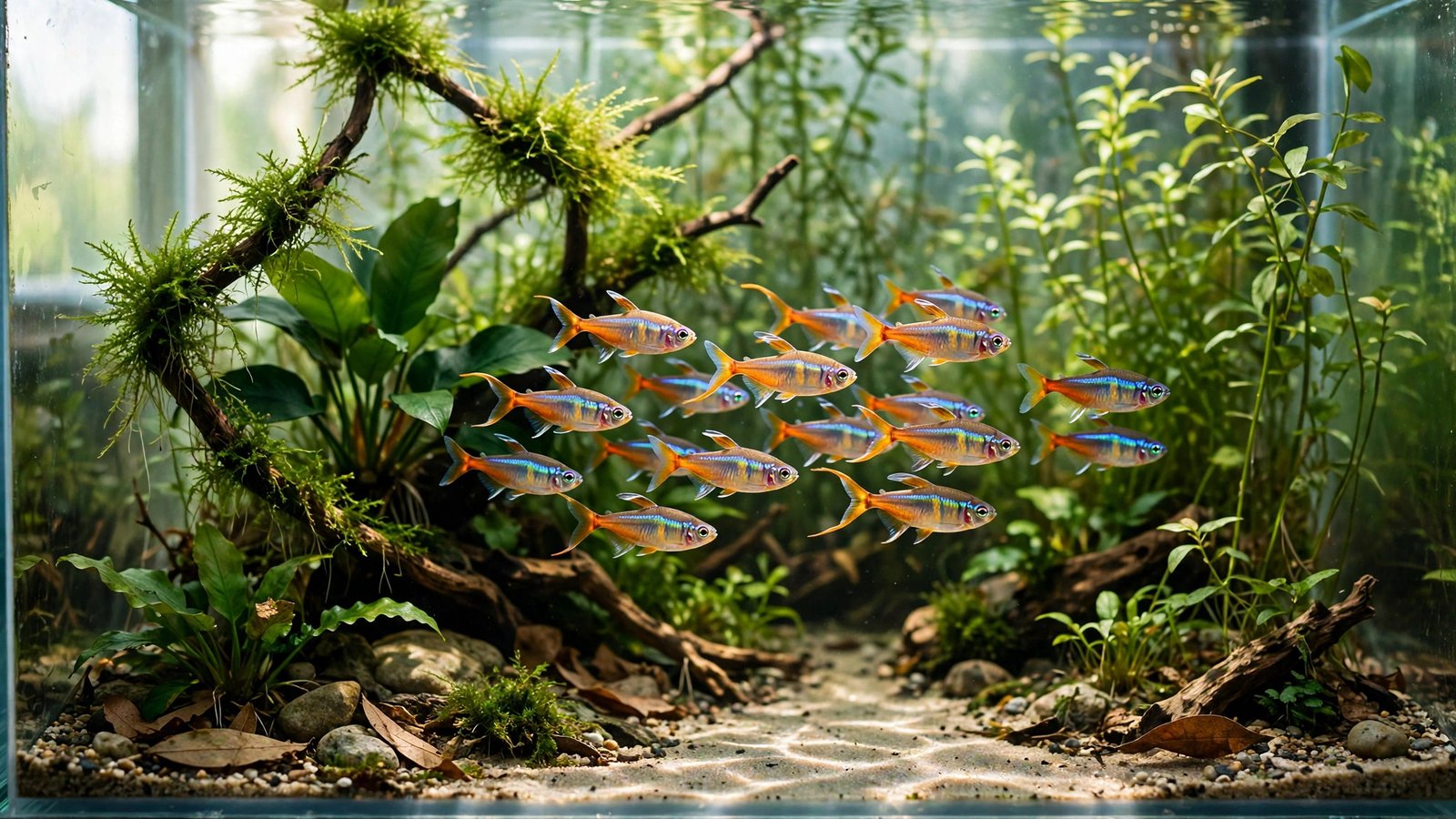
You've seen the photos: a river of gold and turquoise cutting through tall green stems, the school turning in unison. That isn't a camera trick. Building a congo tetra planted tank is how you unlock the colors these fish hide in a bare pet-store display — one of the most rewarding mid-sized schooling setups you can keep.
The Congo tetra (Phenacogramma interruptus) is no neon tetra. Adults reach about 3 inches, with males carrying flowing white-edged fins and a gold-to-teal gradient body. But they are active, open-water swimmers, and that changes how you plan the tank: length beats height, group size drives color, and your plant layout needs display corridors, not a solid wall of green. If smaller tetras appeal instead, the ember tetra planted tank is a gentler option — but nothing glows quite like a Congo school in a planted layout.
Designing a congo tetra planted tank around their swimming style
Most schooling fish hover and dart. Congo tetras cruise. The school works the middle and upper water column in long, looping patrols, and a short, deep tank frustrates that instinct. Give them a 4-foot run and they stretch out, synchronize, and spend the day showing off to each other.
| Parameter | Target | Why it matters |
|---|---|---|
| Tank footprint | ≥ 36 × 12 in (40 gal breeder) or 48 in (55 gal) | Long swimming lanes for a school of active 3-inch fish |
| Water height | 16–21 in | Tall background plants need the depth; fish use the middle |
| Filtration | Canister or large HOB, 4–6× turnover/hour | Gentle flow plus oxygen for an energetic school |
| Temperature | 24–26 °C (75–79 °F) | Mid-range stability; they hate sudden swings |
| pH / hardness | pH 6.2–7.2, soft to moderately hard | Wild fish come from softer water; bred stock is adaptable |
| Lighting | Medium intensity, 6–8 hours/day | Grows stems without blasting a fish that prefers dappled light |
Cycle the tank fully first, then add the school all at once — Congo tetras settle far faster introduced as a complete group of 8–10. Match source water parameters and dim the lights for the first few hours so they explore rather than huddle.
Tall Background Plants That Build Display Corridors
The mistake most people make is planting a full, even back wall. Congo tetras look best with corridors: clusters of tall plants broken by 6–8 inch gaps of open water where the school threads through like a ribbon. Vallisneria (jungle val especially) is the classic pick — its long leaves reach the surface and sway in the flow. Rotala and cabomba add fine texture, and a bundle of easiest aquarium plants for a beginner community tank can fill the rear corners while you're getting started.
Keep the planting behind the school's lane: anubias on driftwood midground, low carpet or open foreground so the patrol lane stays clear. That's what the fish-first guide to aquarium plants for fish tanks recommends — plants chosen for the fish's behavior first.
School Size and Sex Ratios: The Color Engine
Congo tetras are honest fish: their color tells you exactly how secure they feel. Six is the workable minimum, but 8–10 is the sweet spot where confidence — and iridescence — fully switches on. Below five, they skulk among the plants and stay silver. Above ten in a 55-gallon, they turn in synchronized flashes that fill the tank. The Aquarium Wiki's Congo tetra profile agrees: they need a laterally spacious tank and a shoal of five or more to behave naturally.
Sex ratio matters more here than with most tetras. Males are the show fish: larger fins, deeper gold, brighter eyes. Keep at least two or three males per group — their harmless posturing and fin-flaring at each other keeps everyone's colors pinned at maximum. Females run plainer, which is fine; they anchor the school's calmer center.
Feeding for Maximum Color
Color in Congo tetras is diet-driven. Feed variety: a quality micro-pellet or small flake as the staple, plus frozen daphnia, brine shrimp, and the occasional bloodworm. The carotenoids in brine shrimp and daphnia visibly deepen the gold flank within a few weeks — the most reliable color booster you own.
Feed small amounts twice daily and watch the surface — Congo tetras snatch food from just under the surface film. A second daily feeding of frozen food keeps the males' energy high. Fast the tank one day a week for a digestive rest and lower nitrates.
Community Tankmates and Tank Chemistry
Congo tetras are peaceful and make excellent community fish, which is why they anchor so many planted community tank setups. Good companions: bottom dwellers like the pygmy cory planted tank crew, calm centerpieces like the honey gourami in a planted tank, and other mid-water schoolers — the chili rasbora planted tank and celestial pearl danio planted tank combos work, as does the planted cherry barb tank setup. Avoid hyperactive feeders that muscle them off the surface.
Water chemistry is forgiving: pH 6.0–7.5, soft to moderately hard, and a steady 24–26 °C. Stability beats perfection — a steady pH of 7.4 beats a chasing-7.0 rollercoaster. With aquasoil, add the school only after ammonia and nitrite read zero. Weekly 25–30% water changes keep nitrate below 20 ppm. If you're comparing schooling options, the best schooling fish for planted tanks roundup puts Congo tetras among the top mid-size choices — FishLore's Congo tetra care guide sets the same minimum: 30 gallons with a school of at least six to eight.
Weekly Care Rhythm
Once cycled and stocked, this is a low-maintenance setup. Trim background stems every two to three weeks so the display corridors stay open. Wipe the front glass weekly — algae on the front panel kills the flash effect. Test water monthly after the first two months; weekly 25% changes handle the rest.
Frequently Asked Questions
How many Congo tetras should I keep in a planted tank?
Keep 8–10 as the ideal school, never fewer than six. Their color and confidence scale directly with group size — small groups turn shy, hide, and lose their gold within days. Introduce the whole school at once after cycling for the strongest group bond and fastest settling.
What tank size do Congo tetras need?
A 30–40 gallon tank is the practical minimum; a 55-gallon (4-foot) tank is ideal. Footprint matters far more than height for these active open-water swimmers — a long tank lets the school patrol and display instead of pacing the glass.
Why did my Congo tetras lose their color?
The three usual culprits: a too-small school (under six), a light-colored substrate and background, and a diet without carotenoid-rich frozen foods. Fix all three: build the school to 8–10, go dark on substrate and background, and feed frozen brine shrimp or daphnia two to three times weekly.
Are Congo tetras good community fish?
Yes — they are peaceful and mix well with most calm community species, including gouramis, corydoras, rasboras, and cherry barbs. Avoid hyperactive feeders that muscle them off the surface at mealtimes, and skip fin-nippers and aggressive cichlids, which stress them badly.
Do Congo tetras need special water parameters?
No — they adapt to pH 6.0–7.5 and soft to moderately hard water at 23–27 °C, and captive-bred stock is even more flexible. What matters is stability: steady parameters and zero ammonia and nitrite beat "perfect" numbers that fluctuate, so cycle fully and keep up weekly water changes.
The Flashy School Is a Formula, Not Luck
A congo tetra planted tank rewards you in direct proportion to how well you honor the species' instincts: long tank, big school, dark stage, tall-plant corridors, and color-building food. Nail all five and you get the living river of gold and turquoise from those photos — every single day.