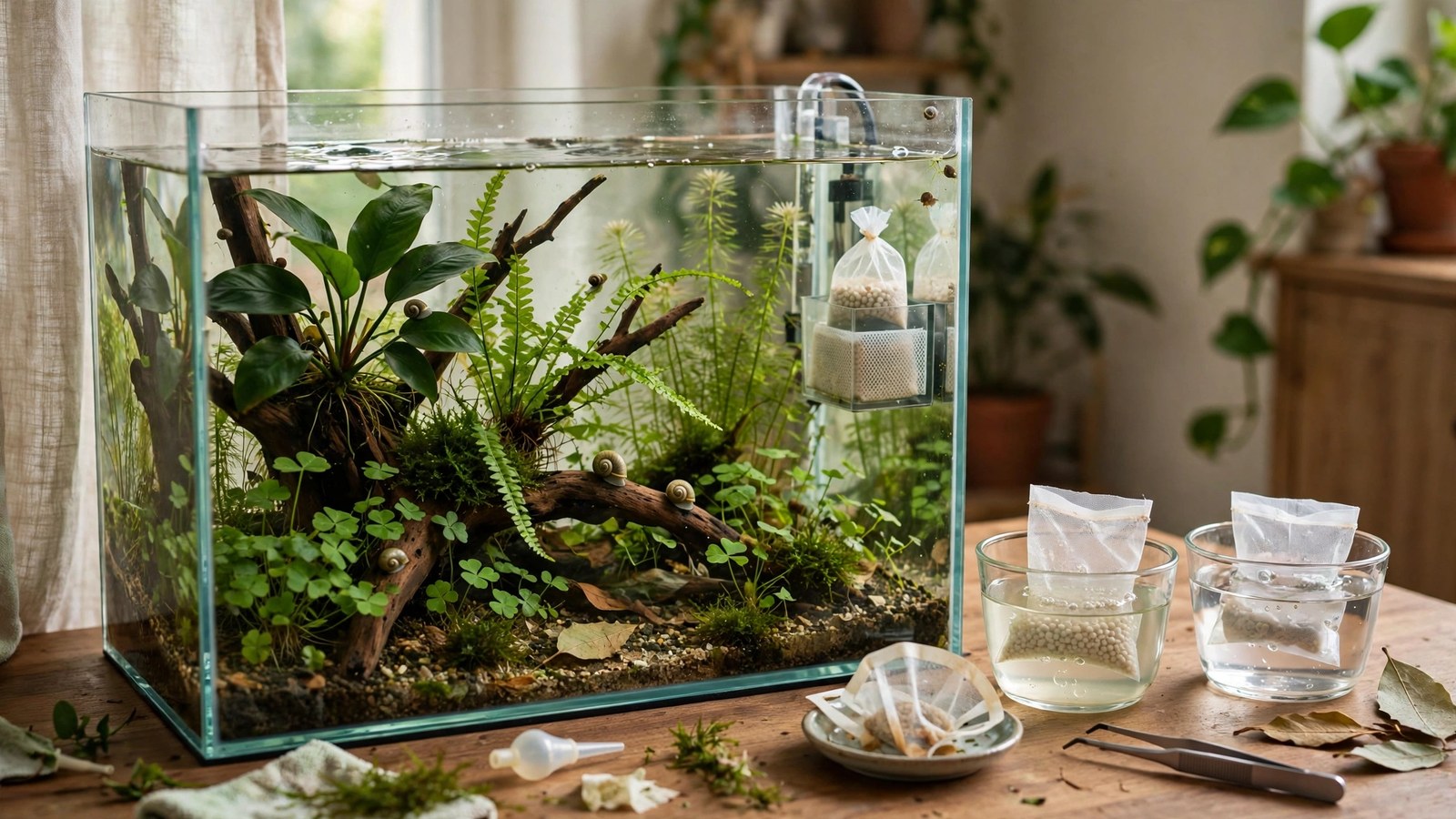
Within days of adding Seachem Purigen to a tank, water that looked "fine" turns invisible — driftwood tea gone, haziness gone, colors popping. That clarity makes a purigen planted tank setup a classic aquascaper upgrade — but it comes with planted-tank caveats the label doesn't spell out. This guide covers filter placement, dosing, safe bleach-recharging, and when to leave it out.
What Purigen Is — and Why It Isn't Filter Floss
Purigen is a synthetic macro-porous polymer resin that adsorbs dissolved organic waste — the soluble stuff that yellows or hazes water: tannins from driftwood, decaying plant matter, protein and nitrogenous waste. Because it targets dissolved compounds, it does a job no amount of filter floss can do. Floss is mechanical: it strains visible particles and gets thrown away when clogged. Purigen is chemical: it pulls invisible organics out of solution, darkens as it loads up, and gets bleach-regenerated instead of replaced.
That distinction drives a different buying decision: yellow tint from driftwood or persistent haze is Purigen territory; polishing visible particles before a photo is floss's job. Most planted tanks benefit from both. New to planted setups? Start with our Freshwater Aquarium Plants: The Complete Guide, and read our Best Aquasoil for Planted Tanks deep-dive if you're running active soil — Purigen interacts with the aquasoil ammonia window (more below).
| Feature | Seachem Purigen | Filter floss | Activated carbon |
|---|---|---|---|
| Filtration type | Chemical (adsorption) | Mechanical (trapping) | Chemical (adsorption) |
| Removes | Dissolved organics, tannins, nitrogenous waste | Visible particles, detritus | Odors, discoloration, some chemicals |
| Tannin removal | Excellent | None | Moderate |
| Reusable | Yes — bleach regeneration | No — disposable | No — must be replaced |
| Lifespan | Up to ~6 months per cycle | Days to weeks | 2–4 weeks |
| Trace-element impact | Minimal | None | Some removal of micros |
Purigen Planted Tank Placement & Dosing
Getting placement right is half the battle. Purigen belongs downstream of mechanical filtration — after floss or foam — where the water hitting it is already particle-free. In a canister filter, put the bag in the top tray above your sponges; in an HOB filter, drop it behind the sponge or pad. Never bury it under coarse media where debris clogs the bag — dirty Purigen is just blocked resin.
Dosing is simple: 100 ml per 100 US gallons (~400 L), up to about 6 months of service. One 100 ml bag is plenty for any tank under ~55 gallons; grab the 250 ml size for larger or heavily stocked setups. Rinse new Purigen in tap water first to clear bead dust, and always contain it in a bag finer than the beads: Seachem's own "The Bag" pouch (chlorine-resistant, handy at recharge time) or any fine-mesh media bag. Loose beads in a filter can migrate straight into your impeller.
When Purigen Helps — and When to Skip It
Purigen earns its keep in three scenarios. Tannin control: new driftwood (especially mopani and other tannin-heavy pieces) can stain a tank tea-brown for weeks; Purigen clears the color in days without harming tannin-loving plants. See our Driftwood Tannins Guide for when tannins help versus when to remove them. Post-rescape haze: after replanting, trimming or substrate work, it clears dissolved gunk faster than water changes alone. Display tanks: contest and photography setups where water should look like air.
But there are times to leave it out. Skip Purigen during the first 4–6 weeks of a new aquasoil tank — fresh aquasoil leaches ammonia, and you want that spike feeding the bacteria establishing your cycle (see our faster cycling guide and the first-month guide). In a deliberate blackwater style it also works directly against your aesthetic. And if you dose lean and notice deficiencies, remove the bag for two weeks and watch your water parameters — a Purigen-related limit would reverse quickly, confirming the cause.
How to Recharge Purigen Safely
Regeneration is Purigen's superpower — but bleach near an aquarium demands respect. Follow Seachem's official regeneration instructions, and read their bleach-type FAQ before buying the bleach — the chemistry is concentration-specific.
- Recognize exhaustion: cream beads turning deep brown to black means the resin is loaded. Pull the bag from the filter.
- Bleach soak: 24 hours in a 1:1 bleach:water solution in a non-metallic container, in a ventilated area. Use regular 8.25% hypochlorite household bleach — unscented, no dyes, no splash-less formulas.
- Rinse: rinse well under running water until no bleach odor remains.
- Dechlorinator soak: 8 hours in a strong dechlorinator — Seachem specifies 4 tablespoons of Prime (or 16 g of Safe) per cup of water. Rinse again.
- Freshwater finish: soak 4 hours with 2 tablespoons of buffer per cup of water. Beads should return to their original cream color.
- Sniff test: any detectable bleach odor means repeat the dechlorinator soak — never return smelly Purigen to the tank. When in doubt, test the soak water with a chlorine test kit.
Two notes straight from Seachem: amine-based slime-coat products can permanently foul Purigen (Prime and Safe are fine — know your conditioner before recharging), and after many cycles the beads stop returning to full cream; that's normal wear. Fold the schedule into your planted tank maintenance schedule. One reassurance: Purigen does not remove your beneficial bacteria — they live on surfaces, not in the water — so regenerating never restarts your cycle.
Frequently Asked Questions
Is Purigen safe for shrimp and sensitive fish?
Yes, when properly rinsed or recharged. Fresh Purigen is inert and widely used in shrimp and nano tanks. The only real risk is a sloppy recharge — bleach residue kills invertebrates fast. Shrimp keepers should never skip the sniff test and a chlorine test-kit check before returning recharged media to the filter.
Will Purigen starve my plants by removing fertilizers?
Not meaningfully. Purigen targets nitrogenous organics, not chelated iron or potassium, and Seachem documents minimal trace-element impact — it doesn't reduce GH either. Standard all-in-one dosing at conservative rates won't be thrown off. Lean-dosers should just watch for deficiency signs after adding it.
How long does Purigen last before it needs recharging?
Up to about 6 months per 100 ml per 100 gallons — bioload and tannins decide reality. Heavy driftwood or messy fish can darken a bag in 4–8 weeks; a lightly stocked aquascape might go the full half year. The beads are their own gauge: cream means active, deep brown means exhausted.
Can I recharge Purigen more than once?
Yes — repeatedly. Most hobbyists get many cycles from one bag before performance drops. Retire it when the beads no longer return to cream after a full bleach-and-dechlorinator cycle, or if amine-based slime-coat products have fouled it, which can make regeneration unreliable.
Purigen or activated carbon for a planted tank?
Purigen wins for plant keepers: it lasts months instead of weeks, largely ignores trace elements, signals exhaustion by changing color, and regenerates instead of going in the trash. Carbon suits short-term jobs — like stripping medication residues — where you want cheap and disposable.
Purigen over-delivers on its marketing: a purigen planted tank gets water so clear it looks empty, and the bleach-recharge loop turns one bag into a multi-year investment. Just respect its limits — keep it out of cycling tanks and medication windows, recharge it carefully, and remember it's a dissolved-organic specialist, not a substitute for mechanical polishing. Pair it with filter floss up front and healthy plants behind it, and your tank will look like it's filled with air.