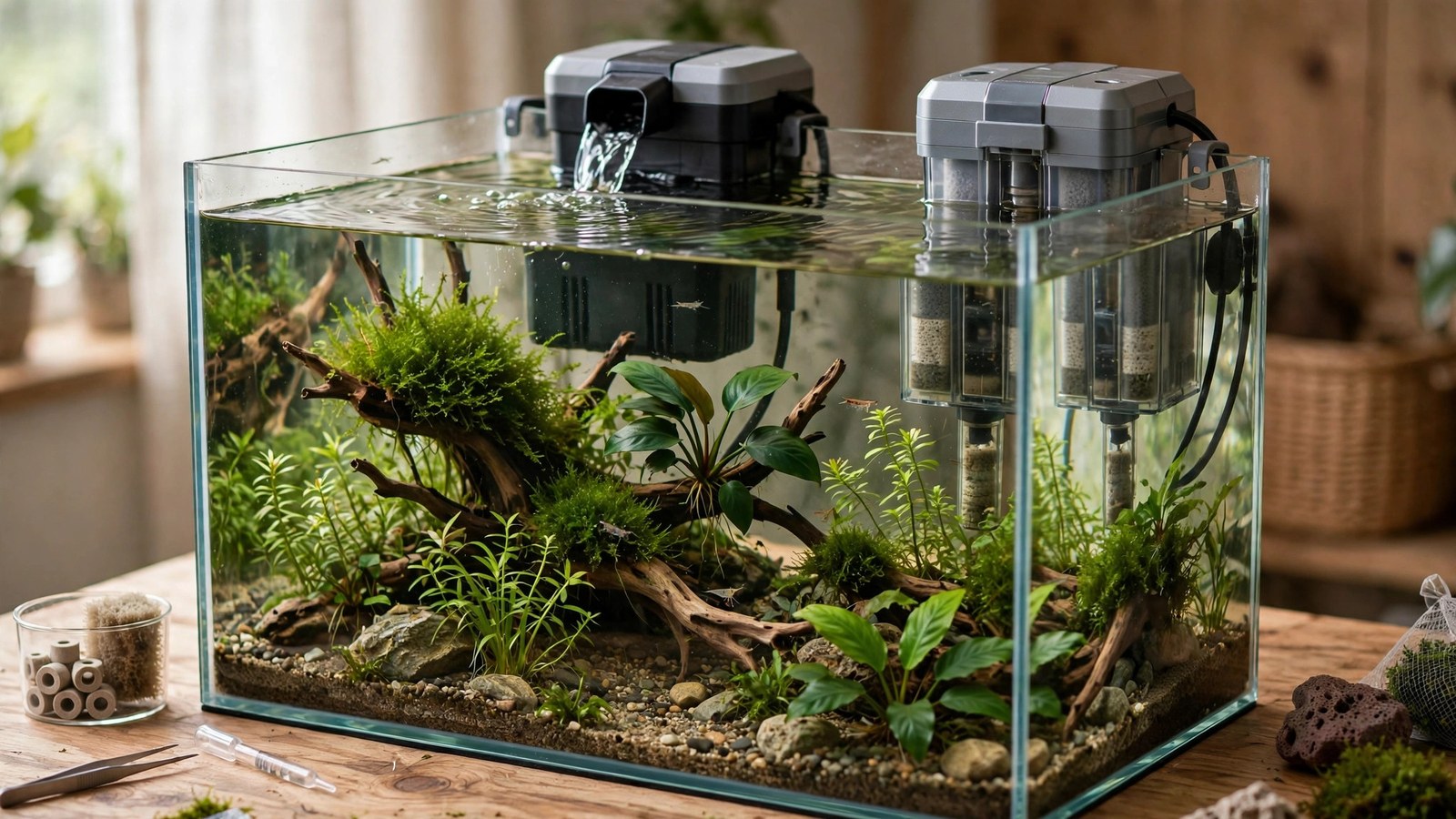
A hang on back filter planted tank combo is one of the most underrated pairings in the hobby — a $35 filter hanging off the back of your aquarium can keep your water crystal clear, your plants pearling, and your shrimp safe, as long as you set it up the planted way. Most people run their HOB exactly the way the box says and unknowingly strip their tank of CO₂, blast their stem plants sideways, and wonder why algae wins. In this guide, you'll learn which HOB to buy, how to set it up for plants instead of just fish, and the CO₂-saving tweaks that let you run injected CO₂ and a HOB on the same tank without conflict.
Why Hang-On-Back Filters Work Surprisingly Well in Planted Tanks
Planted aquariums are not fish tanks that happen to have plants — the plants ARE the filtration. A healthy carpet of Monte Carlo or a jungle of Amazon swords consumes ammonia, nitrate, and phosphate around the clock, so the filter's job narrows to gentle circulation, particulate polishing, and hosting beneficial bacteria as a safety net. You don't need fish-only filtration muscle, and this is where the humble hang-on-back filter shines.
HOBs earn their place for three practical reasons. First, media access is effortless: lift the lid, pull the basket out in ten seconds — no disconnecting hoses or buckets of siphoned water. Second, the intake-to-outflow path creates excellent full-tank circulation: water enters near the intake and returns across the surface, pushing a slow current the length of the tank. Third, they're affordable at $25–80, a third to a quarter of an equivalent canister — a real factor when you're budgeting for lights and substrate on a first planted tank shopping list.
HOBs are genuinely the best tool for nano tanks under 20 gallons, where canisters are overkill, and for low-tech planted tank setups, where the surface-agitation concern below mostly disappears.
The CO₂ Tradeoff You Need to Know
Here is the single most important thing about a hang on back filter planted tank pairing: a HOB's waterfall return churns the surface, and agitated surface water off-gasses dissolved CO₂. A waterfall dropping two inches into an injected tank can waste 30–50% of your CO₂ — you'll burn through cylinders faster, your drop checker will never stay green, and you'll bump your bubble rate higher chasing a level that keeps escaping into the room.
This is a tuning problem, not a reason to abandon the HOB. Gas exchange happens at the air–water interface, and only turbulence right at that interface strips CO₂. A smooth ripple barely touching the surface hardly dents your CO₂ level, while a plunging waterfall strips it aggressively. The difference is often just millimeters of water level — fill the tank until the waterline nearly touches the return lip, and the "waterfall" becomes a gentle glide.
Low-tech tanks without injected CO₂ flip this logic. Your plants get carbon from the water's natural CO₂ level, and surface agitation actually helps by keeping that stable while oxygenating the water for fish and shrimp. Not injecting? Let the HOB run free — the waterfall is a feature, not a bug, and you can skip the CO₂-saving tweaks further down.
HOB vs Canister Filter for Planted Tanks
Here's the honest breakdown for planted tanks:
| Hang-on-back filter | Canister filter | |
|---|---|---|
| Best for | Nano and low-tech tanks up to ~40 gal | High-tech tanks 40+ gal, scaped showpieces |
| Cost | $25–$80 | $150–$400+ |
| CO₂ retention | Poor unless tuned (surface waterfall) | Excellent (sealed, submerged return) |
| Maintenance | Minutes, no mess | 15–30 min with hoses and buckets |
| Media capacity | Small (1–2 cups) | Large (1+ gallons) |
| Surface skimming | Natural with waterfall return | Needs a skimmer add-on |
| Aquascape visibility | Box hangs on the back glass | Only a lily pipe shows in the tank |
| Noise | Trickling water, adjustable | Near-silent |
Choose the HOB when the tank is small, the budget is tight, the setup is low-tech, or you want the simplest maintenance in the hobby. Choose the canister for high light plus CO₂ on larger tanks, or when the aquascape is the centerpiece and you refuse to see equipment. Still planning the system? Our high-tech planted tank setup guide walks through the full equipment stack a CO₂-driven tank needs.
Right-Sizing Flow: How Much Filtration Your Tank Needs
Ignore the box. HOB packaging advertises 8–10x turnover per hour, rated for fish-only tanks — not for what's good for plants. Excess flow uproots stems, pins leaves flat, stresses shrimp, and strips CO₂. The planted-tank rule of thumb: 4–6x tank volume per hour of gentle, diffused flow for low-tech tanks, and 4–5x for CO₂-injected tanks where every bubble should linger. Adjustable-flow models are worth their weight in gold.
| Tank size | Recommended HOB picks | Why |
|---|---|---|
| 5–10 gal nano | AquaClear 20, Seachem Tidal 35 | Adjustable flow is critical at this size; both throttle to a whisper |
| 20 gal long/high | AquaClear 30 or 50, Tidal 55 | Run the 50 throttled back — headroom without the blast |
| 29–40 gal | Two AquaClear 30s or one Tidal 75 | Two smaller filters beat one big one: redundancy plus gentler, even flow |
| 55+ gal planted | Consider a canister instead | Large HOBs create visible clutter and hard-to-tame agitation |
The Seachem Tidal series stands out because its self-priming pump and adjustable flow control solve the two biggest HOB annoyances — re-priming after power outages and too much flow. AquaClear's lift-and-rinse media basket remains the easiest maintenance design ever made.
Setting Up a HOB for a Planted Tank, Step by Step
Hang the filter on one of the tank's short ends, not centered on the back. End-placement pushes a single slow gyre down the tank's length — water exits across the surface, sinks at the far end, and returns along the bottom to the intake. Centered placement creates two competing currents that meet in the middle, leaving dead spots in the front corners where detritus and algae film collect.
Set the intake strainer 2–3 inches above the substrate. Too low and it vacuums aquasoil granules and plant debris; too high and it misses the lower water column where detritus settles. On shrimp tanks, slide a coarse sponge prefilter over the strainer — this is non-negotiable. Newborn shrimp and fry can't fight the intake current, and a prefilter saves them while adding biological surface area. See the planted shrimp tank setup guide for the full livestock-proofing checklist.
Fill the tank until the waterline sits within half an inch of the return lip — this single step converts the waterfall from a CO₂-stripping cascade into a surface glide. Start the flow at roughly 60% of maximum, then watch the plants for a day: stems should sway gently, not bend. Run the filter continuously from day one so it seeds your cycle; the faster planted tank cycle method can colonize the media with bacteria in as little as two weeks.
Break it in quietly. A new HOB is loudest in its first 48 hours — the impeller seats in and biofilm dampens vibration. Check that the impeller shaft is straight and the intake tube firmly seated; a crooked impeller is the most common source of rattling.
CO₂-Saving Tweaks for Injected Tanks
On pressurized CO₂ tanks, these four adjustments together preserve most of your injected gas while keeping water quality high.
1. Kill the waterfall drop. Keep the waterline high. If evaporation lowers the level during the week, top up with treated water rather than tolerating a growing waterfall — a one-inch drop is a measurable CO₂ leak.
2. Baffle the outflow. Cut a plastic bottle into a curved ramp that clips over the return lip, sliding water into the tank instead of dropping it. A cleaner option: a prefilter sponge rubber-banded around the outflow lip, breaking the water sheet into a silent seep.
3. Let floaters buffer the outflow. A mat of floating plants (frogbit, red root floaters, salvinia) directly under the return absorbs its energy and spreads it sideways, while consuming nutrients that would otherwise feed algae. Corral them with a feeding ring so they don't shade your carpet plants.
4. Add a surface skimmer attachment. On baffled, low-turbulence outflows, an oily protein film can form and block gas exchange in an uncontrolled way. A tiny skimmer run a few hours a day clears the film without constant agitation — and doubles as backup circulation if the main filter ever fails.
Test tweaks with the drop checker, not by guesswork. After any flow or waterline change, run CO₂ on its normal schedule for two full days, then read the checker at the same point in the photoperiod. Pair your tuned filtration with strong lighting — the Chihiros aquarium lighting guide covers LED setups matched to CO₂-driven growth rates.
Media Setup for Planted Tanks
Planted-tank media strategy is simpler than the pet store suggests: two stages — mechanical and biological — with chemical media (activated carbon) out of the permanent lineup.
Bottom of the basket: coarse mechanical sponge. Catches leaves, debris, and food. Rinse it in old tank water monthly; never replace it until it's physically falling apart — this is where much of your bacteria live.
Middle of the basket: biological media. Ceramic rings, bio-balls, or sintered glass — any high-surface-area inert media works. Don't buy the premium "planted tank" bio-media; bacteria colonize a $10 bag of ceramic rings exactly as well. Fill this chamber fully so water is forced through it, not around it.
Top of the basket: loose filter floss. The polishing stage. Replace it weekly or when browned — floss is cheap and meant to be disposable.
Activated carbon: temporary use only. Carbon strips dissolved organics and medications — but also liquid fertilizers, iron, and beneficial tannins. Keep it for specific jobs (removing medication after treatment, clearing a tannin burst from new driftwood or fresh soil in a dirted tank setup) and run it for 48–72 hours, then remove it. Permanent carbon in a planted tank quietly starves your plants of trace nutrients.
Fixing HOB Noise in a Planted Tank
HOB noise comes from three sources, each with a planted-tank-friendly fix. Trickle noise disappears when you raise the waterline to the return lip — the same CO₂-saving adjustment. Rattling almost always means the impeller: unplug the filter, pull the impeller, wipe the shaft and magnet, and reseat it firmly. A grain of sand in the impeller well buzzes loud enough to be heard across the room.
Vibration hum travels through the tank rim — wedge a thin strip of foam between the filter body and the glass to decouple it. One caution: never throttle the filter on a timer overnight if you run CO₂, since flow changes shift CO₂ levels. On a low-tech tank like a nano planted tank, night throttling is harmless and makes the tank genuinely silent.
Frequently Asked Questions
Can I use a hang-on-back filter with injected CO₂?
Yes, with the right tweaks. Raise the waterline to eliminate the waterfall drop, baffle the outflow with a sponge or bottle ramp, and keep flow gentle at 4–5x tank volume per hour. The key is minimizing surface turbulence: calm water holds dissolved CO₂ while churning water drives it off.
How much flow does a planted tank actually need?
Aim for 4–6x the tank volume per hour for low-tech tanks and 4–5x for CO₂-injected setups. That's well below the 10x rating on most HOB boxes, which assumes fish-only tanks. Watch your plants as the real gauge: stems should sway gently, not bend flat, and debris should drift slowly toward the intake rather than settling in dead corners.
Do I need a surface skimmer with a HOB?
Not necessarily — the waterfall return naturally breaks up surface film. But on tanks with a baffled, low-turbulence outflow, an oily protein film can still form. A small skimmer add-on run a few hours daily clears it without constant agitation, and it doubles as backup circulation if your main filter ever fails.
Will my HOB intake suck up baby shrimp?
Without protection, yes — newborn shrimp and fry can't fight the intake current. A coarse sponge prefilter over the strainer solves this completely, adds biological filtration, and takes ten seconds to install. Rinse it in old tank water monthly so it doesn't clog and starve the filter of flow.
Should I remove the activated carbon from my new HOB?
For a planted tank, yes — remove it after the first week or two. Carbon strips liquid fertilizers, iron, and beneficial tannins from the water, working against your plants. Keep the cartridge for temporary jobs like removing medication after treatment, and otherwise run the basket with sponge, biological media, and floss.
How often should I clean a HOB on a planted tank?
Rinse the coarse sponge and prefilter monthly in old tank water, swap the filter floss weekly, and leave the biological media alone except for a gentle swish in tank water if visibly clogged. The basket lifts out in seconds, so a full service takes under ten minutes. Never rinse media in tap water — chlorine kills the beneficial bacteria you've spent weeks growing.
Your HOB, Tuned for Plants
A hang-on-back filter was designed for fish-only tanks, but with five adjustments — right-sized flow, water filled to the lip, a baffled outflow, a sponge prefilter, and carbon kept in the drawer — it becomes one of the most practical filters a planted-tank keeper can own. Set it up once, tune it for your CO₂, and get back to what matters: watching the plants grow.