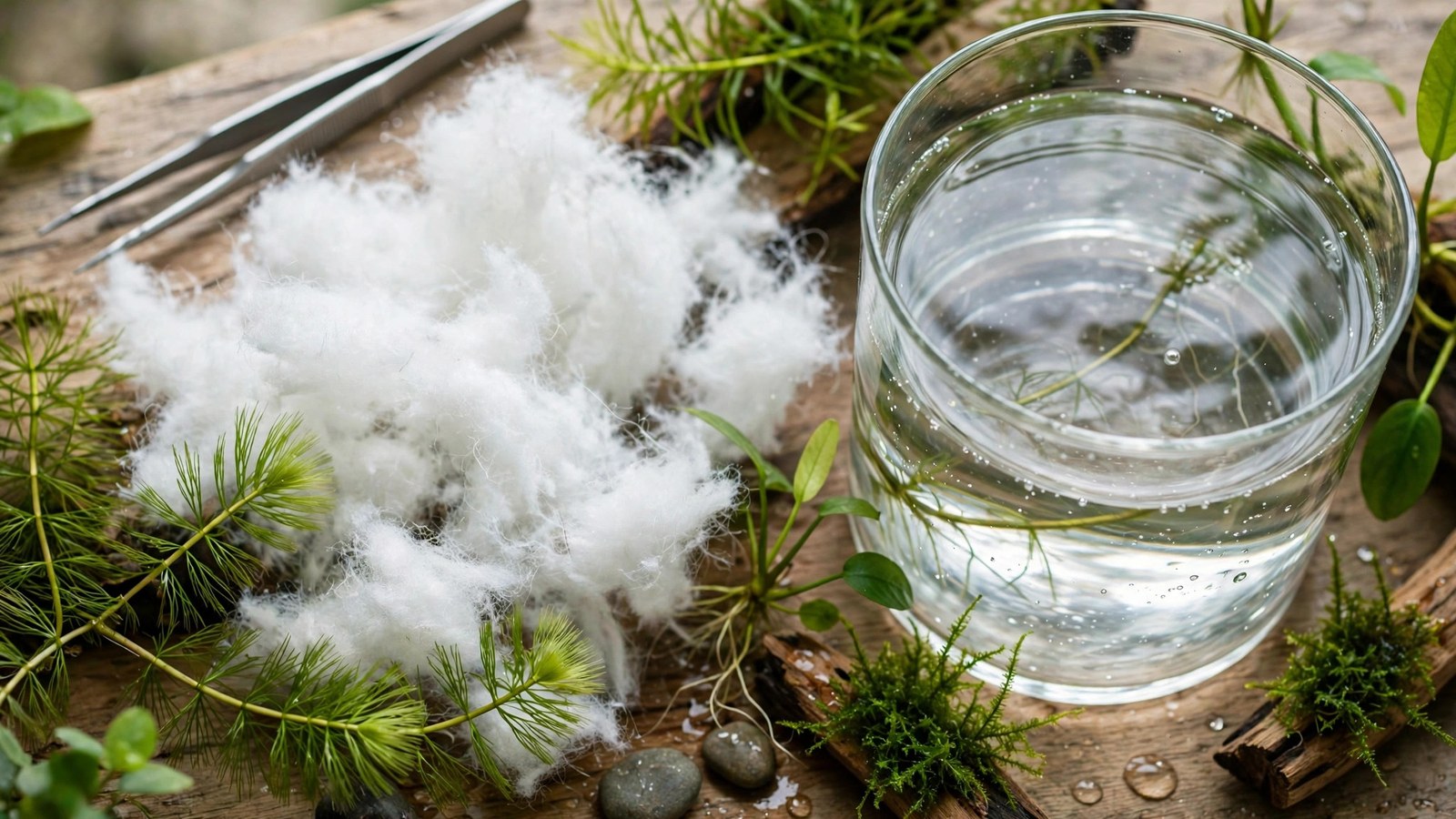
You know that faint milkiness that hangs in your tank no matter how clean the glass is? The culprit is usually particles smaller than a grain of sand, drifting straight through your filter. Using filter floss in your aquarium is the fastest fix: a $4 bag of polyester fiber can take a hazy tank to gin-clear in under 48 hours. This guide covers the three types of floss, exactly where to pack it in your media stack, how often to swap it, and how it compares to polishing pads — starting with how to stack filter media for crystal-clear water in a canister or HOB.
What Filter Floss Actually Does in an Aquarium
Mechanical filtration works in stages. Your coarse sponge catches the big stuff — uneaten food, plant trimmings, waste. But the fine particles that scatter light and cause haze — detritus dust, powdered fertilizer residue, mulm kicked up by trimming — pass straight through 20–30 PPI foam. That is where floss earns its place.
Filter floss is a web of ultra-fine polyester fibers. Water is forced through thousands of tiny, irregular passages, trapping particles down to roughly 100 microns. The effect is called water polishing: it removes the last visible fraction of suspended solids that foam and bio media cannot. In a planted tank the payoff is double — the water looks sharper, and more light reaches your carpet plants, since suspended particles scatter PAR like clouds dim sunlight. If your freshwater aquarium plants underperform despite good lighting, invisible turbidity is worth ruling out.
The catch: floss clogs fast. That same density means a small dirt capacity — once loaded, flow drops, water bypasses the layer, and polishing stops. Treat floss as a consumable, not permanent media.
The Three Types of Filter Floss for Aquarium Water Polishing
Fish shops sell floss in three forms — same principle, different convenience and price:
| Type | What it is | Capture size | Typical price | Replace every |
|---|---|---|---|---|
| Bulk polyfill (pillow stuffing) | Loose polyester fiber (unscented) | ~100 microns | $4–6 per 1 lb bag | 3–7 days |
| Bonded floss pads | Sheets of thermally bonded polyester, cut to size | ~100 microns | $8–12 for a 12-pack | 5–10 days |
| Water polishing pads | Ultra-dense pre-cut pads | ~50–100 microns | $9–18 per 3-pack | 7–14 days |
Bulk polyfill is the value king — one pound fills an average canister's floss chamber 15–20 times. The safety rule: buy plain, unscented, flame-retardant-free fiber only; "anti-microbial" or fragranced fiber can leach chemicals. Bonded pads suit HOBs with tight media slots, since you can cut them to an exact rectangle. Dedicated pads, like the Fluval FX water polishing pads, are the zero-fuss swap option for canister owners.
Dual-density pad: coarse top layer + polishing bottom layer, matches the guide's stack advice: dual-density filter floss like Aquatic Experts FilterFirst.
Filter Floss Aquarium Placement: Building the Polishing Stack
Media order is not a suggestion — water must hit coarse media before fine media, or the fine layer clogs in hours instead of days:
- Coarse mechanical (first): sponge or foam, 20–30 PPI.
- Fine mechanical: fine sponge or bonded pad.
- Biological media: ceramic rings, sintered glass — home to your bacteria; never buried under floss.
- Filter floss (LAST): 1–2 inches thick, packed loosely. Easiest to reach, so swaps never disturb bio media.
Fluff the fiber and press it in gently until it fills the chamber with light resistance — like a pillow, not a brick. Over-packing is the number one floss mistake: compressed floss cuts flow 15–20% the moment you install it, versus about 5% when packed correctly. If your output stream visibly weakens after adding floss, you packed it too tight.
Replacement Schedule: When to Swap Your Floss
- New or high-bioload tanks: every 3–4 days. New setups stir constant fine dust.
- Average planted community: every 5–7 days — swap it at water-change time and it becomes routine.
- Lightly stocked, mature tanks: every 7–14 days. Stable tanks generate less suspended debris.
Watch the floss itself rather than the calendar. Three signs it is done: tan or brown throughout, a weaker output stream, or water channeling around the layer. At ~30% flow loss, the floss is no longer polishing — it is just restricting.
Never swap floss and bio media together — floss holds almost no bacteria, and biological filtration depends on the beneficial bacteria colonies on bio media. Stagger your swaps.
Filter Floss vs Polishing Pads: Which Should You Buy?
The distinction is thinner than the marketing suggests. Polishing pads are just pre-cut, pre-sized, slightly denser floss. Choose bulk floss for canisters with open chambers or multiple HOBs — cheapest per swap, moldable to any shape. Choose bonded pad sheets when your HOB has narrow slots where loose fiber would bunch and cause bypass. Choose brand polishing pads, like the Fluval FX5 water polishing pad, for a custom-fit zero-bypass swap at ~$3–4 per change.
Troubleshooting: Why Your Water Still Looks Hazy
If fresh floss packed correctly does not clear the tank in 48 hours, the haze probably is not particulate:
- Milky-white haze in a young tank: usually a bacterial bloom, which floss cannot catch. Finish cycling your planted tank and it clears on its own.
- Brownish tint or dust on glass: points to brown diatom algae in new tanks — a normal new-tank phase that floss helps with but does not cure alone.
- Oily surface sheen: protein biofilm, not suspended particles — floss barely helps; increase surface agitation.
- Pea-soup green: single-cell algae — a nutrient/light issue needing a UV sterilizer or blackout, not finer media.
Shrimp keepers: stuff a small tuft of floss inside the intake pre-filter sponge. Shrimplets are drawn to intakes, and a floss plug is a gentler barrier than fine mesh — one they can still graze biofilm from. Handy in any planted shrimp tank; check it weekly, since it clogs fast.
Frequently Asked Questions
Can I use regular pillow stuffing as filter floss in my aquarium?
Yes, as long as it is 100% polyester fiberfill with no added fragrance, flame retardants, or antimicrobial treatments. Plain Poly-Fil and similar craft-store stuffing is chemically identical to aquarium-branded floss at a fraction of the price. Check the label carefully — anything marked "anti-microbial," "odor-resistant," or scented can leach chemicals.
How often should I replace filter floss in a planted aquarium?
Most planted tanks need a swap every 5–7 days; new or heavily stocked tanks every 3–4 days, lightly stocked mature tanks every 7–14 days. Swap sooner if the floss browns throughout, the output stream weakens, or water channels around the floss instead of through it.
Does filter floss remove nitrates or help with biological filtration?
No. Filter floss is purely mechanical — it traps suspended particles but does not convert ammonia or nitrites and houses very little bacteria because you replace it constantly. Your biological filtration lives on dedicated bio media like ceramic rings or sintered glass — keep that below the floss layer and disturb it as little as possible during swaps.
Will filter floss reduce my filter's flow rate?
Fresh floss packed loosely reduces flow by only about 5%, which is negligible. Problems come from over-packing (15–20% drop immediately) or leaving it in too long — a clogged floss layer can cut flow by 30% or more. If your output stream weakens right after adding floss, loosen the packing.
Is filter floss or a polishing pad better for crystal-clear water?
Nearly identical — both are fine polyester. Loose floss wins on price and flexibility: a $4 bag fills dozens of swaps in any filter shape. Pre-cut pads win on convenience and exact fit in canisters like the Fluval FX series, stopping water from bypassing the pad. Choose on your filter and budget.
The Takeaway: Polish Often, Pack Loose, Stack Last
Filter floss is the cheapest visible upgrade in the hobby — a few dollars of polyester that turns hazy water gin-clear in a day or two. Last in the stack, packed loose at 1–2 inches, swapped every 3–7 days. Add floss to your planted tank maintenance schedule alongside your weekly water change, and polishing becomes automatic rather than a rescue operation.