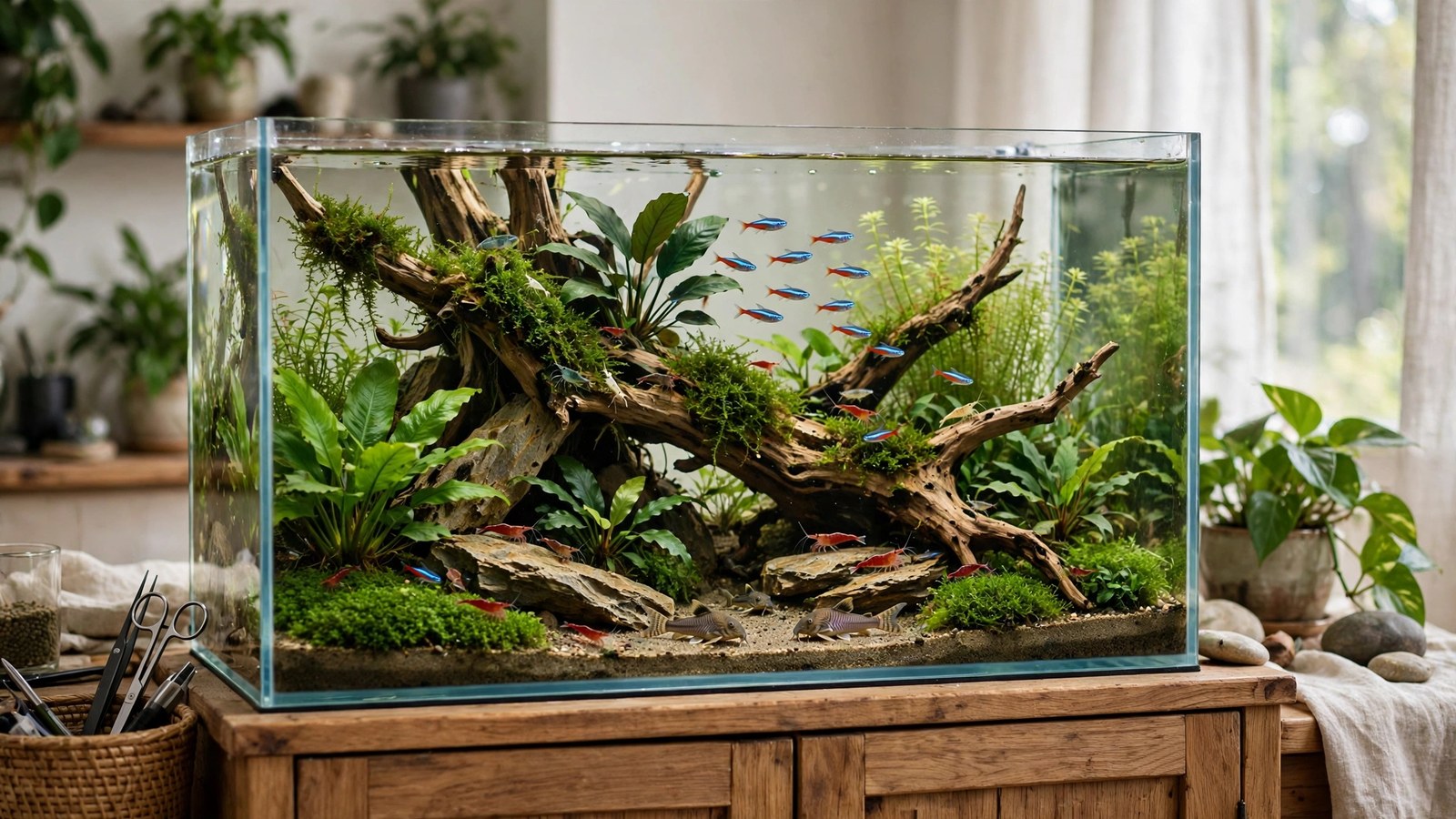
Most planted community tanks fail in the first 90 days for one avoidable reason: the owner bought the tank, plants, and fish in the wrong order, then wondered why algae owned the glass by week six. A proper planted community tank setup runs in reverse — plan the footprint, build substrate and hardscape, cycle without fish, plant heavily on day one, then add livestock in waves.
Planted Community Tank Setup: Planning Tank Size and Budget
The tank is your most consequential decision: footprint and volume set your stocking room, carpeting success, and water stability. A 55-gallon holds about 208 liters — that mass buffers temperature swings and dilutes mistakes that would crash a 10-gallon overnight.
| Tank | Footprint | Best for | Tradeoff |
|---|---|---|---|
| 20 gallon long | 30 × 12 in | Tight-budget first tank | Small stocking headroom; stems outgrow 12-inch depth |
| 29 gallon | 30 × 12 in | Small room, big ambitions | Tall — light penetration matters more |
| 40 gallon breeder | 36 × 18 in | The sweet spot | Needs a stand rated for ~460 lbs |
| 55 gallon | 48 × 13 in | Large schooling displays | Narrow 13-inch depth limits hardscape |
The 40-gallon breeder is the default recommendation: its 36 × 18-inch floor suits layered aquascapes at well under the cost of a big display. Budget honestly before buying anything.
| Item | 40-gallon breeder (USD) |
|---|---|
| Tank + stand | $250–400 |
| LED light, medium intensity | $90–180 |
| Filter (canister or HOB) | $80–160 |
| Heater, 150–200 W | $30–50 |
| Aqua soil, 3 × 9 L bags | $90–120 |
| Driftwood + stone | $60–120 |
| Plants (heavy day-one planting) | $100–200 |
| Livestock (staggered) | $100–250 |
| Test kit, ferts, supplies | $80–120 |
| Total | $880–1,600 |
See how much a planted aquarium really costs for safe places to cut — but never cheap out on the light or filter.
The Equipment Checklist
You need eight categories of gear — nothing more.
- Tank + stand: level, stand rated for at least 10 lbs per gallon.
- Filter: 4–6× tank volume per hour — 200–300 GPH for a 40-gallon breeder. Canisters hold more media; a quality HOB costs less.
- Heater: 3–5 watts per gallon (150–200 W for a 40-gallon), near the filter outflow.
- Light: full-spectrum LED, medium intensity (~30–50 PAR at substrate). Research this hardest; mismatched light drives algae.
- Substrate: 2–3 inches of nutrient-rich aqua soil. Skip inert gravel unless you're committed to heavy root tabs.
- Hardscape: one hero piece of driftwood or 3–5 stones.
- Test kit: liquid ammonia, nitrite, nitrate, pH, GH, KH. Strips drift; the liquid kit is non-negotiable during cycling.
- Liquid fertilizer: all-in-one formula at half the label rate, 2–3× weekly, while the tank is new.
CO2 is a decision, not a requirement — this build is fully low-tech. If you later want faster growth and red plants, a high-tech CO2 setup is an upgrade path. Cross-check your cart against a complete first planted tank shopping list before spending a cent.
Substrate Layering: Build From the Bottom Up
Slope the bed 3 inches at the back down to 2 at the front — it creates depth and gives background stems root space. Use aqua soil straight from the bag, misting as you slope so layers hold.
- Base layer (optional, 0.5 inch): pumice or lava granules in large tanks, to save expensive soil in deep zones.
- Main bed (2–3 inches): nutrient-rich aqua soil, sloped higher at the back. Three 9-liter bags covers a 40-gallon breeder.
- Carpet zone cap (0.5 inch, optional): fine sand where you'll plant monte carlo or dwarf hairgrass — runners spread through sand more easily.
Don't stir the bed once filled. Aqua soil leaches ammonia for the first 1–3 weeks — free fuel for your fishless cycle.
 ★4.7
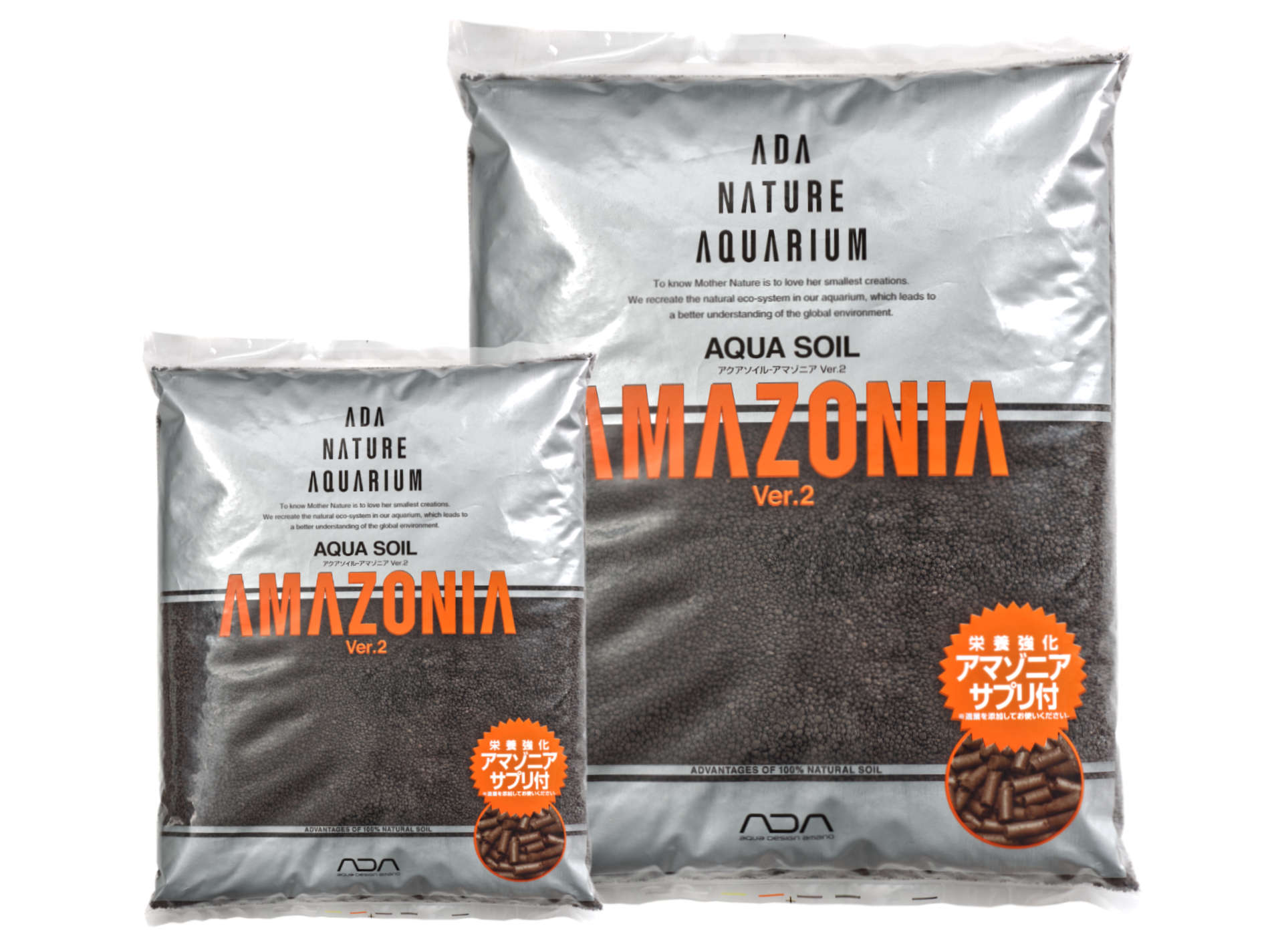
ADA Aqua Soil Amazonia Ver 2
Check Price on Amazon ★4.7Hardscape Layout Rules
Pick ONE focal point — one dramatic driftwood branch or one group of 3–5 stones. Five rules separate tanks that photograph well from rock collections:
- Rule of thirds: place the focal piece at an imaginary thirds-intersection, never dead center.
- Odd numbers: groups of 3 or 5 stones read natural; even numbers look arranged.
- One wood, one stone type: mixing three woods and two stones is visual noise. Commit to one of each.
- Lean into the flow: angle branches 30–45 degrees, all pointing the same way, as if a current shaped them.
- Bury the base: press hardscape 1–2 inches into the substrate. Teetering wood screams "just set up."
Soak driftwood 3–7 days first (change the water daily) so it sinks and releases tannins. Tropica's aquascaping inspiration gallery is the best free layout reference online. For a masterclass in restraint, study the Iwagumi tank build guide — its rules apply even to wilder community scapes.
Cycling the Tank: The Non-Negotiable 3–6 Weeks
Cycling grows the bacteria that convert toxic ammonia into nitrite and then nitrate. This build skips fish-in cycling entirely: plant first, feed the cycle with controlled ammonia, and add zero livestock until the bacteria are proven. Plants absorb ammonia directly, so cycling with plants usually finishes on the fast end.
| Week | What's happening | Your job |
|---|---|---|
| 1 | Ammonia rises to 2–4 ppm; soil leaching adds more | Test every 2 days; dose ammonia to 2 ppm if low; lights 5–6 hrs/day |
| 2 | Nitrite appears and climbs | Keep ammonia at 2 ppm; 25% water change if nitrite passes 5 ppm |
| 3–4 | Nitrite falls; nitrate rises | Test every 3 days; change water when nitrate passes 40 ppm |
| 5–6 | 2 ppm dosed ammonia clears to 0/0 in 24 hours | Three passing days in a row = cycle complete |
Use pure liquid ammonia (shake the bottle — if it foams, it contains surfactants and will ruin the tank) or a pinch of fish food daily. Bottled bacteria starters can shave off a week; they're accelerators, not instant cycles — see beneficial bacteria starters explained.
Planting Order: Fill 60–70% of the Substrate on Day One
Plant on the same day you start the cycle. Dense planting starves algae of nutrients and light from day one — and this habit decides whether months 1–3 are enjoyable or an algae war. Work in this order:
- Epiphytes: glue or tie anubias, java fern, bucephalandra to hardscape. Never bury a rhizome — it rots.
- Background stems: rotala, ludwigia, bacopa in the deep rear bed, 1–2 inches apart. Trim and replant tops for free doubling within a month.
- Midground rosettes: crypts and swords at mid-depth, one root tab per plant.
- Foreground carpet: monte carlo or dwarf hairgrass in clumps 1 inch apart, never one big mat (the center melts from poor flow).
- Floaters: frogbit or red root floaters, corralled in a ring so they don't starve everything below.
Buy 20–40% more plants than feels right — sparse day-one planting is the most common beginner error; how many plants a new aquarium needs covers the density math. Expect 30–50% leaf melt in the first two weeks as nursery plants adapt; snip the mush, keep the roots, and new growth appears in 2–3 weeks. For a density-first, low-equipment philosophy, compare the dirted tank setup and Walstad vs dirted approaches.
Stocking a Community Tank: Peaceful Species in Waves
A community tank works when every species agrees on temperature, temperament, and chemistry. Build around a peaceful core: a schooling species, a centerpiece pair, and a bottom crew plus cleanup team.
| Role | Proven species | Number | Notes |
|---|---|---|---|
| Schooling midwater | Neon tetra, cardinal tetra, harlequin rasbora | 10–15 | Schooling fish for planted tanks compares the top dozen |
| Centerpiece | Honey gourami (pair), German blue ram (pair) | 2–3 | Honey gouramis are the safest bet; rams need warmer, softer water |
| Bottom crew | Bronze or panda corydoras | 6–8 | Never fewer than 6 — they shoal and feed together |
| Algae crew | Amano shrimp (6–10), nerite snails (3–5) | As listed | Add around week 8–10, once biofilm and algae appear |
Stock in three waves, two weeks apart, so bacteria grow into each new bioload instead of being overwhelmed:
- Wave 1 (week 1 post-cycle): 8–10 hardy schoolers, fed lightly once daily.
- Wave 2 (week 3): the corydoras plus the centerpiece pair. Test ammonia twice that week — above 0.25 ppm means an immediate 30% water change.
- Wave 3 (week 5–6): top the school up to 12–15, and add the algae crew once there's actual algae to eat.
Quarantine every new fish 2–4 weeks in a bare 10-gallon with a sponge filter — one sick fish can wipe out $200 of livestock and force you to tear the scape apart to treat. Keeping livebearers? The best plants for molly tanks shows fry-friendly cover that works in any livebearer community.
Water Parameters: The Mixed-Community Compromise
Every species has an ideal, but a community tank runs on the overlap zone — where nobody thrives maximally yet everybody thrives adequately. Planted tank water parameters covers the full chemistry; here's the compromise window for tetras, rasboras, corydoras, gouramis, and most plants:
| Parameter | Target | Why |
|---|---|---|
| Temperature | 75–78°F (24–26°C) | Warm enough for tetras, cool enough for corys and plants |
| pH | 6.8–7.4 | Aqua soils buffer toward 6.5–7.0; fish tolerate up to 7.4 |
| GH | 4–8 dGH | Soft enough for tetras, hard enough for plants |
| KH | 2–5 dKH | Stable pH without locking it above 7.5 |
| Ammonia / nitrite | 0 ppm | Any reading post-cycle = water change now |
| Nitrate | 10–30 ppm | Change water when it passes 40 ppm |
Consistency beats perfection — fish adapt to a stable pH of 7.4 far better than to one swinging between 6.8 and 7.2 weekly. Test weekly for the first two months, then monthly.
Maintenance Schedule: Weekly, Monthly, Rarely
Planted tanks need less maintenance than fish-only tanks — plants absorb nitrate and outcompete algae — but the maintenance they need must happen on schedule.
| Frequency | Task | Details |
|---|---|---|
| Daily | Feed + glance | One feeding, 2 minutes' worth; confirm temperature and filter flow |
| Weekly | 30–40% water change | Lightly vac open areas (never deep-vac planted soil); wipe front glass |
| Weekly | Trim stems | Cut above a node, replant tops; remove dead leaves before they rot |
| Monthly | Filter maintenance | Rinse media in old tank water — never tap water, which kills bacteria |
| Monthly | Full test panel | Ammonia, nitrite, nitrate, pH, GH, KH; log numbers to catch trends early |
The planted tank maintenance schedule guide has a printable log sheet. Once stocked, never skip more than one weekly water change.
Algae Prevention in Months 1–3
Every new planted tank grows some algae — brown diatoms in weeks 3–5, then green dust or hair algae as things settle. Algae wins when light and nutrients fall out of balance, so keep the triangle tight:
- Start at 6 hours of light daily for the first month, adding 30 minutes weekly to a 7–8 hour ceiling.
- Dose lean: half the label rate, 2–3× weekly. Fresh aqua soil feeds roots already; overdosing the water column feeds algae.
- Change water twice weekly (30% each) for the first month to export what the soil leaches, then drop to weekly.
- Remove algae manually every water change. Twirl hair algae onto a toothbrush; wipe glass before it hardens.
- Let the plants win: floaters shade the surface and devour excess nutrients — the cheapest algae control you can buy.
If algae explodes anyway: cut the photoperiod by 2 hours, do three 40% water changes over one week, and add fast-growing stems. Resist algaecides — they nuke the bacteria you spent six weeks growing. When it's time for reinforcements, a cleanup crew for planted tanks matches each algae type to the right eater.
Frequently Asked Questions
How long does a planted community tank setup take from empty to fully stocked?
Plan 10–12 weeks. The fishless cycle takes 3–6 weeks with heavy day-one planting; then stock in three waves two weeks apart, finishing around week 9–12. Rushing is the number one cause of livestock losses — a tank that looks ready is not the same as one whose bacteria can handle a full bioload.
Can I build this without CO2 injection?
Yes — this guide is written low-tech: medium light 6–8 hours daily, nutrient-rich substrate, lean liquid fertilizer, and easy plants like anubias, java fern, crypts, and rotala. CO2 speeds growth 2–3× and unlocks red plants and dense carpets, but it's an upgrade for month six, not a day-one requirement.
What's the biggest beginner stocking mistake?
Adding all the fish at once. A newly cycled tank's bacteria are sized for the 2 ppm ammonia you dosed during cycling — dumping 25 fish in overnight overwhelms it, spiking ammonia and killing the weakest fish within days. Three waves let bacteria grow into each new bioload safely.
Why are my new plants melting in the first two weeks?
Transition melt. Most store plants are grown emersed (in air) and must shed those leaves to grow submerged ones — 30–50% melt in weeks 1–3 is normal. Trim the mush, leave roots and rhizomes alone, and expect new growth in 2–3 weeks. A plant is only dead if roots and rhizome turn to mush.
How many fish fit in a 40-gallon planted community?
Roughly 25–35 small fish: 12–15 schooling tetras or rasboras, 6–8 corydoras, a pair of honey gouramis, plus 6–10 amano shrimp and 3–5 nerite snails. Plants absorb waste, so a planted tank carries a slightly higher bioload than fish-only — but that isn't a license to overstock.
Do the lights need a timer?
Yes — a timer is mandatory. Inconsistent photoperiods are a top algae trigger. Start at 6 hours daily for the first month, increase 30 minutes weekly to a 7–8 hour ceiling, and never shuffle the schedule. A $15 outlet timer pays for itself the first time it prevents a green-water bloom while you're away.
Your Tank, Twelve Weeks From Now
A planted community tank setup rewards patience with compound interest: the bacteria from weeks 1–6, the plants from day one, and the fish added in waves all start reinforcing each other around month three. Keep the water changes boring and regular, the photoperiod fixed, and the stocking restrained — and you'll have a living ecosystem that looks better at month twelve than at month three. There is no shortcut, but the slow way works every single time.