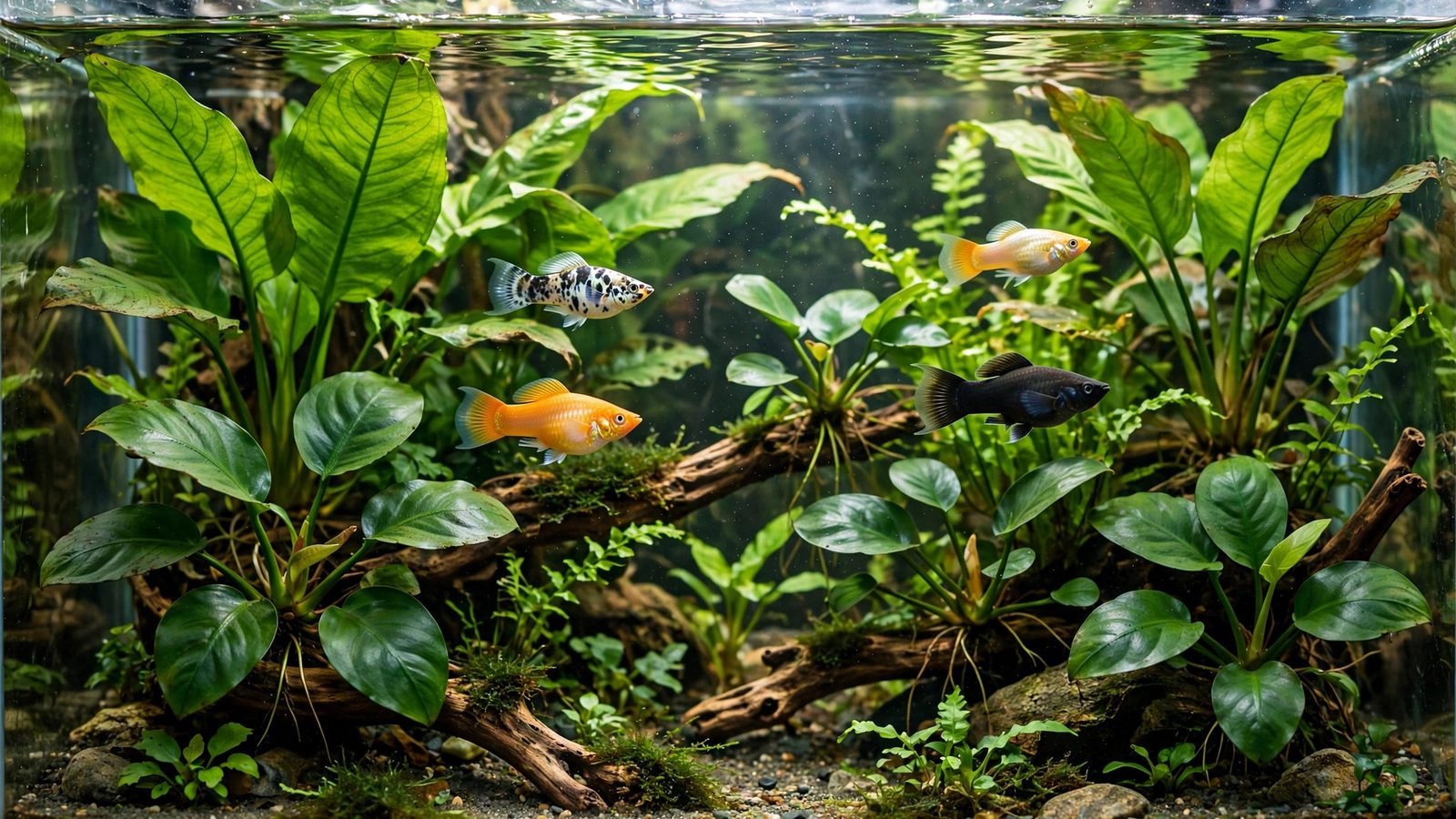
Mollies can be surprisingly fussy about one thing: most "easy aquarium plant" lists were written for soft, acidic Amazon-basin water, and mollies come from the opposite world. These livebearers thrive in hard, alkaline water at pH 7.5–8.5, shrug off a little aquarium salt, and — like all good livebearers — they have fry to protect every 30 days or so. The best plants for molly fish tanks are the ones that love hard water as much as your mollies do, survive their constant algae-grazing, and give newborn fry somewhere to hide. This guide ranks 9 plants that genuinely thrive in molly water, with a side-by-side comparison table.
Best Plants for Molly Fish: What Makes a Plant Right?
Before the list, it helps to know what your mollies actually need from their plants. Mollies (Poecilia sphenops, Poecilia latipinna, and the balloon hybrids) do best at 24–28°C (75–82°F), pH 7.5–8.5, and GH above 10 dGH. Many aquarists add 1 tablespoon of aquarium salt per 5 gallons — mollies tolerate true brackish conditions, though your tank plants don't need to be full salt-marsh species. They just need to handle mineral-rich water and the occasional light salt dose.
Your plant picks also have to survive molly behavior. Mollies are relentless grazers: they nip soft algae off leaves all day — free algae control — but also rasp tender new growth. Tough, slightly leathery leaves hold up far better than delicate ones. And because mollies drop 20–60 fry every month, fine-textured cover near the surface and substrate is the difference between a few surviving fry and none. See our best plants for fry cover for the full logic.
1. Java Fern (Microsorbus pterotoides)
Java fern is the single safest plant you can buy for a molly tank. It actively prefers pH 6.0–8.0, shrugs at high GH, and tolerates the light salt doses molly keepers use. Its rhizome must stay above the substrate — tie it to driftwood or rock with thread or glue — and its tough, leathery fronds are completely molly-graze-proof.
Why it suits mollies: broad leaves give adult mollies a sense of cover while fry hide in the roots and crevices underneath. The leaf texture collects biofilm, which fry pick at in their first days. It also competes with algae for nutrients, keeping the tank cleaner between your natural algae-control plantings.
Placement: midground on hardscape. Planting tip: tie the rhizome — never bury it, or it rots in 2–3 weeks. Plantlets on older leaves give you 5–8 free divisions within 6 months.
2. Anubias barteri
Like Java fern, Anubias is an epiphyte — it feeds from the water column and anchors to wood or stone. It grows slowly (one new leaf every 3–6 weeks) but is nearly indestructible: it tolerates pH up to 8.5, hard water, low light, and light brackish conditions. Mollies ignore its waxy leaves entirely while they pick algae off them.
Why it suits mollies: rock-solid under molly grazing, and the broad leaves break up sightlines in a busy livebearer tank — dominant males can't constantly eyeball rivals. Placement: midground to background, tied or glued to hardscape. Compare varieties in our Anubias varieties compared guide; barteri and coffeefolia are the hardiest for alkaline tanks.
3. Vallisneria spiralis
If Java fern is the safest pick, Vallisneria is the happiest — it genuinely prefers hard, alkaline water and grows like a weed in it. A single runner can send up 30–50 ribbon leaves reaching 60 cm tall, turning the back of a molly tank into a swaying green curtain.
Why it suits mollies: tall blades give the security nervous livebearers crave, and dense runners create fry-hiding pockets at the substrate line. It tolerates light salt and pulls nitrates hard — ideal for molly-heavy stocking. Plant the crown just above the gravel surface and let runners do the rest.
Placement: background. Planting tip: trim leaves at the base rather than the middle — cut leaves brown at the tips and look ragged.
4. Hornwort (Ceratophyllum demersum)
Hornwort is a floating or bunched stem plant with needle-fine leaves — and one of the best fry covers in the hobby. It thrives at pH 6.0–8.5, tolerates hard water and brackish doses, needs zero substrate, and grows inches per week, soaking up nitrates faster than algae can use them.
Why it suits mollies: float a thick bunch and molly fry instinctively dive into it — dense hornwort can save noticeably more fry per drop than bare tanks. Placement: floating or weighted at the back.
5. Amazon Sword (Echinodorus amazonicus)
The Amazon sword gets a pass here because, despite the name, it's remarkably adaptable: it handles pH up to 8.0, hard water, and warm 24–28°C molly temperatures. Its big rosette leaves make it the centerpiece of most molly setups.
Why it suits mollies: broad leaves host algae-grazing sessions your mollies will love, and the deep rosette gives fry a protected nursery zone near the bottom. Placement: background centerpiece. Planting tip: bury one root tab per plant every 6–8 weeks — swords are root feeders and will yellow within a month without them. See our sword plant varieties compared for alternatives.
6. Water Wisteria (Hygrophila difformis)
Water wisteria is the workhorse stem plant of this list: it tolerates pH 6.0–8.0, hard water, light brackish doses, and low-to-medium light, and it grows fast enough (up to 5 cm per week) to starve out algae in new setups. Its lace-like leaves also make excellent fine cover for fry.
Why it suits mollies: it's a true beginner-friendly plant that needs no CO2, it recovers from molly nibbling almost overnight, and you can replant trimmings to fill the tank for free. Placement: midground to background, planted in groups of 5–8 stems 3 cm apart. Pinch tops regularly to keep it bushy.
7. Cryptocoryne wendtii
Crypt wendtii is the midground anchor this list needs. It's famous for adapting to nearly any water, and that includes pH 7.5–8.0 molly tanks — it stays a compact 15–25 cm rosette with ruffled bronze-to-green leaves. It does suffer "crypt melt" if conditions change suddenly, so plant it once and leave it alone.
Why it suits mollies: dense, low rosettes give shy fry and subdominant mollies bottom cover, and the leathery leaves resist molly rasping. Placement: midground, 10–12 cm apart. Planting tip: expect existing leaves to melt within 2 weeks of planting — new submersed leaves follow in 3–4 weeks. Don't move it; that's what triggers the melt.
8. Java Moss (Taxiphyllum barbieri)
Java moss is the ultimate fry nursery. It grows at pH 6.0–8.0, tolerates hard water and brackish doses, needs almost no light (even 0.5 W per liter is enough), and its tangled fronds create thousands of tiny hiding pockets. Fry disappear into it like smoke, and adults can't follow.
Why it suits mollies: no other plant on this list saves more newborn fry per square inch. Placement: attached to wood, rock, or breeding-mop-style bundles.
9. Dwarf Sagittaria (Sagittaria subulata)
Dwarf sag is the foreground carpet of this list, and it earns its place by tolerating what most carpet plants can't: hard alkaline water (pH up to 8.2) and genuine brackish conditions — in the wild it grows in estuaries. Under medium light it stays a 5–10 cm lawn; under low light it stretches taller but still carpets.
Why it suits mollies: it survives the 1 tablespoon-per-5-gallons salt doses many molly keepers use, which rules out most delicate foreground plants. It spreads by runners — plant individual nodes 5 cm apart and expect coverage in 8–12 weeks.
Side-by-Side Comparison: All 9 Plants
| Plant | Placement | pH range | Light | Salt OK? | Fry cover rating | Notes |
|---|---|---|---|---|---|---|
| Java fern | Midground | 6.0–8.0 | Low | Yes | ★★★ | Tie to wood; never bury rhizome |
| Anubias barteri | Midground | 6.0–8.5 | Low | Yes | ★★★ | Slow; buy enough up front |
| Vallisneria spiralis | Background | 6.5–8.5 | Low–med | Yes | ★★★ | Loves hard water; trim at base |
| Hornwort | Floating/back | 6.0–8.5 | Low–med | Yes | ★★★★★ | Fastest nitrate uptake; never release |
| Amazon sword | Background | 6.5–8.0 | Medium | Light | ★★★ | Needs root tabs every 6–8 weeks |
| Water wisteria | Mid–back | 6.0–8.0 | Low–med | Yes | ★★★★ | Trims replant for free |
| Crypt wendtii | Midground | 6.0–8.0 | Low–med | Light | ★★★ | May melt on planting; don't move it |
| Java moss | Anywhere | 6.0–8.0 | Low | Yes | ★★★★★ | Best fry nursery per square inch |
| Dwarf sagittaria | Foreground | 6.5–8.2 | Med | Yes | ★★ | Estuary plant; runners in 8–12 weeks |
Plants to Avoid in Molly Tanks
Not every beautiful plant belongs in hard, alkaline water. Skip Rotala species (they need soft, acidic water and stall above pH 7.5), Tonina and Eriocaulon (same problem, plus they demand CO2), and most carpet plants like HC Cuba and Glossostigma — they want soft water and high light that a molly tank shouldn't have. The hard-water aquarium plants guide has a longer safe list if you want to experiment.
Also skip plastic imitations as your only cover — real plants pull nitrates, which matters when livebearers keep multiplying. Mollies eat soft algae, not leaves, so don't blame the fish when a soft-water plant melts — blame the water chemistry. Past 1 tablespoon of salt per 5 gallons, switch to true salt-tolerant species from our brackish water aquarium plants guide.
Planting a Molly Tank: A Quick Layout
For a standard 20-gallon molly tank, here's a layout that works: Vallisneria or Amazon sword across the back (3–5 plants), Java fern and Anubias tied to driftwood in the midground, Crypt wendtii in front of them, dwarf sag as the foreground lawn, water wisteria filling any bare midground gaps, and a floating hornwort bunch plus a Java moss mound for the fry. That's roughly 40–60% coverage — enough security for nervous livebearers without turning the tank into a jungle they can't swim through.
Plant in this order: hardscape epiphytes first (Java fern, Anubias, moss), then rooted background plants, then midground, then the foreground carpet. Fill the tank slowly, dose root tabs under swords and crypts on day one, and run the lights 6–8 hours daily for the first month while everything establishes. The same principles behind our planted community tank setup apply here, tuned for livebearers, and our aquarium plant placement guide explains the zones in more detail.
Frequently Asked Questions
Can mollies live with live plants?
Yes — mollies are excellent planted-tank fish. They graze algae off leaves, which keeps plants cleaner, and rarely eat healthy foliage. Choose hard-water-tolerant species like Java fern, Anubias, and Vallisneria, which thrive at pH 7.5–8.5. Skip delicate soft-water plants — they melt in molly parameters and often get wrongly blamed on the fish.
Do molly fry need plants?
Survival rates are far higher with cover. Dense fine-leaved plants like hornwort and Java moss shelter newborn fry from hungry adults, including their own mother. In a bare tank you may save 2–3 fry per drop; with good cover, 10–20 or more can survive in a typical 20-gallon setup. Add cover before the female drops.
Can aquarium plants survive aquarium salt with mollies?
Most survive the light salt doses molly keepers use — about 1 tablespoon per 5 gallons. Java fern, Anubias, Vallisneria, hornwort, Java moss, and dwarf sagittaria all tolerate it; Amazon sword and Crypt wendtii tolerate only light doses. Above 1.005 specific gravity, switch to dedicated salt-tolerant species instead.
How many plants does a molly tank need?
Aim for 40–60% plant coverage of the footprint. For a 20-gallon tank, that's typically 3–5 background plants, 4–6 midground plants, a dwarf sagittaria foreground patch, and a floating bunch for fry cover. This density absorbs nitrates from livebearer-heavy stocking while leaving open swimming space — mollies are active and hate a fully choked tank.
What is the easiest plant for a beginner molly tank?
Java fern: tie it to driftwood or a rock, keep the rhizome above the substrate, and it survives low light, hard water, light salt, and neglect. It needs zero planting, zero CO2, and zero fertilizer to stay green. Hornwort is the easiest fast grower if you want quick fill-in and fry cover within days.
Will mollies eat the plants?
Healthy mollies graze soft algae and biofilm, not leaves. They may rasp tender new growth on very soft plants, but the tough leaves of Java fern, Anubias, Vallisneria, and swords are effectively molly-proof. If leaves are disappearing, check water chemistry first — melting soft-water plants look "eaten" when they're actually just dying.
Your Molly Tank, Planted
Start with the two indestructibles — Java fern and Anubias on driftwood — add Vallisneria for the back curtain and hornwort plus Java moss for the fry, then round out with a sword, wisteria, crypts, and dwarf sag. Give everything 4–6 weeks to establish before your first big fry drop. Tropica's aquarium plant database documents each species' parameters, and the University of Georgia extension publishes practical aquarium-plant guidance for verifying new hard-water picks.