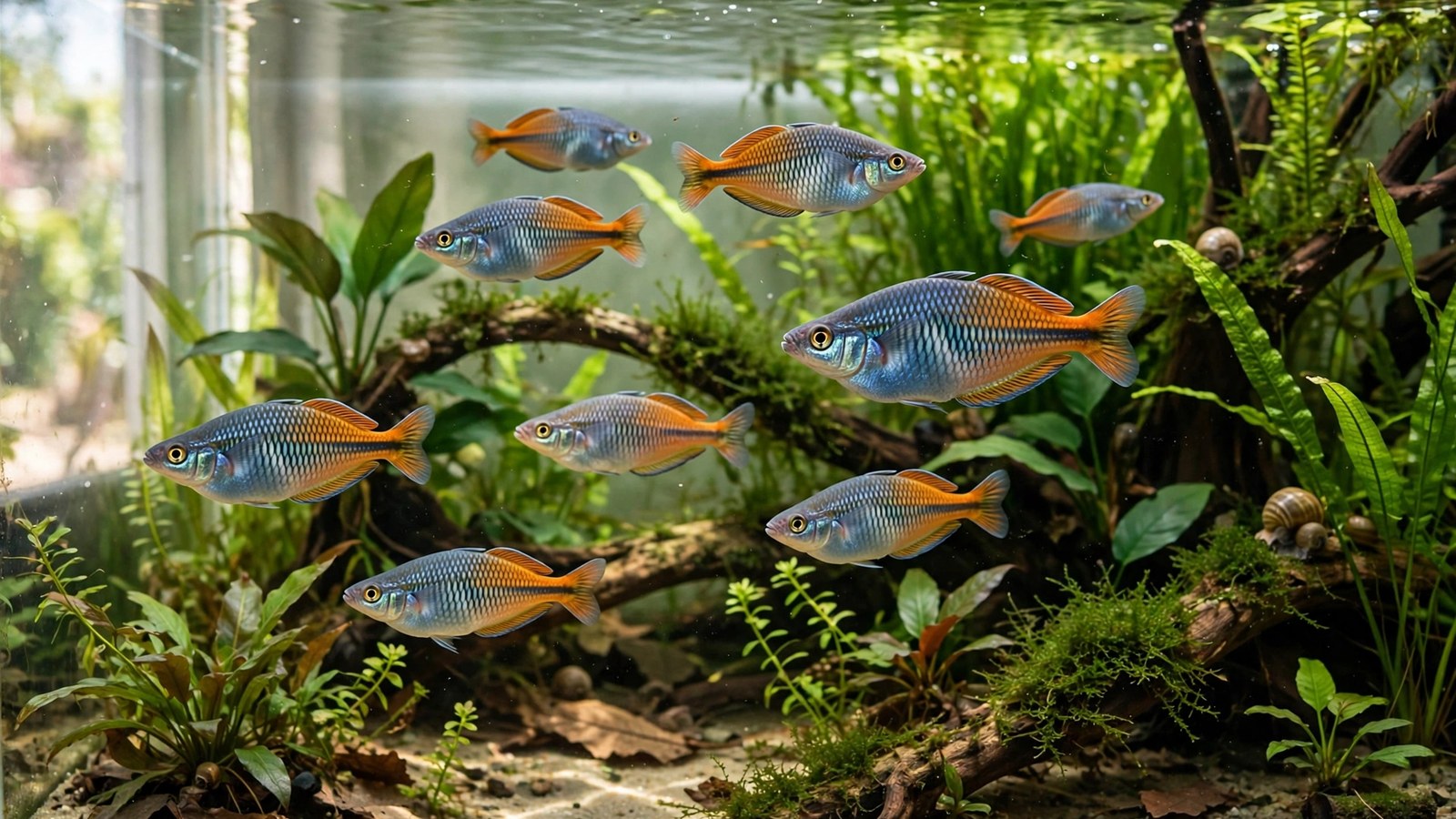
The drabbest fish on the store shelf is often the one that looks best in your living room. Juvenile Parkinson's rainbowfish sell as pale, silver-grey silhouettes that most shoppers walk straight past — then spend two weeks in a secure parkinsoni rainbowfish planted tank and turn copper-orange with electric fins. That transformation is the whole point of this build: dark substrate, dense planting along the sides and back, and open swimming room in the middle let Melanotaenia parkinsoni — Papua New Guinea's "Orange Rainbow" — reach the color it only shows in the wild.
Quick answer: Keep 6–8 Parkinson's rainbowfish in a 4-foot tank of at least 100 litres, with dark substrate, dense planting on the sides and back, open central swimming space, and clean, well-oxygenated water at 24–28 °C and pH 6.5–7.5. They accept harder, slightly alkaline water — and their orange shows strongest there. Feed quality micropellets or flakes twice daily, plus frozen daphnia or brine shrimp; floating duckweed gets grazed. Males reach 4–5 inches, so the 4-foot footprint is the true minimum, not a luxury.
Your parkinsoni rainbowfish planted tank: the three non-negotiables
A Parkinsoni setup stands on three decisions: length, numbers, and sex ratio. A 4-foot tank gives a school of fish this size — mature males reach 4–5 inches and are deep-bodied — room to cruise and display without colliding. Six to eight fish is the sweet spot: fewer, and males turn their rivalry on each other; more, and you need a bigger tank. Skew the group toward females. Parkinsoni males are pushier than most Melanotaenia, and constant chasing washes out the very color you built the tank for.
This is also a species that rewards the fish-first approach to planting. If you are building the whole aquascape around livestock, the logic in our fish-first aquarium plant guide applies directly here: choose plants for cover and function, then let them look good doing it.
Layout: dark floor, dense edges, open middle
The scape that makes Orange Rainbows glow is simple. Start with a dark substrate — dark brown or black fine gravel or sand. Against a pale floor, rainbowfish instinctively mute their colors; against dark, they relax and intensify. Then plant heavily along the sides and back and leave the center open. The fish swim in the open water; the plants frame them and give subordinate fish escape routes when males spar.
Plant choice can stay easy. Tall stems like Vallisneria or Limnophila sessiliflora along the back create the green curtain; Cryptocoryne or Java fern tied to driftwood fill the mid-ground. A low-tech planted tank setup is all this build needs — moderate light for 6–8 hours a day, no injected CO2 required. Add floating plants such as duckweed or frogbit: the dappled shade gives the fish overhead security, and Parkinsoni genuinely browse duckweed. The species also works in a lightly planted aquarium setup as long as the open middle and dark floor stay.
Water: clean and oxygenated beats chemically perfect
Parkinsoni are adaptable, and that is the point most keepers overcomplicate. Aim for 24–28 °C and pH 6.5–7.5, but do not contort your tap water to hit a magic number — this species handles slightly harder, slightly alkaline water, and many keepers report their orange is deepest there. What actually matters is what moves through the filter: well-filtered, clean, highly oxygenated water.
| Parameter | Target | Notes |
|---|---|---|
| Temperature | 24–28 °C (75–82 °F) | Stable beats ideal; avoid swings over 2 °C |
| pH | 6.5–7.5 | Slightly hard/alkaline shows them best |
| Ammonia / nitrite | 0 ppm | Non-negotiable; cycle the tank first |
| Nitrate | Under 20 ppm | Weekly 25–30% water changes |
| Oxygenation | High | Surface agitation or airstone, especially in warm water |
Feeding small, feeding often
Parkinsoni are enthusiastic omnivores with one limitation: a narrow throat that cannot take big food. Feed quality micropellets or flakes twice daily in amounts they clear in about two minutes. Supplement three or four times a week with frozen daphnia or brine shrimp — thawed and rinsed first, since whole cubes dumped in a planted tank foul the water around the roots. And do not forget the free grazing: floating duckweed gets browsed continuously between meals.
Tankmates: the narrow-throat rule
The narrow throat is the single most useful fact about this species' temperament. Because they physically cannot swallow small tankmates, Parkinsoni live peacefully with smaller fish — threadfin rainbows work well as upper-water dithers, and forktail blue-eyes suit the same layout. Corydoras fill the lower level the school ignores. Avoid fin-nipping species and anything large enough to bully a 4-inch fish. One honest caveat: the narrow-throat fact covers small fish, not shrimp — shrimplets are fair game for any fish this size, so do not expect a shrimp-safe setup.
If you like this build but want to compare the recipe against its cousins, the Boesemani rainbow planted tank and praecox rainbow planted tank run on the same layout logic.
Why the shop juveniles look nothing like the adults
This is the detail that matters most at the store. Parkinsoni juveniles are sold small and silver-grey — genuinely drab — and they are routinely overlooked in shop tanks. That is not a warning sign; it is the species. Buy the healthiest juveniles, quarantine them for two to four weeks, and move the group in together. Give them the dark floor, the plant cover, and clean oxygenated water described above, and the males begin coloring up within weeks. The late-blooming habit is actually your advantage: the fish everyone else ignored turn into the tank nobody walks past.
Frequently Asked Questions
How big a tank do Parkinsoni rainbowfish need?
A 4-foot tank of at least 100 litres is the minimum for a school of 6–8. Mature males reach 4–5 inches and are active swimmers, so a 3-foot tank crowds them — crowding shows up as male-on-male aggression and washed-out color. If you only have room for a smaller tank, choose a dwarf rainbow species instead.
Do they need CO2 or high-tech lighting?
No. Parkinsoni thrive in low-tech setups with moderate light running 6–8 hours a day. CO2 injection grows denser plants but the fish themselves need nothing fancier than that. Just make sure the lighting level matches your plant mass — strong light with few plants grows algae, not color.
Will Parkinsoni rainbowfish eat my shrimp?
Their narrow throats protect small fish but not shrimplets — any fish this size eats newly hatched shrimp. Adult cherry shrimp are usually ignored, but if you want a breeding colony, give shrimp their own tank. Do not buy Parkinsoni expecting a guaranteed shrimp-safe setup.
Why are my Parkinsoni still pale after a month?
Run this checklist: bright or pale substrate, blinding light with no floating plants, too few tankmates, a male-heavy group, or slipping water quality. Fix the substrate first — a dark floor is the single fastest color change most keepers can make — then add overhead cover and confirm the school is 6–8 strong.
Can I keep just a pair or a trio?
Do not. This is one of the pushier Melanotaenia species, and in groups under six the males focus their sparring on each other nonstop. You get frayed fins, stressed fish, and dull colors. Six to eight with a female bias spreads the social pressure and lets every male display instead of fight.
The payoff
A Parkinsoni tank is a delayed-reward build, and that is exactly its charm. The dark substrate goes in on day one, the plants fill in over the first month, and the silver-grey juveniles become copper-orange showpieces while it happens. Buy the overlooked fish, give them the setup above, and the tank handles the transformation. For the species' full taxonomic details and wild range, see the Wikipedia profile of Melanotaenia parkinsoni.