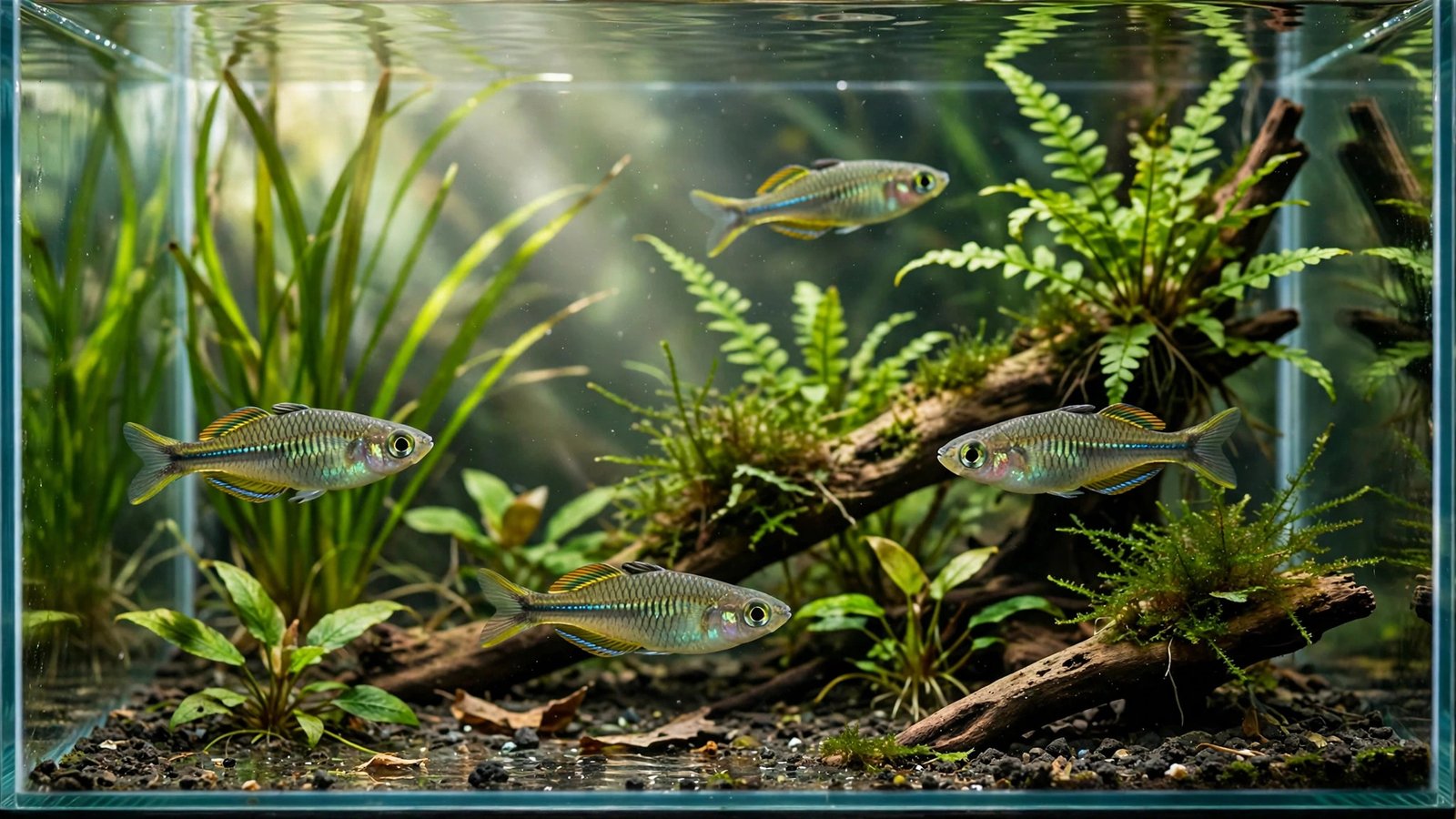
Here is the fact that trips up most buyers first: the Celebes rainbowfish is not a true rainbowfish at all. Marosatherina ladigesi belongs to the sailfin silverside family, is found nowhere but the rivers of Sulawesi, and still gets sold under care advice written for Australian rainbowfishes that want the opposite water. The costliest mistake is the one the internet keeps recommending: aquarium salt. A celebes rainbowfish planted tank should be salt-free, and this guide shows you exactly how to build one.
A celebes rainbowfish planted tank is a hard-water community setup of at least 20 gallons holding 6–8 fish at 22–28 °C, pH 7.0–8.0, and 10–25 dGH, with planted zones beside open swimming lanes and a tight lid — this species is a confirmed jumper. Do not add salt: Celebes rainbowfish tolerate mildly brackish water but never need it.
The Species Behind the Setup: Marosatherina ladigesi
It helps to know what you are actually stocking. Marosatherina ladigesi (older trade name Telmatherina ladigesi) is a sailfin silverside from the Telmatherinidae family, endemic to Sulawesi's rivers — not a Melanotaenia, and not a fan of the soft, acidic water many Australian rainbows tolerate. Males reach 7–8 cm, shimmer yellow with a black-edged sail-like dorsal fin, and spend the day posturing with each other. They are peaceful but skittish: in a bare tank they huddle and wash out, while dense planted cover turns them into confident shoalers within a week or two — a need that should shape every choice from plant placement to lighting.
Designing Your Celebes Rainbowfish Planted Tank
The single most important decision is tank footprint: these fish are horizontal swimmers that spar in bursts. A 24-inch-long 20-gallon tank is the practical minimum for 6–8 fish; a 30-gallon long is better. Height matters far less than length, so avoid tall hex or cube tanks. If you are choosing aquarium plants for a fish-first tank, this is exactly the species that guide was written for. Lay out the aquascape as a racetrack — plant the back and both sides densely, keep the center lane open — because males claim display stations in the open lanes but retreat into the planted margins between bouts. Fine gravel or sand suits them best, and any nutrient-rich substrate layer must be capped well, since a disturbed cap clouds the water they are meant to sparkle in.
Water Parameters: Hard, Alkaline, and Salt-Free
Here is where the advice gets murky online, so be precise. Published care data for Marosatherina ladigesi conflicts on pH: some retailers list ranges dipping toward neutral or slightly acidic, others push toward 8.0. The safe consensus is neutral to slightly alkaline water at pH 7.0–8.0, with 10–25 dGH hardness and 22–28 °C (72–82 °F). Most aquarium plants do their best work between pH 6.5 and 7.8, so there is no real conflict to resolve.
| Parameter | Target | Why it matters |
|---|---|---|
| Temperature | 22–28 °C (72–82 °F) | Activity and color peak in the upper half |
| pH | 7.0–8.0 | Consensus range; ignore wider retailer claims |
| General hardness | 10–25 dGH | Hard-water species; skeleton and egg development |
| Salt | None | Brackish tolerance ≠ brackish requirement |
| Nitrate | Below 20 ppm | Keep color bright and fins undamaged |
The salt question deserves emphasis because it is the most repeated error in this hobby: Celebes rainbowfish tolerate mildly brackish water in the wild, and some sellers list "brackish" on their tags, but they thrive in pure freshwater and never need salt. Salt also harms most freshwater plants, so adding it sabotages the planted half of your tank for zero benefit.
Plant Choices and Aquascape Layout
Pick plants that like what the fish like: hard, alkaline water and moderate light. Vallisneria and Cryptocoryne are the backbone — both thrive in 10–25 dGH, and Vallisneria's tall leaves give nervous fish a forest edge to duck behind. Anubias and Java fern on driftwood fill the midground with no injected CO2, keeping this a genuinely low-tech planted tank in the spirit of a lightly planted aquarium setup. Finish with floaters like frogbit: these fish color up under dimmed, dappled light, and a startled Celebes rainbowfish's first instinct is to jump — harsh glare with no cover is what puts fish on the floor. Dim the fixture, shade it with floaters, and leave the planted margins dark.
Stocking and Tank Mates
Stock 6–8 fish as the working minimum; fewer than six and the group never relaxes. Aim for 2–3 females per male so display energy spreads across rivals, not one harassed female, add the full group at once, and expect two weeks of caution before the male circling displays and dawn spawning runs begin. Tank mates should be peaceful hard-water community fish that will not outcompete a shy shoaler at feeding time. The threadfin rainbowfish planted tank is a natural companion reference, since threadfins share the gentle temperament and mid-water niche. Forktail blue-eyes, kubotai rasboras, and small livebearers such as endlers all work, and a forktail blue-eye planted tank runs on nearly identical water. Skip fin-nippers like tiger barbs and anything large enough to see a 7 cm fish as food.
Feeding and Weekly Care
Celebes rainbowfish are unfussy omnivores with one preference: small, varied food. Rotate a quality micro-pellet or crushed flake with frozen daphnia, baby brine shrimp, and cyclops — the carotenoids in frozen foods deepen the males' yellow within a month. Feed twice daily what they finish in 60–90 seconds, choosing slow-sinking pellets over floating flakes, which they often ignore. Maintenance is straightforward: 25–30% water changes weekly, nitrate under 20 ppm, filter cleaning monthly. Resist the urge to "improve" the water with peat or almond leaves; those push pH down against the fish's needs. The neon dwarf rainbowfish planted tank follows a similar weekly rhythm, and detailed species data is on the Seriously Fish profile for Marosatherina ladigesi.
Frequently Asked Questions
Do Celebes rainbowfish need brackish water?
No. They tolerate mildly brackish water but thrive in pure freshwater and do not need salt. Salt harms most freshwater plants and gives the fish zero benefit. Run the planted tank as a standard freshwater setup with hard, alkaline water at pH 7.0–8.0.
How many Celebes rainbowfish should I keep?
Keep 6–8 as a minimum in a 20-gallon or larger tank, with 2–3 females per male. A male-heavy ratio concentrates display aggression on too few females. Smaller groups stay skittish and colorless; the full social dynamic only appears in a proper shoal introduced all at once.
Why do my Celebes rainbowfish jump?
Jumping is this species' startle response, peaking in the first two weeks, at feeding time, and when lights change suddenly. A tight-fitting lid with all gaps under 5 mm is mandatory. Dim lighting and floating plants reduce the triggers, but the lid is what saves lives.
What plants work best with Celebes rainbowfish?
Vallisneria and Cryptocoryne as the hard-water backbone, Anubias and Java fern on wood for the midground, and floating plants like frogbit to dim the light. These thrive in 10–25 dGH without injected CO2, and the dimmed light brings out the males' yellow color and confident display behavior.
Are Celebes rainbowfish true rainbowfish?
No. Despite the trade name, Marosatherina ladigesi belongs to the sailfin silverside family (Telmatherinidae), not the rainbowfish family (Melanotaeniidae). They are endemic to Sulawesi, Indonesia, and need hard, alkaline water rather than the soft, acidic water some true rainbowfish tolerate.
Your Setup, Ready to Stock
A celebes rainbowfish planted tank rewards one design philosophy: serve the fish first and let the plants do the calming. Hard alkaline water, a planted racetrack with open lanes, dimmed light under floaters, a full group added at once, and a lid that admits no escape — get those five right and you will see the shimmering, sparring shoal this species is famous for.