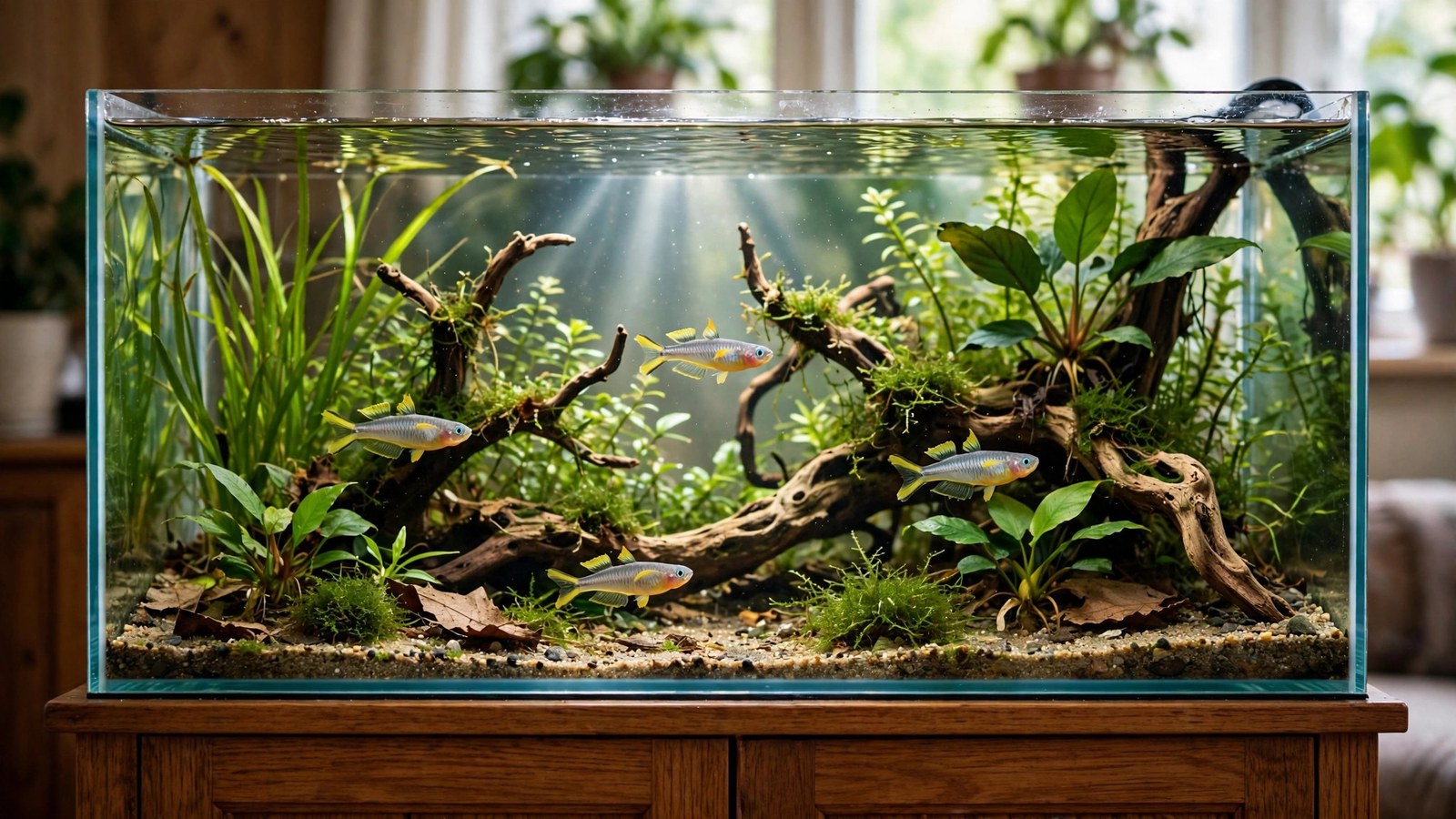
Under a raft of red root floaters, a school of forktail blue-eyes doesn't swim so much as flicker — ten blue-eyed sparks in the dappled light. Most keepers botch the forktail blue eye planted tank by treating them like ordinary tetras: strong flow, bright lights, no lid. That gives you shy fish and jumpers dried on the floor. This guide builds what Pseudomugil furcatus actually wants — a low-tech, lid-sealed, soft-water scape where the school displays at the surface.
Citable summary: A forktail blue eye planted tank is a 10-gallon, low-tech, fully lidded setup for Pseudomugil furcatus: a school of 8–10, dim-to-moderate light (15–30 PAR) under a floating-plant canopy, gentle sponge filtration, pH 6.5–7.5 at 75–79°F (24–26°C), and fine-leaved plants that shelter eggs and fry. The lid is the most important equipment — adults can clear a 2-inch rim gap.
Why a forktail blue eye planted tank works so well
Pseudomugil furcatus comes from slow, shaded rainforest pools in Papua New Guinea. A planted tank with a floating-plant canopy is the closest thing to home they'll get in captivity — and it shows. Under harsh open light, forktails hug the corners. Under a canopy, males fan their yellow tails and display constantly. That display is the reward for getting the setup right.
Plants do reproductive work here too. Forktails lay tiny adhesive eggs on fine-leaved vegetation near the surface, and in a well-planted tank a few fry survive without any separate breeding project. If you're building your first species tank, start with the principles of aquarium plants for fish tanks: the fish-first plant guide, then narrow to the specifics below.
The tank: size, lid, and hardscape
Ten gallons is the honest minimum for a school of eight. These are top- and mid-water swimmers that dart in short bursts, so footprint matters more than height — a standard 10-gallon beats a tall cube. For a school of twelve or a small cleanup crew, step up to a 20-gallon long.
The lid deserves its own paragraph. Forktails spook easily, launch upward, and a rimless tank with a 1–2 inch light gap is a fatality waiting to happen. Use a full glass canopy or tight mesh lid, and seal filter and heater cutouts with sponge or trim. Check it weekly — lids warp, and a half-inch gap is all it takes.
Keep hardscape simple: a gentle slope of fine sand or aquasoil as a streambed, plus a piece of driftwood angled toward the surface that gives fish a ceiling and moss an anchor. This tank is a stage for fish behavior, not an aquascaping contest.
Planting plan: canopy up top, texture below
Build two layers. The floating canopy is non-negotiable; the submerged layer supports eggs, fry, and the look of the scape.
| Layer | Best picks | Role |
|---|---|---|
| Floating canopy | Red root floater, frogbit, dwarf water lettuce | Shades the tank; trailing roots shelter eggs |
| Fine-leaved mid-ground | Hornwort, guppy grass, Java moss | Spawning medium, fry refuge, flow baffle |
| Low foreground | Cryptocoryne parva, dwarf sagittaria | Streambed texture; thrives in low light |
| Attachable accent | Anubias nana petite, Java fern | Wood decoration for deep shade |
Let floaters cover 40–60% of the surface — more starves the lower plants, less and the fish never relax. Thin the canopy weekly; floaters double fast. Everything above grows without CO2, so pair this build with the fertilizing and substrate guidance in low-tech planted tank setup for beginners.
 ★3.9
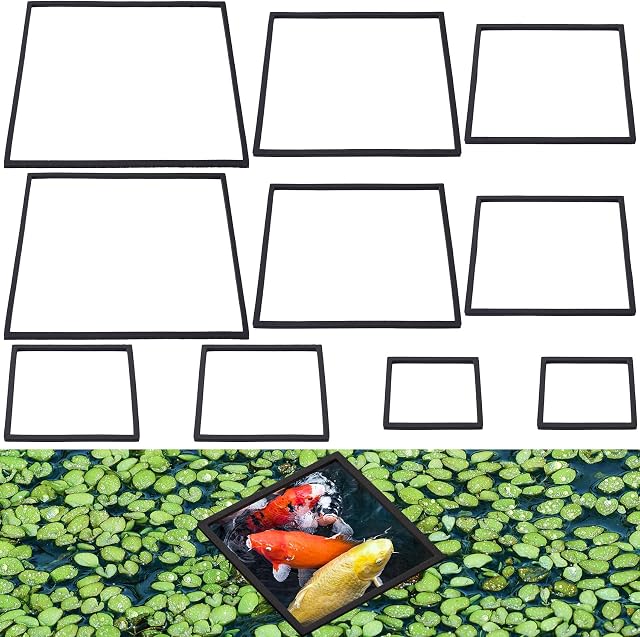
PAGOW Floating Plant Corral Rings
Check Price on Amazon ★3.9Light, flow, and filtration
Forktails come from still water. A canister filter at full blast will pin them in a corner all day. A single air-driven sponge filter is the classic choice — cheap, fry-safe, and impossible to over-power. If you prefer a hang-on-back, baffle the outflow with a sponge and run it at its lowest setting.
Target 15–30 PAR at the substrate: a small LED bar on a dimmer, or a modest light raised 4–6 inches. Start at 6–7 hours daily and extend only once plants grow well. Their blue eye-ring shows most vividly in soft, green-filtered light and washes out under harsh white LEDs.
Water parameters and stocking
Forktail blue-eyes are forgiving but not bulletproof. Keep pH 6.5–7.5, hardness under 12 dGH, and temperature 75–79°F (24–26°C). Stability matters more than any perfect number: change no more than 25–30% weekly and temperature-match the refill.
Stocking is simple: one school of 8–10 forktails, plus optional small tankmates. Good companions are peaceful nano fish that won't outcompete them at feeding time — ember tetras, chili rasboras, or pygmy corydoras for the bottom. Cherry shrimp work too, with dense planting to shelter shrimplets. Skip anything boisterous (danios bully them at the surface) and anything with a mouth big enough for a 2-inch fish.
Comparing to other rainbowfish setups
Forktails get lumped with bigger rainbowfishes, but their needs differ. Species like bosemanis want open swimming lanes and 4-foot tanks; forktails want a shaded, planted surface. The planted rainbowfish tank setup covers the bigger species, while the best schooling fish for planted tanks guide compares forktails against other nano schoolers. For a 10-gallon footprint, forktails are arguably the best-behaved top-water schooler in the hobby — peaceful, hardy once established, and always visible.
Frequently Asked Questions
Do forktail blue-eyes really need a lid, or is it optional?
Mandatory, not optional. Forktails are among the hobby's most reliable jumpers — they startle easily and can clear a 2-inch rim gap. Use a full glass canopy or tight mesh lid, and seal every cutout for filter cords and heaters. A half-inch gap from a warped lid is a genuine escape route, so check the seal weekly.
How many forktail blue-eyes should I keep together?
At least 8, ideally 10 or more. Their whole appeal — the darting displays, males fanning yellow tails, the blue-eyed shimmer — only appears in a confident group. Smaller groups turn shy and hide in the corners, which defeats the purpose of a species tank. A standard 10-gallon comfortably holds 8–10 fish.
Can forktail blue-eyes breed in a planted tank without help?
Yes, they often do. They lay tiny adhesive eggs on fine-leaved plants like Java moss, hornwort, or floating-plant roots near the surface. In a well-planted tank, some eggs survive predation and fry appear after 10–14 days. For higher yields, move a moss clump to a separate container. Frozen daphnia triggers spawning.
Do forktail blue-eyes need CO2 or high light?
No — this is a true low-tech fish. All the plants in this build (floaters, moss, hornwort, crypts, anubias) grow well without injected CO2 at 15–30 PAR. Dimmer light is actually better: the blue eye-ring shows most vividly in soft, shaded light and washes out under bright white LEDs. Dose a basic liquid fertilizer weekly instead.
What tankmates are safe with forktail blue-eyes?
Stick to peaceful nano species that won't outcompete them at the surface: ember tetras, chili rasboras, pygmy corydoras, and cherry shrimp all work. Avoid boisterous fish like danios or tiger barbs — they bully forktails away from food. Skip anything large enough to eat a 2-inch fish. Forktails themselves are completely peaceful.
Where can I find an authoritative Pseudomugil furcatus profile?
Seriously Fish's Pseudomugil furcatus profile is the most authoritative single reference — wild collection data, water parameters, and breeding notes from published literature. Note that domestic lines handle neutral water better than wild-caught fish, so calibrate its parameters to your stock.
Setting up your forktail blue eye planted tank this weekend
A forktail blue eye planted tank rewards restraint: a 10-gallon with a real lid, a floating-plant canopy, gentle flow, and soft light — then patience while the plants root in. Give it two weeks of plant establishment, add your school of eight to ten, and within days you'll see what makes this fish special: males hovering under the floaters, tail fins spread, blue eyes flashing in the green-filtered light.