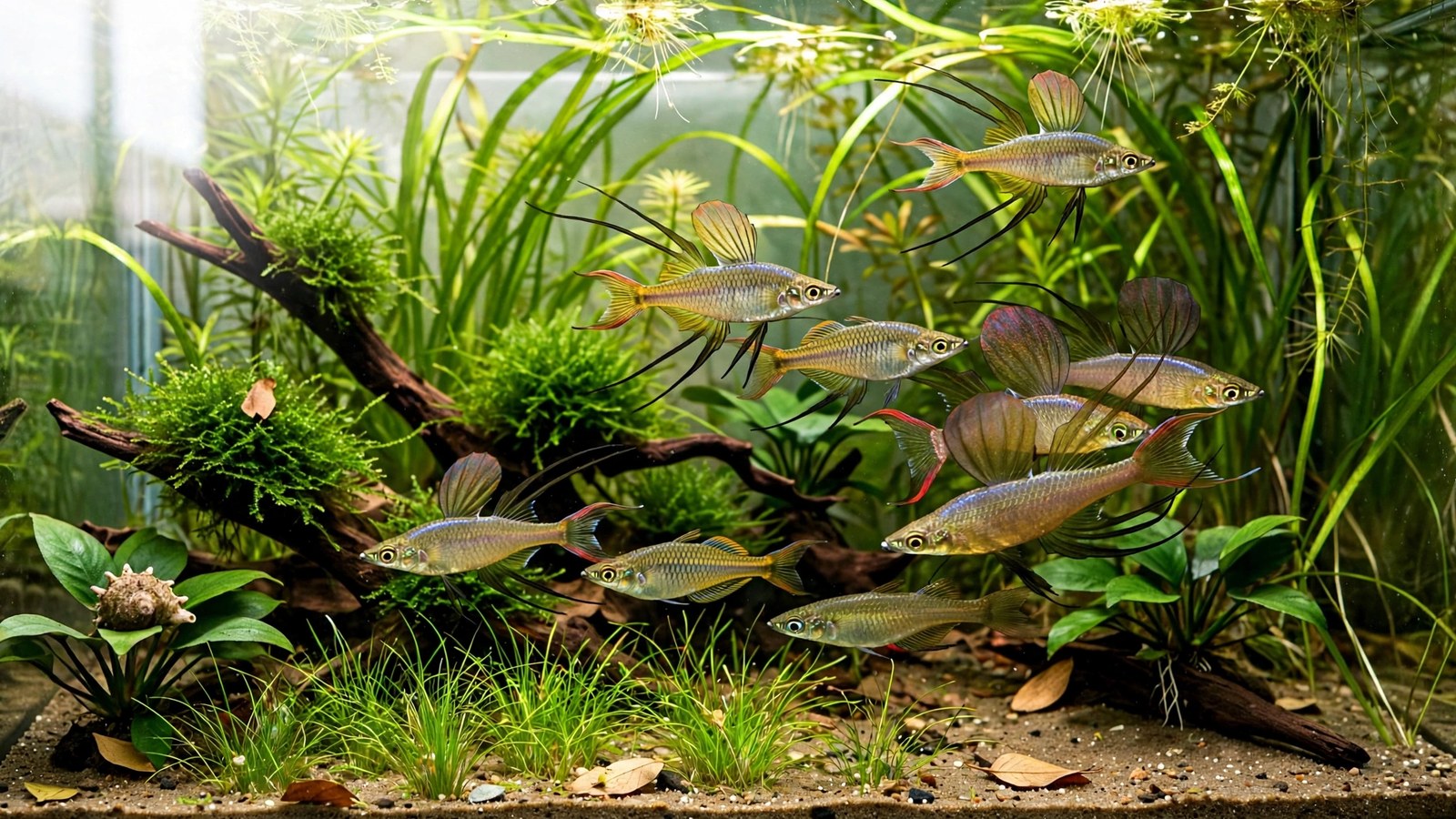
Most rainbowfish crash through a tank like they own it. The threadfin rainbowfish is the exception — a five-centimetre wisp of copper and black that drifts instead of dashes, its fins trailing like silk ribbon in slow water. A threadfin rainbowfish planted tank built around that delicacy is one of the prettiest nano setups you can keep: soft flow, dense fine-leaved cover, and dimmer light that turns every fin flash into theatre. Get the gentleness wrong, though, and these fish fade — literally.
Why threadfins are the feather-fin nano schoolers
Iriatherina werneri, the threadfin rainbowfish, comes from the slow swamps and billabongs of northern Australia and southern New Guinea. Males develop absurdly long second dorsal and anal fins, jet-black and feathered, which they flare at rivals and females in a shimmering semaphore. In an open, high-flow community tank that behaviour disappears: the fish wash out, hide, and stop eating. The planted rainbowfish tank setup gets the basics right — cover, soft water, calm corners — but threadfins need that formula turned gentler and denser than their boisterous cousins like Boeseman's rainbows or dwarf neon rainbows.
Size is the selling point: adults reach 4–5 cm, so a school of ten fits comfortably in a 60-litre aquascape. Females are smaller and plainer; males are the show. Aim for a male-heavy ratio — two males per female — because male rivalry is what keeps the fin displays coming. A school of only females and one male will display rarely, and you'll miss the whole point of the fish.
Building the threadfin rainbowfish planted tank: tank and flow
Start with a 60 cm (60-litre) tank if you can — the footprint gives a ten-fish school a real display lane along the front glass. Threadfins live in sluggish water in the wild, so filtration should be gentle: a small canister or hang-on-back with the outflow baffled, or a large sponge filter. Target 3–4× turnover per hour, not the 6–8× of a typical high-tech layout. Watch the fish, not the numbers: if fins are streaming backward at rest, the flow is too strong.
Water parameters are forgiving — pH 6.0–7.5, 23–28°C, soft to moderately hard water. Stability matters more than precision; threadfins sulk after big swings. A weekly 25–30% water change with matched-temperature water keeps them settled, and they handle the soft, slightly acidic water most planted tanks already run.
Planting for feather fins: dense, fine, and dim
Threadfins spawn by scattering eggs in fine vegetation, and males display among stems — so fine-leaved plants are both décor and function. Plant 60–70% of the substrate with soft, dense growth:
- Background: Cabomba furcata, Limnophila sessiliflora, or rotala — tall, fine stems for spawning and cover.
- Midground: Cryptocoryne wendtii or Staurogyne repens for calm resting zones between displays.
- Foreground: Monte Carlo or Helanthium tenellum carpet, left open along the front for the display lane.
- Floaters: Salvinia minima or frogbit covering 30–40% of the surface — this is non-negotiable.
The floaters do three jobs: they dim the light to the soft, dappled levels threadfins prefer; they give shade that brings males' black fins into high contrast; and they calm the surface, which makes shy fish bolder. Light the tank at low–medium intensity (roughly 20–30 PAR at substrate) for 7–8 hours. CO2 is optional — fine-leaved stems grow well in low-tech setups with good substrate.
For plant choices that thrive in exactly this kind of low-energy, fish-first aquascape, see the aquarium plants for fish tank guide and the complete freshwater aquarium plants guide — both favour the hardy, undemanding species threadfin tanks do best with.
 ★3.9
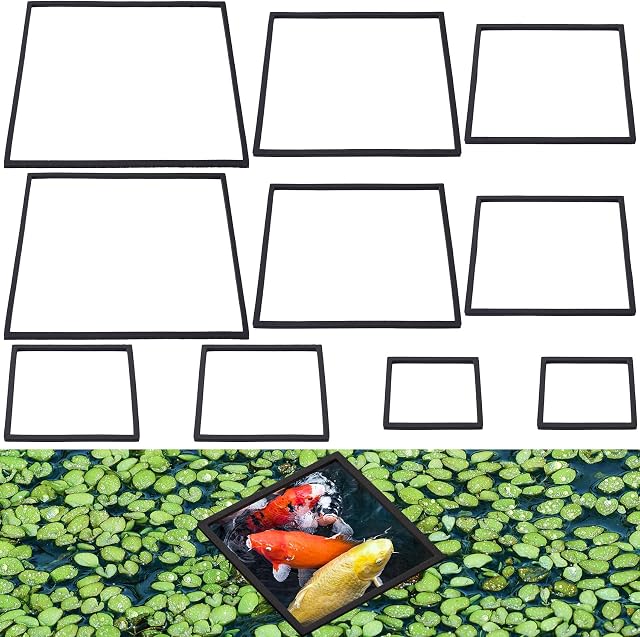
PAGOW Floating Plant Corral Rings
Check Price on Amazon ★3.9Tankmates: calm company only
Threadfins are the slowest eaters in any tank they share. Put them with hungry tetras and they'll starve in plain sight — the food vanishes before it reaches them. Choose companions that are small, unhurried, and plant-friendly:
| Tankmate | Why it works | Notes |
|---|---|---|
| Ember tetra | Slow, mid-water, similar size | Ember tetra planted setup for details |
| Celestial pearl danio | Gentle, occupies lower levels | Celestial pearl danio setup |
| Neon tetra | Calm schooler, mid-water | Planted neon tetra tank |
| Pygmy corydoras | Bottom dweller, never competes | School of 6–8 |
| Cherry shrimp | Cleanup, zero competition | Some shrimplets may be eaten |
Avoid: tiger barbs, serpae tetras, danios (Danio rerio), gouramis, bettas, or any large cichlid. Fast or nippy fish don't just outcompete threadfins — they'll chew the trailing fins that make these fish worth keeping.
Feeding small mouths, twice a day
Threadfins have tiny mouths and small stomachs. Feed small portions twice daily rather than one big meal, and vary the menu: high-quality micro-pellets or crushed flake as the base, frozen cyclops or daphnia 3–4 times a week, and powdered fry food for conditioning. They take 2–3 minutes to finish a feeding — if food hits the substrate uneaten, you're overfeeding.
New fish often refuse food for 2–3 days after arrival. Dim the lights, offer frozen daphnia, and don't panic — once the first fish eats, the school follows. Colour is your report card: well-fed males glow copper-gold with black fins; underfed ones turn grey within a week.
Breeding threadfins in the planted tank
A well-planted threadfin tank breeds itself quietly. Males spar among the fine stems at dawn, females scatter a few adhesive eggs daily into plants like cabomba or spawning mops, and the parents largely ignore the eggs — but they will eat free-swimming fry. If you want numbers, move a spawning mop with eggs to a separate 20-litre container with matching water and an air-driven sponge filter. Eggs hatch in 7–10 days at 26°C; fry take infusoria or powdered fry food for the first week, then microworms. Leave the tank as-is and a few fry will still survive in dense planting — a bonus colony that slowly tops up your school. Worth bookmarking: Tropica's plant database for fine-leaved stem choices, and Seriously Fish's Iriatherina werneri profile for wild habitat data.
Frequently Asked Questions
How many threadfin rainbowfish should I keep together?
Keep 8–12 as a minimum school, with two males per female for the best displays. Smaller groups turn shy and hide; single pairs rarely colour up. In a 60-litre planted tank, 10–12 fish is the sweet spot between a lively school and manageable bioload.
Can threadfin rainbowfish live with a betta?
No — don't try it. Bettas are territorial and see the threadfins' long, flowing fins as rival flags; fin-nipping and stress follow quickly. Threadfins also lose every feeding contest against a betta. House them only with small, peaceful species.
Why are my threadfin rainbowfish losing colour?
The three usual causes are too few males (no display rivalry), overly bright lighting with no floating-plant shade, and being outcompeted at feeding time. Check all three: male-heavy ratio, 30–40% surface cover, and confirm each fish actually eats at mealtimes.
Do threadfin rainbowfish need a heater?
Yes in most homes — they prefer 23–28°C and sulk below 22°C. A 50W adjustable heater in a 60-litre tank holds a steady 25–26°C. Keep the heater near the filter outflow so warmth distributes evenly without creating hot spots.
Are threadfin rainbowfish good for beginners?
They're a solid second fish, less forgiving than a first-tank tetra. The care itself is easy — hardy, adaptable water needs — but beginners often fail on tankmate choice and feeding competition. If you can commit to calm companions and small twice-daily feedings, you'll do fine.
Your gentle-water showpiece
A threadfin rainbowfish planted tank rewards restraint: soft flow, dim light, dense fine stems, and patient feeding. Build it that way and ten males sparring in a sun-dappled display lane will outshine any high-energy community tank.