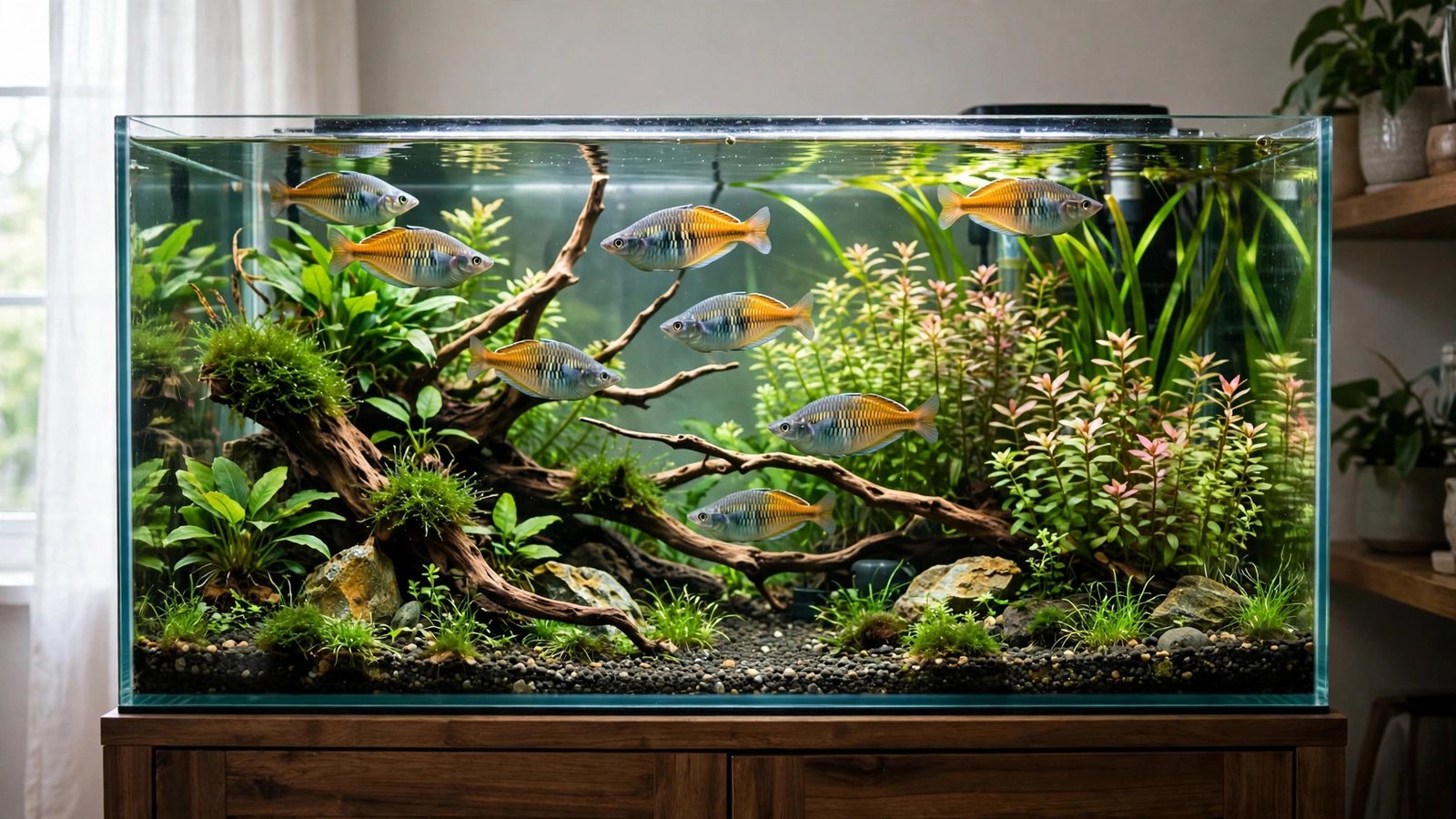
A juvenile Boeseman's rainbowfish looks like a mistake — dull grey, half of it missing its color. Six months later, that same fish can outshine everything in your tank. The costliest error in a boesemani rainbowfish planted tank is building it like a soft-water Amazon setup: low pH, delicate stems, CO2-driven fragility. These are boisterous swimmers from the hard, alkaline lakes of New Guinea. Build for their biology — big tank, open swimming lanes, tough rooted plants — and you get one of the most rewarding displays in the hobby.
Boeseman's rainbowfish (Melanotaenia boesemani) are bicolor showstoppers — iridescent blue-grey fronts melting into burnt orange rears in dominant males, and four-inch torpedoes that never sit still. Success is less about aquascaping finesse and more about engineering a tank that looks beautiful while surviving a daily stampede. Our planted rainbowfish tank guide compares the whole family; this article goes deep on the Boeseman's-specific build.
Why Boeseman's Suit Planted Tanks
Many classic planted-tank fish prefer soft, acidic water and calm corners. Boeseman's flip that script:
- Hard-water friendly. Most tap water is moderately hard and alkaline. These fish thrive in it, so you're working with your tap, not against it.
- Plant-safe. They don't dig, uproot, or chew leaves. Damage comes from traffic, not teeth.
- Mid-to-upper water column. They patrol the top half, leaving the substrate and foreground in peace.
- Big-tank scale. A school of ten 4-inch fish gives a presence nano species can't.
Tank Size and Schooling: Go Bigger Than You Think
A 55-gallon tank is the honest minimum for 6–8 fish; a 75-gallon (48-inch) tank is where they settle and color up. Longer beats taller — horizontal swimming room is the currency.
School size matters as much as tank size: six fish survive, but eight to ten transform — sub-dominant males show more color, sparring spreads out, and the school moves as a shimmering unit instead of hiding.
Building Your boesemani rainbowfish planted tank: Step by Step
Layout follows one rule: plant the borders, leave the center open. A dense perimeter of tall plants with a wide central lane gives the school a runway.
- Back wall — the tall screen. Giant Vallisneria (V. americana or V. spiralis) along the back glass. It grows fast in hard water, tolerates traffic, and its ribbons sway with the current the fish create.
- Midground anchors. Amazon swords (Echinodorus bleheri, E. amazonicus) and large Anubias (A. barteri, A. coffeefolia) tied to driftwood or lava rock — nearly indestructible once established.
- Foreground — low and tough. Dwarf sagittaria (Sagittaria subulata) handles hard water and the occasional fish blitz better than a delicate carpet. Let it colonize naturally.
- Root deeply. Root tabs under every heavy feeder, swords planted 2–3 inches into the substrate, and 4–6 weeks of anchoring before the full school goes in.
For the full planting playbook, our complete freshwater aquarium plants guide covers substrate, lighting, and fertilization.
Water Parameters: Hard and Alkaline Wins
Here's where Boeseman's diverge from the typical planted-tank script. They come from the hard, alkaline lakes of West Papua — Lake Ajamaru, Lake Hain, Lake Aitinjo. They do not want your pH 6.5 CO2-crashed scape.
| Parameter | Target range | Notes |
|---|---|---|
| Temperature | 72–77 °F (22–25 °C) | Cooler end extends lifespan |
| pH | 7.0–8.0 | Stability beats exact numbers |
| GH (hardness) | 10–20 dGH | Most US tap water lands here naturally |
| KH | 6–12 dKH | Buffers pH drift |
| Ammonia / nitrite | 0 ppm | Cycle fully first |
Most hardy plants — Vallisneria, swords, Anubias, Java fern — grow fine at pH 7.5 with moderate hardness. If your tap is soft, add crushed coral or aragonite to the filter or substrate to raise KH rather than chasing bottled buffers. Read planted tank water parameters for the full logic — and cycling a planted tank faster to get fish-ready in weeks.
Feeding: Fuel for Color and Speed
A varied diet is the biggest lever on color. These omnivores lean protein: a quality small pellet or flake as the base, plus frozen daphnia, bloodworms, or mysis shrimp two to three times a week. The carotenoids in crustacean-based foods directly feed that orange rear half.
Feed twice daily what they finish in two minutes — a big school generates serious waste. Skip dyed "color-enhancing" flakes as a staple; whole-ingredient variety beats artificial enhancers.
What to Buy for a Rainbowfish Planted Tank
Boeseman's don't need exotic gear, but their size and speed make a few choices matter. A canister filter rated for at least 1.5× your tank volume keeps up with the bioload — pair it with a spray bar so flow is even, not blasting. A 4-foot light in the medium range (30–50 PAR at substrate) grows Vallisneria and swords without CO2; skip high-light, high-CO2 regimes, which fight the hard-water chemistry these fish want. Stock one quality staple pellet plus frozen daphnia and bloodworms for the color rotation. And get a tight-fitting lid — rainbowfish are jumpers, especially the first week. (See our 75-gallon planted tank build for the full large-tank filtration layout.)
Keeping the School Happy Long-Term
Boeseman's are peaceful but relentless. A few long-game notes:
- Males spar, harmlessly. Flaring and side-by-side posturing is display, not aggression. Worry only if one fish is consistently pinned and not eating — then add females or more tall-plant sightlines.
- Sex ratio. Aim for roughly equal males and females. Juveniles can't be sexed reliably, so buy 8–10 and let ratios sort themselves.
- Lifespan. Expect 5–8 years in good conditions — stock it like the long-haul school it is.
- Tankmates. Peaceful mid-size fish that tolerate hard water: Congo tetras, larger danios, bristlenose plecos, cherry barbs. Our best schooling fish for planted tanks ranks a dozen options.
- Maintenance. 30% water change weekly, trim Vallisneria runners monthly, root-tab the swords every 6–8 weeks.
Frequently Asked Questions
How many Boeseman's rainbowfish should I keep together?
Eight to ten is the sweet spot. Six is the absolute minimum, but small groups produce shy, washed-out fish that hide behind the filter. Larger schools spread sparring across the group, and sub-dominant males develop far better color when they're not the sole target. In a 75-gallon tank, 10–12 fish is spectacular and sustainable.
Do Boeseman's rainbowfish eat aquarium plants?
No — they don't graze, dig, or uproot plants. The only risk is physical: a school of 4-inch fish sprinting through delicate stems can snap them or dislodge fresh plantings. That's why this setup favors tough, deep-rooted species like Vallisneria and swords, and gives new plantings a month to anchor before the full school goes in.
Can I keep Boeseman's rainbowfish in soft, acidic water?
You shouldn't. They evolved in hard, alkaline New Guinea lakes (pH 7.0–8.0, 10–20 dGH), and soft acidic water stresses them, dulls their color, and shortens their lifespan. If your tap is soft, raise KH with crushed coral or aragonite. The upside: most US tap water is already in their preferred range.
Why is my Boeseman's rainbowfish not colorful?
Three usual causes: it's a juvenile (full bicolor develops over 8–12 months), the group is small or male-skewed (color is social — bigger, balanced schools color up), or the diet lacks carotenoids (add frozen daphnia, mysis, or bloodworms). Only dominant, comfortable males show the full blue-to-orange split — give them time, company, and good food.
Do I need CO2 in a Boeseman's rainbowfish planted tank?
No. The hard-water, medium-light palette here — Vallisneria, swords, Anubias, dwarf sagittaria — grows vigorously without CO2 injection. CO2 also pulls pH down, working against the alkaline conditions these fish prefer. Spend the CO2 budget on a larger filter and better frozen food instead.
A Tank Worth the Wait
Boeseman's reward patience twice: the scape matures into a swaying green valley in months, and the fish transform from grey juveniles into bicolor showpieces within a year. Build big, plant tough, keep the water hard and stable, feed like you mean it. For broader inspiration, our aquarium plants for fish tanks guide covers species pairings for the whole hobby.