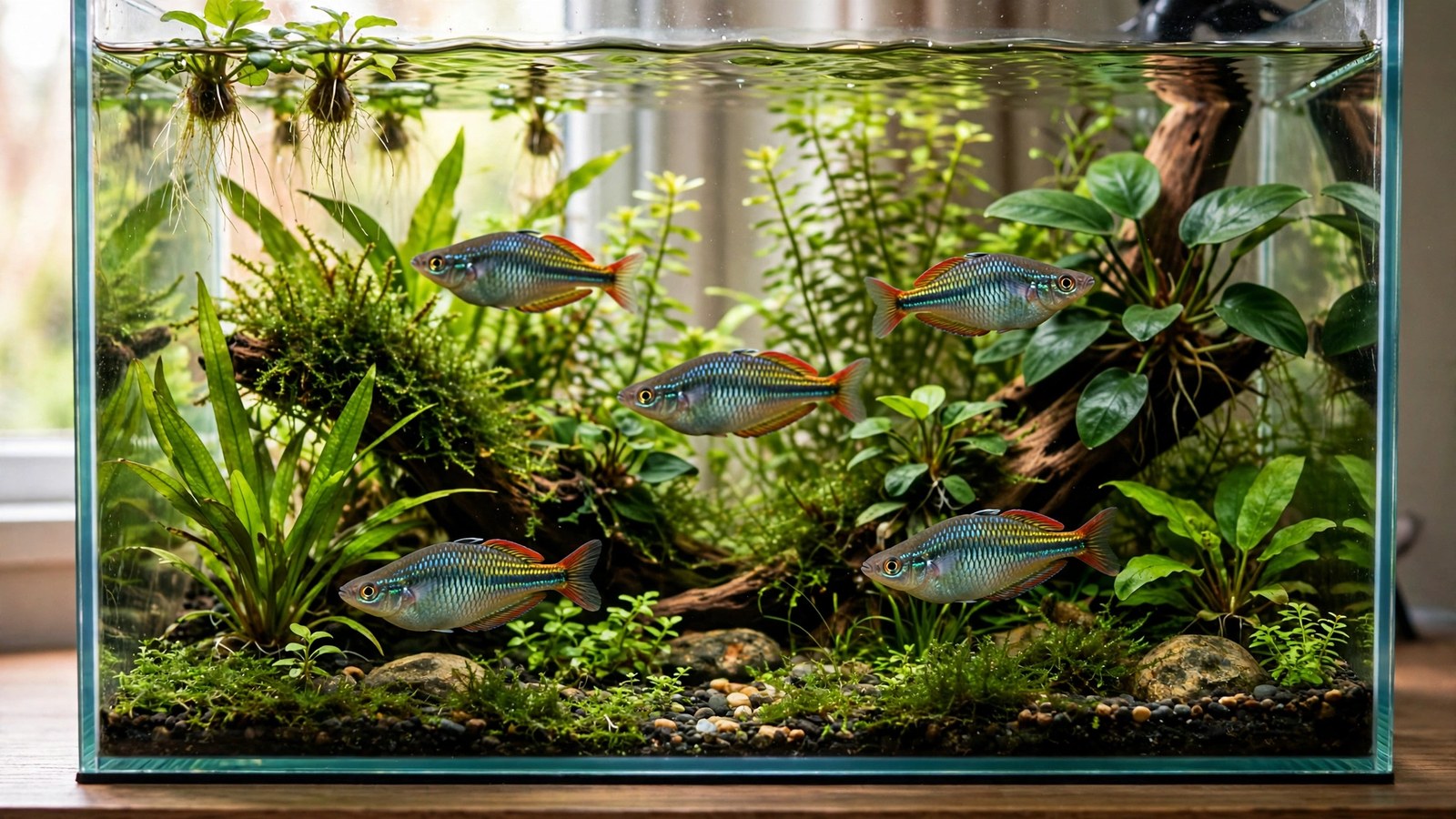
Flip on your aquarium light at dusk and a school of dwarf neon rainbows ignites — cobalt-blue bodies flashing iridescent stripes as they dart through the plants, red fins glowing like embers. That five-second moment is exactly why the dwarf neon rainbowfish planted tank has become the go-to showpiece for nano and mid-size setups. Melanotaenia praecox packs the movement, color, and schooling drama of fish twice its size into a tidy 2.5-inch body, and it thrives in exactly the kind of planted aquascape you already want to build. By the end of this guide, you will know the tank size, school, water chemistry, plant layout, and weekly routine that keep a praecox school flashing at full color for years.
Dwarf neon rainbowfish vs. other rainbows: know what you are buying
Rainbowfish is a crowded family, and mix-ups at the fish shop are common. The dwarf neon rainbowfish (Melanotaenia praecox) from the Mamberamo River in Papua reaches about 2.5 inches — half the bulk of Boeseman's rainbowfish, which grows to 4 inches and needs a 55-gallon tank. Praecox bodies are iridescent electric blue from head to tail with vivid red fins; Boeseman's shows a blue-grey front half melting into orange-red rear. That distinction matters for your aquascape: a school of praecox fits comfortably in a 20-gallon long, while Boeseman's rainbowfish demand a much bigger planted setup and harder, alkaline water. If you want big-swim drama in a modest tank, praecox is the right rainbow.
Your dwarf neon rainbowfish planted tank: the core setup
Build around two needs: lateral swim space and a lighting "stage" that makes the iridescence pop. A 20-gallon long is the sweet spot for a school of 8–10; praecox cruise the middle third of the water column, so a long, shallow footprint beats a tall cube.
| Parameter | Target | Why it matters |
|---|---|---|
| Temperature | 23–26 °C (73–79 °F) | Cool ends of this range extend lifespan; avoid long spells above 28 °C |
| pH | 6.8–7.4 | Slightly alkaline-leaning neutral; praecox are flexible within this band |
| GH (general hardness) | 5–12 °dGH | Soft-to-moderate water suits both fish and most plants |
| KH | 3–8 °dKH | Buffers pH against CO2 injection swings |
| Ammonia / nitrite | 0 ppm | Cycle the tank fully before the school arrives — praecox hate fresh tanks |
| Nitrate | <20 ppm | Hold with weekly 30% water changes and plant uptake |
| Filtration | Gentle HOB or canister, 4–6× turnover | Praecox enjoy mild flow but not a torrent |
| Lid | Tight-fitting, always | Rainbows are strong jumpers, especially new arrivals |
Lighting the flash
The neon shimmer is structural coloration — it needs light to read. Run a full-spectrum LED at moderate intensity (roughly 30–50 PAR at substrate) for 7–8 hours a day, concentrating the brightest zone over the open swim lane where the school feeds. Keep at least half the surface open so light reaches mid-water.
Plant picks that suit an active rainbow school
Choose plants that tolerate curious fish and open up the middle of the tank. Fine-leaved stems (cabomba, myriophyllum) can look shredded after a school of rainbows barrels through them daily — lean on tougher, broader leaves instead. If you are still choosing between easy plant lists, start with this fish-first plant guide before you buy.
| Plant | Placement | Why it works for praecox |
|---|---|---|
| Vallisneria spiralis | Background, sides | Flowing grass ribbons form visual "walls" that calm the school without blocking lanes |
| Cryptocoryne wendtii | Midground | Dense low rosettes give juveniles hiding spots; unfazed by darting fish |
| Java fern (Microsorum pteropus) | On driftwood | Tough, unpalatable leaves; anchors the hardscape beautifully |
| Anubias barteri 'nana' | Foreground accents | Slow, sturdy, and shrugs off curious mouths |
| Amazon frogbit or salvinia | Surface (cover ≤50%) | Diffuses light for a natural river look and gives shy fish overhead cover |
Lay out dense plantings along the back and both ends, then leave the central 12–18 inches open — that is your swim lane and viewing stage. If a minimalist approach appeals to you, the lightly planted setup guide pairs perfectly with praecox: sparse planting plus open water is their native river shape.
Feeding, tankmates, and weekly routine
Praecox are easygoing omnivores that snatch food mid-water. A quality micro-pellet or crushed flake is the staple; rotate in frozen daphnia, baby brine shrimp, and cyclops 3–4 times a week for the carotenoids that keep red fins red. Feed little and watch — food that sinks in under a minute goes uneaten.
Tankmate selection is straightforward: nothing big enough to eat them, nothing nippy enough to shred fins. Peaceful mid-water schoolers like cardinal tetras or rummynose tetras make superb companions and embolden praecox — bigger mixed schools read as safety. Bottom dwellers (corydoras, otocinclus, cherry shrimp) fill the lower layers the rainbows ignore. For a contrasting surface species, zebra danios share similar water and energy — but they are jumpier, so keep that lid sealed.
Your weekly routine stays simple: 30% water change with dechlorinated, temperature-matched water; quick test of nitrate and pH; trim any vallisneria runners creeping into the swim lane; wipe front glass. In a CO2-injected tank, check the drop checker stays green-yellow and never runs after lights-out — pH swings stress rainbows faster than slightly high nitrates do.
Frequently Asked Questions
How many dwarf neon rainbowfish should I keep together?
Keep 8–10 as a comfortable minimum, never fewer than 6. Praecox are true schooling fish: small groups hide in corners, lose their iridescent blue, and stress easily. A school of 8–10 in a 20-gallon long behaves boldly, displays to each other, and flashes full color within a couple of weeks of settling in.
Why did my dwarf neon rainbowfish lose their blue color?
Nearly always one of three things: a school that is too small, inadequate lighting, or stress from unstable water. Check that you have 6+ fish, that light reaches the mid-water zone where they swim, and that ammonia/nitrite read zero. New arrivals often look grey for 1–2 weeks; color returns as they settle and recognize feeding routines.
Do dwarf neon rainbowfish need CO2 or special plants?
No. They thrive in low-tech setups with easy plants like Java fern, Anubias, and Cryptocoryne. CO2 injection is optional and purely for plant growth ambitions. What they do need is open swimming space — prioritize a clear mid-water lane over planting every square inch, since darting through gaps is how they display.
Can dwarf neon rainbowfish live with cherry shrimp?
Adults and dense plant cover make it workable, but expect losses. Praecox will eat newborn shrimplets on sight. If shrimp are a priority, establish a thick colony in moss or Cryptocoryne first, add the fish later, and accept that breeding will be slow. Keep shrimp in a separate tank if you want full breeding output.
How long do dwarf neon rainbowfish live?
Typically 3–5 years with good care, and they can reach 6+ in cool, stable tanks. Keeping them at the cool end of their range (23–24 °C) rather than the warm end slows metabolism and extends lifespan. Avoid long spells above 28 °C, which visibly shorten their lives. The Seriously Fish species profile for Melanotaenia praecox notes similar longevity ranges from hobbyist records.
A dwarf neon rainbowfish school is one of the highest joy-per-dollar purchases in the hobby: a 20-gallon long, honest plants, and a group of eight is all it takes to own that electric blue flash every day. Set it up right once — long lanes, lit stage, full school — and the fish do the rest.