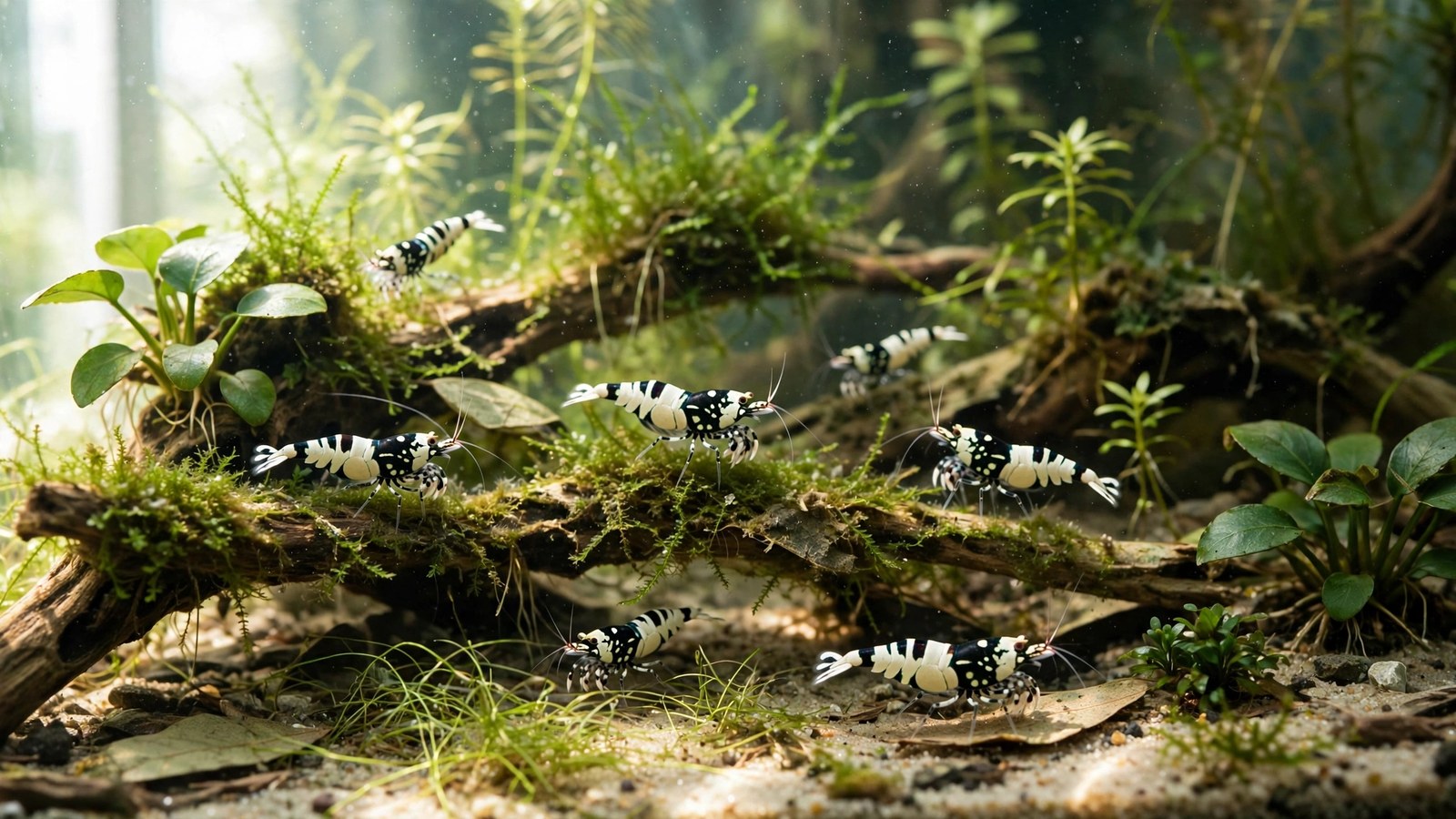
Most panda shrimp deaths happen within the first month — not from disease, but from water that was never right for them. The black-and-white bee-banded morph of the Taiwan Bee family is one of the prettiest dwarf shrimp you can keep, and one of the least forgiving: soft acidic water, an active buffering substrate, and a mature planted tank are the price of admission. Below: the exact setup, a 2–3× weekly feeding rhythm, and the near-75°F breeding trigger that turns survivors into a colony.
How do you care for panda shrimp? Keep them in a mature, heavily planted tank with an active buffering substrate and RO water at pH 6.0–6.8, GH 4–6, KH 0–1, and TDS 120–150 at 68–78°F. Feed 2–3 times a week, change 10–20% of the water weekly, and don't mix them with other Taiwan Bee varieties unless you want mixed-pattern offspring. Breeding initiates near 75°F with stable parameters and a protein-rich diet; females carry eggs for roughly 30 days.
Panda or Shadow Panda? Read this first
Panda shrimp are not Shadow Panda shrimp, though retailers sometimes blur the two. The Panda is the original black-and-white bee-banded morph — crisp white bands across a black body, no blue anywhere. The Shadow Panda came later: a selective cross of black panda × blue bolt that reads as solid dark blue-black, with a blue hue that deepens as it matures and no clean white bands. Both are Caridina cf. cantonensis (see the Caridina cantonensis species profile for the lineage) — Taiwan Bee shrimp with identical water needs — and because they are the same species, they interbreed freely. Kept together they produce mixed-pattern offspring, not hybrids — so breeders keep each line in its own tank.
Pandas sit inside a larger family of selectively bred Taiwan Bee varieties — crystal reds, blue bolts, tigers — all on the same soft-water chemistry. For the whole Taiwan Bee family and which morph to buy first, see the Bee Shrimp family guide. If you are torn between the two dark morphs, the shadow panda shrimp guide breaks down how the blue-black cross differs.
The panda shrimp tank setup
Start with a well-planted tank — and not just for looks. Dense planting feeds the colony: leaves and stems grow the biofilm shrimp graze all day, mosses shelter newborn shrimplets, and shaded pockets keep Pandas foraging in the open. Plan your planting around plants that feed a shrimp colony rather than whatever looks good at the shop.
Under the plants, use an active buffering shrimp substrate — this pins pH in the 6.0–6.8 window and strips carbonate hardness out of your water. Add driftwood, smooth rocks, and small caves for grazing surfaces and molting cover. Cycle the tank fully, then let it mature: a brand-new tank has no biofilm, and biofilm is the pantry.
Keep dosing light and plant-appropriate; heavy fertilizer routines have no place in a Caridina tank, so read the shrimp-safe fertilizing angle before you dose anything. Change 10–20% of the water weekly with RO water — never straight tap — and when new shrimp arrive, drip-acclimate new shrimp slowly; the first day's parameter shock is where most losses happen.
Water parameters: the non-negotiable table
| Parameter | Target | Why it matters |
|---|---|---|
| pH | 6.0–6.8 | Held by active substrate; stability beats chasing a number |
| GH | 4–6 | Molting minerals — too low and molts fail |
| KH | 0–1 | Must stay near zero to hold pH down |
| TDS | 120–150 ppm | The quick daily check with a handheld meter |
| Temperature | 68–78°F | Cooler side of tropical; near 75°F to trigger breeding |
| Ammonia / nitrite | 0 | Non-negotiable — any reading means the tank isn't ready |
| Nitrate | <25 ppm | Kept low with weekly water changes |
Test pH, GH, and KH with liquid kits and check TDS with a meter. What matters most is that the numbers look the same week after week — a flat pH 6.4 beats a swinging perfect 6.0.
GH+ remineralizer matches the RO-water recipe in the parameter table: Bee Shrimp Mineral GH+ remineralizer ★4.8.
Feeding: less is the whole game
A mature planted tank feeds Pandas most of the week on its own — biofilm on leaves, wood, and glass, plus decaying plant matter they graze constantly. That is why you feed a quality shrimp food only 2–3 times a week, in an amount finished within a couple of hours. Uneaten food rots, spikes the water, and kills faster than any missed meal.
If your tank is new or thinly planted, grow the pantry deliberately — growing biofilm on purpose for shrimp covers botanicals, surfaces, and seasoning timelines. For the grazing layer itself, easy plants for grazing cover are the ones that survive while you learn shrimp water chemistry.
Breeding panda shrimp
Pandas breed readily once conditions are right — the challenge is entirely in the conditions. Keep parameters rock-stable for weeks, feed a protein-rich diet, and hold the tank near 75°F; those three together are the trigger. Females carry their eggs for roughly 30 days before releasing fully formed shrimplets, so the only "fry care" is a tank already full of biofilm.
One more breeding truth: because every Taiwan Bee variety is the same species, Pandas will cross with blue bolts, shadow pandas, or crystal reds in the same tank — and the offspring come out mixed-pattern, not pure. Keep your Panda line alone if you care about the pattern. Expect collector pricing: SoShrimp lists its BKK/Panda juvenile mix (¼–½ inch) at $39.95.
Frequently Asked Questions
Are panda shrimp good for beginners?
No — Panda shrimp are an intermediate-to-advanced shrimp, not a first shrimp. They need RO water, an active buffering substrate, and parameter discipline beginners are still learning. Start with a hardy colony like cherry shrimp, and graduate to Pandas once your parameters stay steady for months.
What is the difference between panda shrimp and shadow panda shrimp?
Panda shrimp are the original black-and-white bee-banded morph: crisp white bands on a black body, no blue. Shadow pandas are a later selective cross of black panda × blue bolt — solid dark blue-black with a blue hue that deepens as they mature, and no clean white bands. Both are the same species with identical water needs, so buy whichever pattern you love and keep the lines in separate tanks.
Will panda shrimp breed with my blue bolts?
Yes. Every Taiwan Bee variety — Panda, blue bolt, shadow panda, crystal red, and the rest — is the same species, so they interbreed freely. The offspring aren't hybrids; they're mixed-pattern shrimp carrying traits from both parents. Fine for a lively mixed colony, but house each variety in its own tank if you paid collector prices for a pure Panda line.
How long do panda shrimp carry their eggs?
About 30 days — a family trait of Taiwan Bee shrimp. Once a female is berried, leave the tank alone: stable parameters and plenty of biofilm matter more than any intervention. Eggs hatch into fully formed shrimplets that graze immediately, which is why a seasoned planted tank breeds Pandas and a sterile one doesn't.
Why did my panda shrimp die after a water change?
Almost always a parameter swing: water that differs in pH, GH, or temperature shocks a soft-water shrimp fast. Change only 10–20% at a time, always with RO water remineralized to match the tank, and temperature-match every bucket. Ammonia and nitrite must stay at zero, nitrate under 25 ppm — and drip-acclimate new arrivals instead of floating and dumping.
Panda shrimp reward patience more than spending. The keepers with thriving colonies aren't the ones with the priciest gear — they're the ones who built soft, stable water and then left it alone. Give Pandas that foundation and the black-and-white colony becomes the calmest corner of your tank.