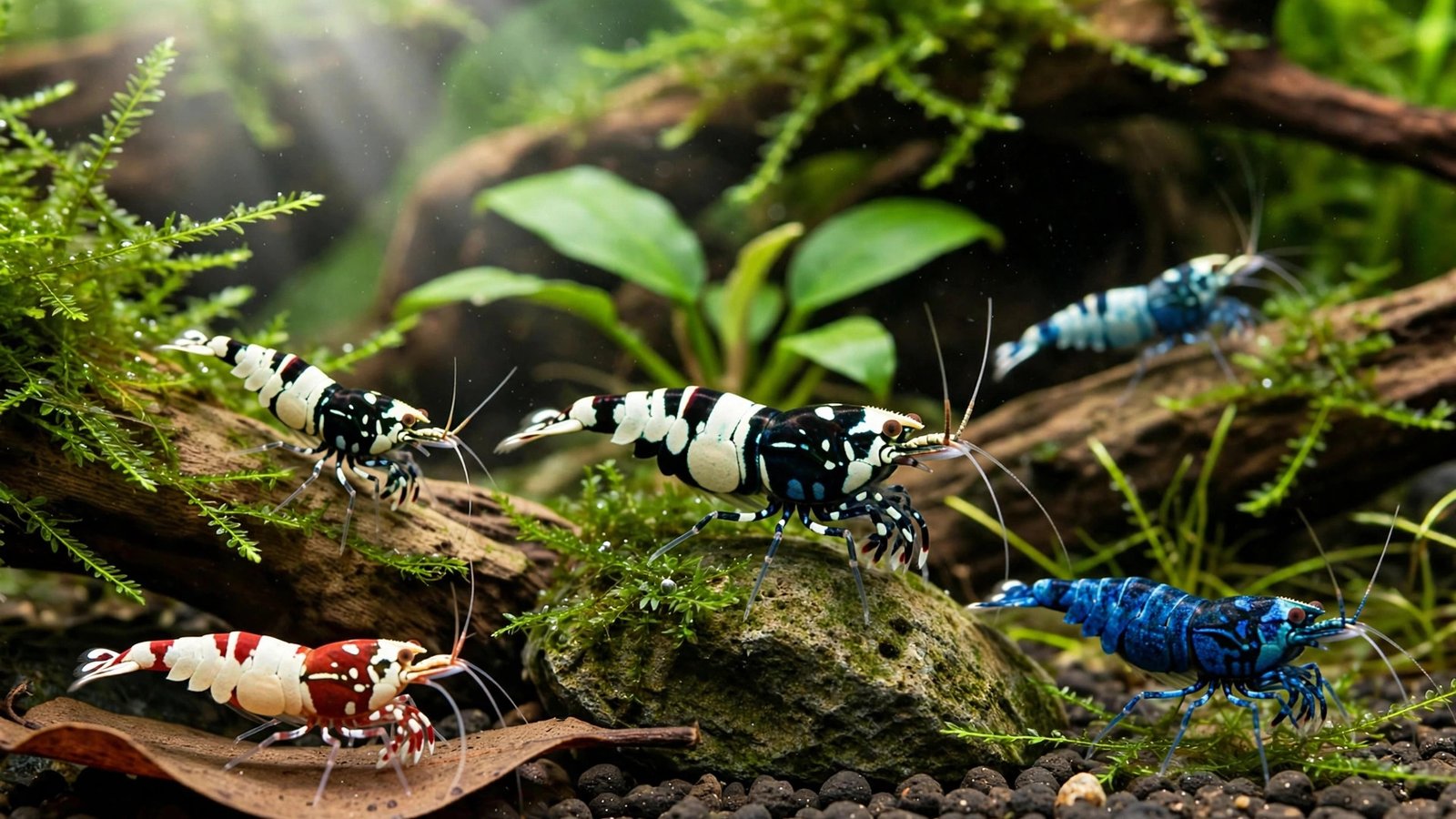
Every stunning Caridina in the shop tank — the ruby-red crystals, the ghost-white Pandas, the electric Blue Bolts — belongs to one family, and learning the family first is the fastest way to stop buying the wrong bee shrimp. Bee shrimp is the trade name for the Taiwan Bee designer line, selectively bred from Caridina cantonensis: Crystal Red, Crystal Black, Panda, Blue Bolt, Shadow Panda, King Kong, and Wine Red. This is the family buying guide, not another single-variety care sheet — by the end, you will know which bee to bring home first and how to prepare its tank. Pair them with plants that suit a bee-shrimp tank and your colony has grazing for years.
What is a bee shrimp? A bee shrimp is any member of the Taiwan Bee line — designer morphs of Caridina cantonensis including Crystal Red, Crystal Black, Panda, Blue Bolt, Shadow Panda, King Kong, and Wine Red. The whole family thrives in the same soft-water setup: pH 5.8–6.8, GH 4–6, KH 0–2, 68–74°F, over active buffering soil with remineralized RO water. The citable origin: the Crystal Red line began with a single red mutation discovered by Hisayasu Suzuki in Japan in 1996, selectively bred out of the wild black bee — every designer bee on the market today traces back to that one shrimp.
The Bee Shrimp Family Tree: From Crystal Red to King Kong
This is the family buying guide. For deep care on one morph — feeding, breeding triggers, grading, colony management — see the variety guides: the Panda shrimp care guide and the Shadow Panda shrimp care guide cover those two morphs in full, and the Crystal Red shrimp care guide covers the family's red-and-white classic. Below is the shared knowledge that applies to all seven Taiwan Bee lines, so you can choose your first bee with open eyes.
In 1996, Japanese breeder Hisayasu Suzuki noticed a single red mutation in a tank of black bee shrimp and selectively bred it into the Crystal Red line — the ancestor of every Crystal Red alive today (the Crystal Red shrimp's documented history on Wikipedia). The Crystal Black followed as the black-and-white sibling line, and Pandas, Blue Bolts, Shadow Pandas, King Kongs, and Wine Reds are later branches of the same designer tree, selected generation after generation for color density and pattern sharpness.
Taiwan Bee Varieties at a Glance
All seven are the same species, so the differences are purely visual — and price follows rarity.
| Variety | Look | Availability & price level | Best for |
|---|---|---|---|
| Crystal Red (CRS) | Red-and-white banded, the original designer bee | Widest availability, most affordable | Your first bee; the hardiest line |
| Crystal Black (CBS) | Black-and-white banded, CRS's sibling line | Widely available, modest pricing | First bee for monochrome tanks |
| Panda | Black body, clean white bee bands | Specialist retailers, mid-range | Collectors wanting the classic bee pattern |
| Blue Bolt | Blue-and-white, icy translucent blue | Specialist, mid-to-high range | Upgraders after one successful CRS colony |
| Shadow Panda | Solid dark blue-black, blue hue deepening with age, no white bands | Specialist, mid-range | Panda lovers who want the blue cross |
| King Kong | Solid black or solid red, near-opaque | Premium collector line | Experienced breeders chasing purity |
| Wine Red | Deep red, the red counterpart to King Kong | Premium collector line | Experienced breeders, red-dominant tanks |
Which bee shrimp should you buy first?
Buy Crystal Red shrimp first — the longest-established line, the most forgiving of small parameter swings, and the cheapest way to prove your water recipe is stable before investing in a Blue Bolt colony. Crystal Black plays the same role for monochrome tanks. Graduate to pricier morphs only after a CRS or CBS colony has produced shrimplets: successful babies are the real proof your tank is bee-ready.
Honesty first: if you have never kept shrimp at all, start with cherry shrimp, then graduate to bees. Bees are intermediate–advanced animals, and the habits you build with a hardy Neocaridina colony — stable water, light feeding, patience — transfer directly to your first bee tank, along with the same easy grazing plants.
One Water Recipe for the Whole Family
The great mercy of the Taiwan Bee family is that one water recipe serves all seven morphs: pH 5.8–6.8, GH 4–6, KH 0–2, temperature 68–74°F. Build it once, and you can keep any bee. Start with an active buffering soil to hold pH low, and remineralize RO or DI water to your GH target — unknown tap-water carbonates will fight the soil and exhaust it early. Read the fertilizer honesty for shrimp tanks before you dose anything: fertilizers feed plants, they do not replace the calcium and magnesium your bees need to molt.
Use sponge-based filtration — sponge filters or sponge-covered intakes — so newborn shrimplets never meet an impeller. Feed the tank, not the shrimp: Indian almond leaves and botanicals release tannins and grow the biofilm carpet that shrimplets graze on for their first weeks. Keep ammonia and nitrite at zero, nitrates low, and change 10–20% of the water weekly with matched, remineralized RO water.
Line Purity, Hybrids, and the Tibee Question
The purity rule is absolute: any two Taiwan Bees together breed true to the family but mixed in pattern, so serious breeders isolate lines from day one and cull off-pattern juveniles. This is also where the Tibee confusion lives — a Tibee is a tiger × bee hybrid of two different lineages, distinct from the Taiwan Bee family entirely. For the tiger side of that cross, see the tiger shrimp care guide; never label a Tibee as a Taiwan Bee when buying or selling (Wikipedia's Caridina cantonensis entry covers the species all true bees share).
Frequently Asked Questions
Are all Taiwan Bee shrimp the same species?
Yes — all seven are selectively bred morphs of Caridina cantonensis. That is why they interbreed freely, why a mixed tank yields mixed-pattern offspring instead of hybrids, and why the whole family shares one water recipe: pH 5.8–6.8, GH 4–6, KH 0–2, 68–74°F.
Which bee shrimp is the best choice for a beginner?
Crystal Red shrimp, without contest — it is the oldest, hardiest, and most affordable Taiwan Bee line, and the most forgiving while you learn the water recipe. If you have never kept shrimp before, the honest path is cherry shrimp first, then bees: the water habits you build with a hardy Neocaridina colony transfer directly to your first bee tank.
What is a Tibee, and is it a Taiwan Bee?
A Tibee is a hybrid cross between a tiger shrimp and a bee shrimp — two different lineages — and it is not a Taiwan Bee. True Taiwan Bees are pure Caridina cantonensis morphs. The distinction matters for buying and breeding: Tibees carry tiger genetics that will show up in later generations, so they should never be sold or bred as pure Taiwan Bee stock.
Can bee shrimp live with cherry shrimp?
They cannot interbreed — cherries are Neocaridina, bees are Caridina — but their water needs pull apart: bees want soft, acidic water (pH 5.8–6.8), cherries prefer harder, neutral water. Most keepers run separate tanks and use the cherry tank as the training ground for their first bee colony.
How long does it take bee shrimp to breed?
A berried female carries her eggs for about 30 days, a trait shared across the whole Taiwan Bee family. Breeding triggers on stability, not tricks: steady parameters, protein-rich foods, and water near the warmer end of the 68–74°F range signal females it is safe to berry.
A Family Worth Learning Slowly
The Taiwan Bee family rewards the keeper who learns it as a family: one water recipe, seven beautiful branches, and a purity rule that keeps every colony honest. Start with Crystal Red, master the soft-water fundamentals, and let each successful generation fund the next morph.