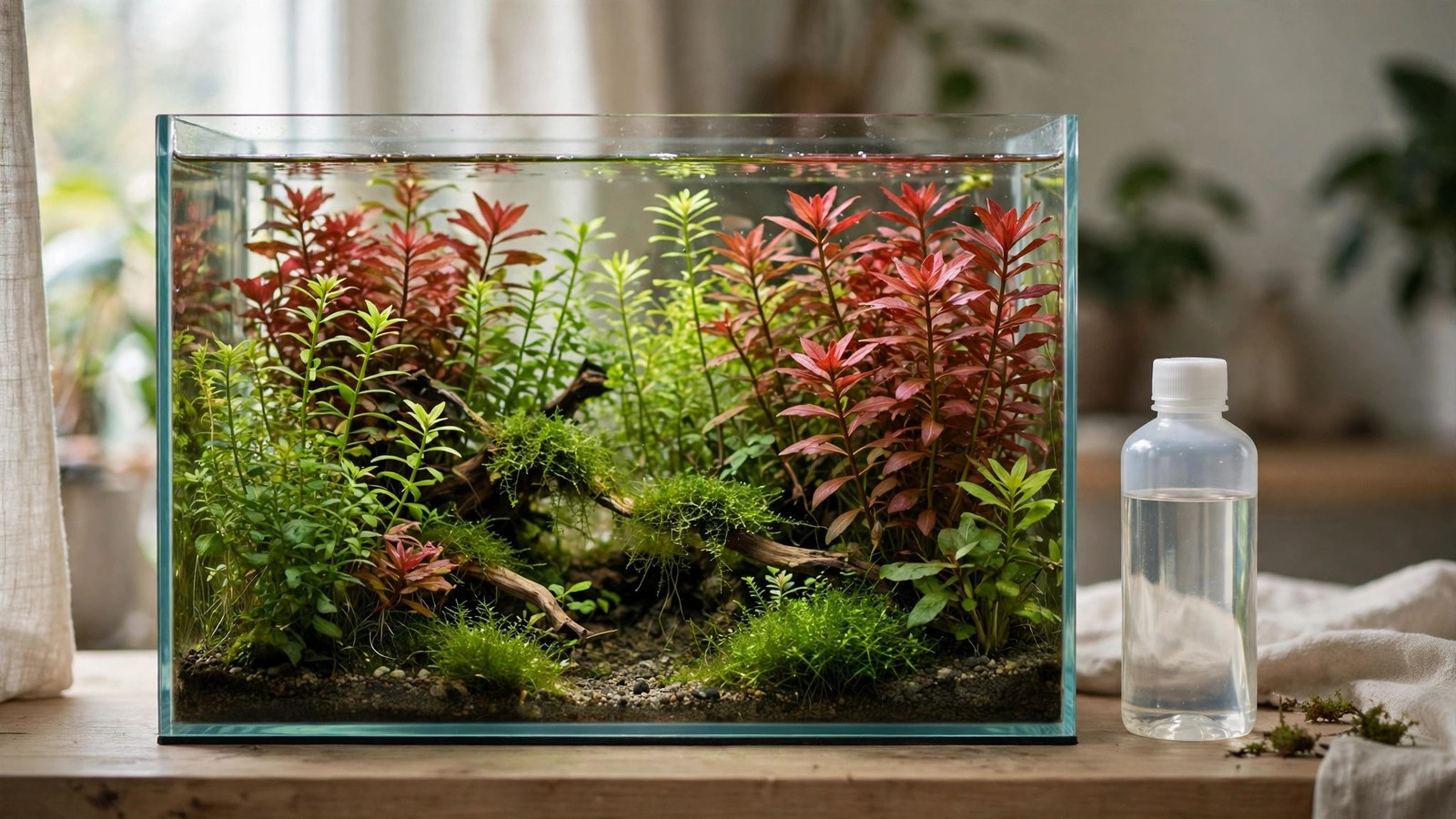
Your plants are stalling, leaves are yellowing, and every forum thread ends the same way: someone links you an aquarium plants fertilizer. But some of the healthiest planted tanks in the world have never seen a fertilizer bottle. By the end of this guide, you'll know exactly which kind of tank you run, whether it genuinely needs dosing, and the honest signs that prove it either way.
The short answer: yes, but maybe not from a bottle
Hobbyists who dose nothing and grow lush jungle tanks aren't defying chemistry — they're farming their fish's output.
So the real decision isn't "fertilizer or no fertilizer." It's whether your tank's natural nutrient supply keeps up with what your plants consume. If you're ready for the mechanics, our all-in-one fertilizer dosing guide covers exactly how much to add and when.
What aquarium plants fertilizer actually provides
Plants pull nutrients from two places: the water column through their leaves, and the substrate through their roots. Fertilizer just tops up whichever is running dry:
| Nutrient | Role | Free source in your tank | When it runs out |
|---|---|---|---|
| Nitrogen | Leaf growth, green color | Fish waste, food, tap water | Heavily planted tanks with few fish |
| Phosphorus | Roots, energy transfer | Fish food and waste | Rarely — usually oversupplied |
| Potassium | Enzyme function, hardiness | Almost none in tap water | Very commonly — first deficiency most tanks hit |
| Iron & traces | Chlorophyll, red coloration | Minimal amounts in tap water | High-light, fast-growing setups |
Notice the pattern: nitrogen and phosphorus are the two nutrients most tanks already have in excess — which is why blanket "just add fertilizer" advice so often fuels algae instead of plant growth. Potassium and micronutrients are what genuinely go missing, and that's what a good all-in-one supplies.
Aquarium Plants Fertilizer: When You Can Skip It Entirely
Not every tank needs a dosing routine. You can honestly skip fertilizer — at least for a while — in these situations:
- Low-light beginner tanks. Anubias, Java fern, and Java moss under modest lighting grow so slowly that fish waste covers their needs for months. (See our low-light fertilizer guide.)
- Walstad-style soil tanks. Mineralized soil under a cap is a slow-release fertilizer battery that can run a tank for 1–3 years.
- New setups in the first month. Fresh aquasoil leaches ammonia and nutrients aggressively — dosing on top is asking for an algae farm. Wait until week 4–6; see when to fertilize a new planted tank.
- Fish-heavy, plant-light tanks. A tank full of fish with a few anubias gets more nitrogen and phosphorus than the plants can use. Adding more is pointless.
- Tanks on fresh aquasoil. Rich substrates like ADA Amazonia carry enough stored nutrients for the first 6–12 months of moderate planting.
The three honest signs your plants are starving
Forget generic "yellow leaves" — that can be a dozen things. These three patterns are the reliable ones:
1. White new growth (iron / trace deficiency)
When the newest leaves emerge pale or almost white while older leaves stay green, the plant can't make chlorophyll — usually an iron shortage, since iron doesn't move within the plant and the newest tissue suffers first. A trace-rich all-in-one or dedicated iron dosing fixes it within 2–3 weeks.
2. Pinholes with yellow edges on old leaves (potassium deficiency)
Small holes appear in older leaves, ringed with yellowing spreading inward. Potassium is mobile, so the plant cannibalizes its oldest leaves first. Since tap water carries almost no potassium, this is the most common deficiency in planted tanks — see our potassium dosing guide to confirm it.
3. Twisted shoot tips (calcium / magnesium shortage)
New stems emerge deformed or tiny while the rest of the plant looks fine. In soft-water and RO tanks this usually means calcium or magnesium is bottomed out — the fix is remineralization rather than a standard NPK fertilizer.
Test before you dose: the 5-minute answer
Guessing costs more than testing. A liquid nitrate test kit (the API Freshwater Master Kit is the hobby standard) plus a phosphate test gives you a definitive read on your two macro nutrients for under $30 total:
- Nitrate 10–40 ppm, phosphate 0.5–2 ppm: macros are fine — skip NPK; consider potassium/traces only.
- Nitrate near 0 with healthy fish: your plants are eating everything — a genuine macro deficit, and dosing will help.
- Nitrate above 40 ppm: you have the opposite problem. More fertilizer is the last thing this tank needs.
Test just before your weekly water change, two weeks in a row. One reading can be a fluke; two tell you the tank's real rhythm. Our fertilizer schedule guide shows what a balanced weekly routine looks like once you know your numbers.
What to buy if your tank genuinely needs fertilizer
If the tests or the deficiency signs say "dose," keep it simple. For 90% of hobbyists, the buying decision has three tiers:
- One all-in-one liquid fertilizer. Look for N, P, K, iron, and traces on the label — NilocG Thrive, Aquarium Co-Op Easy Green, and Tropica Specialised Nutrition are the proven names. Start at half the label dose for two weeks, then adjust. Compare picks in our best liquid fertilizer roundup, and read a liquid vs. root tabs comparison if you run heavy root feeders like swords.
- A nitrate + phosphate test kit. The purchase most beginners skip and most veterans consider mandatory. Without it, you're dosing blind.
- Root tabs (optional). Swords, crypts, and Vallisneria feed through roots; one tab per large plant every 2–3 months covers them even in inert gravel.
Skip the five-bottle "advanced" lines unless you're running high-tech CO2 and enjoy chemistry — for everyone else they create more imbalance than they solve. Shrimp keepers: verify any formula is copper-free (see our shrimp-safe fertilizer guide). For an authoritative deep dive, the Tropica fertiliser guide is excellent.
Frequently Asked Questions
Do aquarium plants really need fertilizer, or is it a marketing upsell?
They need nutrients, but not necessarily from a bottle. Fish waste, food, and rich substrates supply nitrogen and phosphorus in most stocked tanks. What usually runs out is potassium and trace minerals, which tap water barely provides. Fertilizer isn't a scam — but blanket advice to dose every tank from day one is.
Can fish waste replace fertilizer completely?
For low-light tanks with hardy species, often yes — for months or even years. Fish waste supplies nitrogen and phosphorus but almost no potassium or iron, so heavily planted tanks eventually show potassium deficiency. Think of fish as a free nitrogen/phosphorus drip, not a complete fertilizer.
Will adding fertilizer cause an algae bloom?
Only if you add what the tank doesn't need — especially excess nitrogen and phosphorus under high light with low plant mass. Fertilizer matched to actual uptake, confirmed by test kits, rarely causes algae. Start at half dose and watch for two weeks.
How long should I wait before fertilizing a new planted tank?
Four to six weeks with active aquasoil, which leaches heavy nutrients on its own; two to three weeks with inert gravel or sand. Dosing from day one on fresh aquasoil is a classic new-tank algae trigger. Watch for the deficiency signs above rather than dosing on a calendar.
Is aquarium fertilizer safe for shrimp and snails?
Most mainstream all-in-ones are shrimp-safe at label doses, but always check for copper — it's lethal to invertebrates in trace amounts. Never use terrestrial-plant fertilizers; their urea and ammonia can spike tanks. Keep your weekly water change routine to prevent accumulation.
The bottom line
So: do aquarium plants really need fertilizer? They need nutrients, and your tank already produces half of them for free. Observe for two weeks, test for five minutes, and only then — if the signs point to a real deficit — buy one good all-in-one and dose conservatively. The lushest tanks belong to the hobbyists who read what their tank was telling them, and topped up only what was missing.