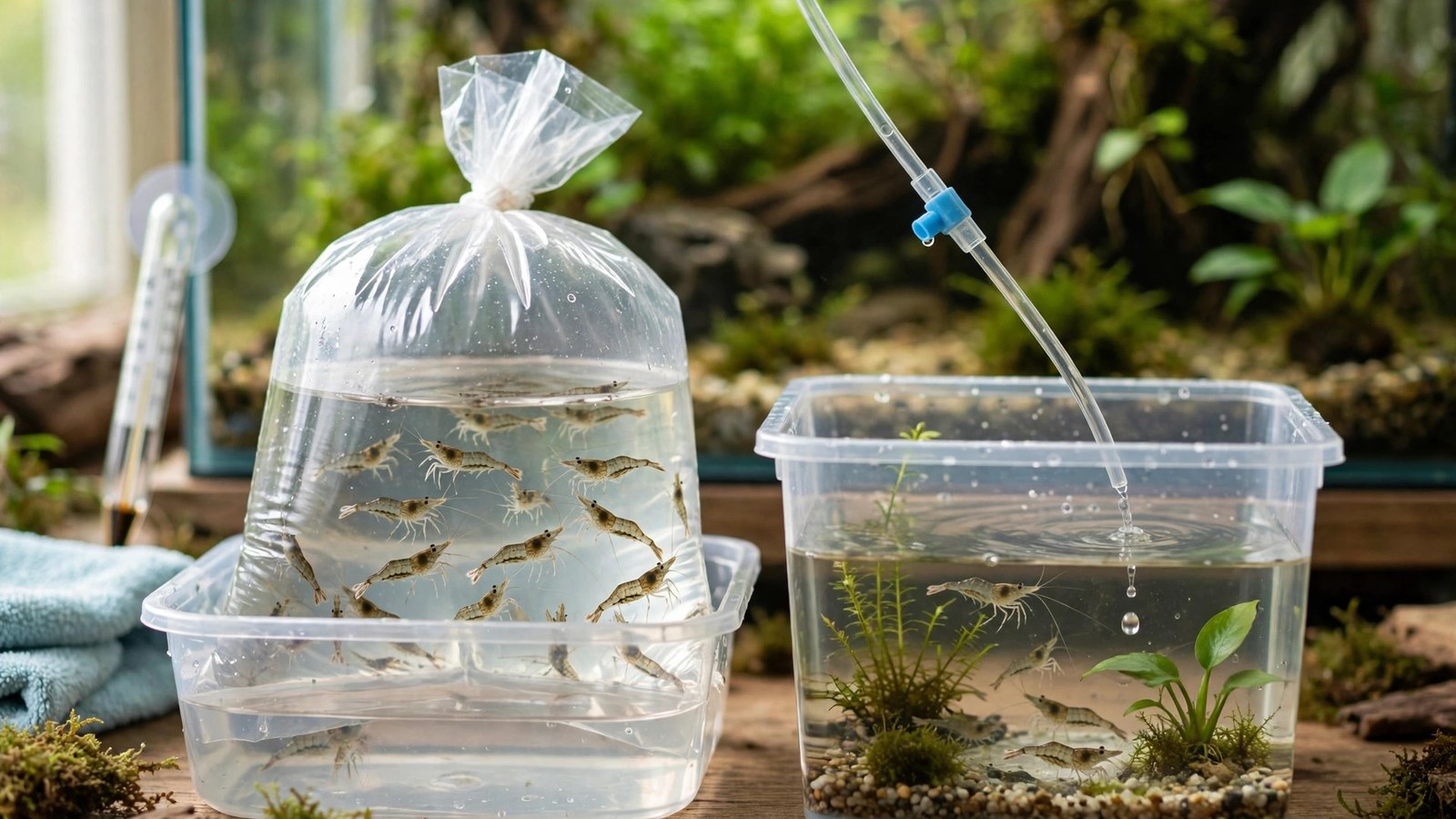
Most new shrimp don't die from disease — they die within 48 hours of arrival because someone tipped them straight into the tank. The shock of new water chemistry is the number one killer of mail-order shrimp, and it is entirely preventable. This guide shows you drip acclimation for shrimp: the slow-mixing procedure breeders use, with exact drip rates and durations for neocaridina vs caridina.
A planted shrimp tank setup gives new shrimp the cover and biofilm they need — but even a perfect tank kills unacclimated shrimp. This procedure bridges that gap.
Why Shrimp Need Drip Acclimation
Fish can often handle a float-and-release. Shrimp cannot: every molt demands precise calcium and magnesium, and their gills trade ions directly with dissolved solids. Move one from 150 ppm water to 350 ppm, and osmotic shock can kill it — sometimes days later, when it fails its next molt. Three parameters do the damage:
- TDS: the blunt-force parameter. A gap over ~150 ppm between bag and tank deserves a slow drip.
- GH: the molt parameter. Caridina live at 4–6 dGH; neocaridina thrive at 6–8. A shrimp raised at 4 dGH dropped into 10 dGH can fail its next molt outright.
- pH and temperature: float the sealed bag 15–20 minutes to equalize temperature first; opened bag water off-gasses CO2 and shifts pH fast.
The drip halves the parameter gap every time the volume doubles. Triple the bag's original volume and the shrimp swims in roughly 90% tank water — the difference between settling in and a failed first molt.
The Drip Acclimation Shrimp Procedure, Step by Step
What you need
- Clean bucket or tall specimen container, 2–3 gallons (aquarium-dedicated, never soap-touched)
- Airline tubing, 4–6 feet, plus an airline control valve to throttle the drip (a knot works; a valve holds a steady rate)
- A TDS meter — the single best acclimation tool you can own
- A fine soft-mesh shrimp net (stiff aquarium nets can crush legs)
- Dechlorinator, in case the bag water smells of ammonia
The procedure
- Float the sealed bag 15–20 minutes in the tank to equalize temperature. Don't open it yet — opened water off-gasses CO2, shifting pH and making built-up ammonia more toxic.
- Open the bag and tip shrimp plus water into your container, tilting it so the shrimp stay submerged.
- Test the bag water's TDS against your tank's. A gap under 50 ppm means a shorter drip (30–45 min); over 200 ppm means longer and slower.
- Smell of ammonia? Add one drop of conditioner now. Long acclimations on foul water kill more shrimp than fast ones on clean water.
- Start the siphon. Place the container below the tank, one tubing end in the tank (clipped so it stays), the other in the container. Open the valve to the rate in the table below.
- Hold the rate and wait. Dim the lights and let the drip run.
- End when the volume triples (or the table duration passes, whichever is later). Rest 10 minutes, then gently net each shrimp into the tank.
- Discard all acclimation water down the drain — it carries the shipper's pathogens and chemistry. Never pour it into your aquarium.
Drip-rate table by shrimp type
| Shrimp type | Drip rate | Duration | Target TDS |
|---|---|---|---|
| Neocaridina (cherry, blue dream) | 2–4 drops/sec | 1–2 hours | 150–300 ppm |
| Caridina (crystal red/black) | 1–2 drops/sec | 2–3 hours | 100–150 ppm |
| Amano / ghost shrimp | 3–5 drops/sec | 45–90 minutes | 150–250 ppm |
Caridina get the slow lane because they are the least forgiving — crystals bred in 120 ppm, GH 4–6 water can die from one fast transition. Moving crystal red shrimp into a tank that has drifted up in TDS? Default to the longest duration in their row.
When to Net vs Pour — and What Happens Next
Net, always. Pouring drip water into the tank imports copper-based medications and chemistry your tank doesn't want. A fine net also lets you inspect each animal: milky muscle tissue or a cracked shell means quarantine, not the display tank. Ghost shrimp — often sold as feeders — deserve the same discipline, since feeder tanks are the most likely source of hitchhikers.
For the 48 hours after introduction: keep lights low, don't feed (the tank's mature biofilm is their first meal), and don't panic over one early death if the rest graze normally. A pattern of deaths means a parameter gap you haven't measured.
What NOT to Do
- No "plop and drop" for shrimp. Fish keepers get away with it; with shrimp it's the leading cause of first-week deaths.
- No speeding the drip. A faster drip is the same shock in smaller steps.
- No copper anywhere near the process. Swap brass valve fittings for plastic — copper is acutely toxic to invertebrates.
- Don't stretch the drip past 4–5 hours "to be safe." Past that point you're acclimating shrimp in their own waste. If gaps are that extreme, fix the tank's parameters first.
For comparison, aquarium plants for fish tanks acclimate almost trivially — plants don't osmoregulate like animals do, which is exactly why the livestock procedure exists and the plant-only version doesn't transfer over.
Frequently Asked Questions
Can I skip the drip if bag water and tank water match?
Mostly, yes — if TDS matches within ~30 ppm, pH is within 0.2, and temperature is equalized, a 20–30 minute float with small water additions is fine. But test before you assume: TDS can hide a GH difference, and mail-order bags are rarely what the listing promised.
How slow is too slow for the drip rate?
Below ~1 drop per second for neocaridina you're wasting time without safety gains, and the shrimp sits longer in degrading water. For caridina, 1 drop per second is the sweet spot for large gaps. Cap the whole session at about 3–4 hours.
Should I drip-acclimate shrimp from my local fish store?
Test and drip if there's a gap. Store water is often harder and warmer than your home tank, and store shrimp are frequently recent imports. The procedure is identical — it may just take 45 minutes instead of 2 hours when the TDS gap is small.
Why did my shrimp die a week after a perfect drip?
Delayed death usually means a failed molt from a GH mismatch the drip narrowed but didn't erase, or unstable tank parameters — check GH, KH, and TDS over several days. A shrimp that died milky-white days after arrival is the classic molt-failure signature.
Can I use the float-and-add-cup method instead?
It's acceptable for hardy neocaridina with small gaps, but it delivers water in steps rather than continuously, and the shrimp sits in an open bag losing heat. A $3 valve on airline tubing is cheaper and strictly gentler — the continuous drip also holds temperature steady while an open bag lets water cool around the shrimp.
Do snails and fish need drip acclimation too?
Snails benefit from it, and sensitive fish do too — but shrimp are the animals most likely to die without it. If you only learn one acclimation procedure, make it this one, then apply it to other sensitive livestock as needed.
Set Them Up to Stay
The drip gets shrimp through day one; the tank decides the rest. New shrimp need dense, fine-leaved cover — java moss, pearl weed, floating plants — for grazing and hiding during their first vulnerable molts. The easiest aquarium plants for a beginner community tank reads like a shrimp-safe plant list for a reason. For technique, Flip Aquatics' video guide to acclimating freshwater shrimp mirrors this procedure, and the long-running acclimation FAQs for ornamental livestock cover the chemistry behind it.