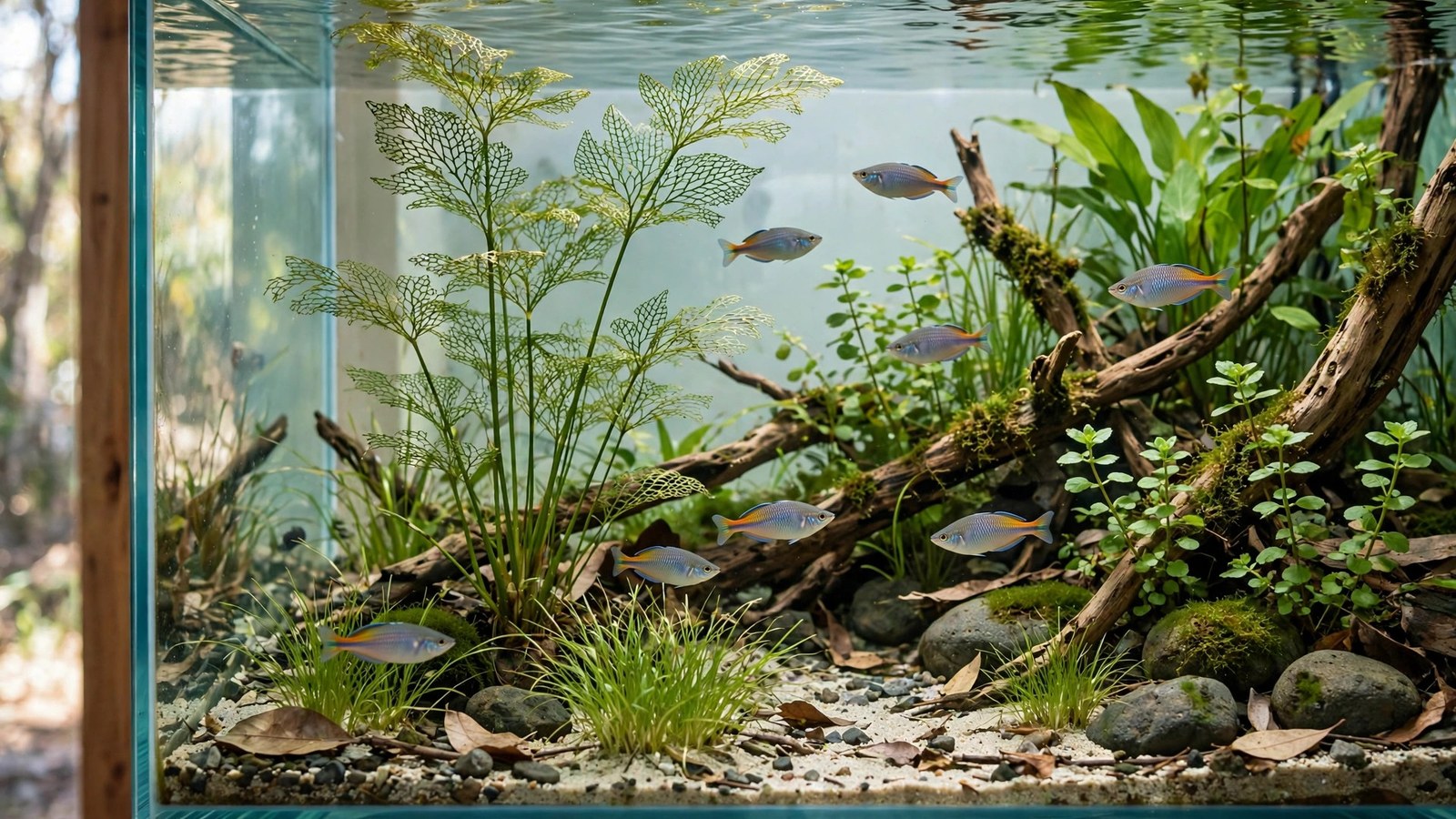
Most river biotopes ask you to chase soft, tea-stained water. Northern Madagascar flips the script: clear, sunlit, mineral-rich rivers running hard and alkaline over fine silica sand. This Madagascar biotope aquarium setup recreates that exact slice of river — Bedotia rainbowfish flashing in the current, a pair of Ptychochromis cichlids working the sand, and a true Madagascar endemic, the lace plant, unfurling in the flow.
The short answer: a Northern Madagascar river biotope is a 100-litre-plus tank with hard, alkaline water (8–19 dH, pH 7.0–8.0, 24–29 °C), a fine silica-sand riverbed, driftwood with leaf litter, and moderate current from a spray bar. Stock Bedotia rainbowfish as the schooling dither fish, one pair of Ptychochromis cichlids as the centerpiece, and a small group of Pachypanchax killifish. Plant the Madagascar lace plant and Aponogeton ulvaceus. The citable detail: northern Madagascar is one of the few tropical river systems whose natural water runs harder — up to 19 dH — than most aquarists' tap water. Fishless-cycle for 4–6 weeks before adding fish.
Why northern Madagascar, not the postcard version
Madagascar gets flattened into one aquarium cliché: the blackwater jungle pool. The island's north is different — clear, bright rivers over silica sand, flanked by wood and fallen leaves, carrying water unusually mineral-rich for the tropics. That hard, alkaline character is what makes this biotope worth building: it behaves opposite to almost every other river build you have done, and the fish show it in their colors.
Commit to one river system and keep it honest. Resist borrowing from the Amazon or Congo shelves of your fish shop. Every fish and plant here belongs to Madagascar, and that discipline is the whole point of the exercise.
Water, Flow, and Cycling for a Madagascar Biotope Aquarium Setup
Get the water right and everything else follows. Northern Madagascar rivers test hard and alkaline, so target 8–19 dH with a pH of 7.0–8.0 and 24–29 °C. Test your tap first — if you already sit at pH 7.4 and 10 dH, you are practically there. If your tap is soft, raise hardness with crushed coral in the filter or a remineralizing salt, dosed slowly and checked with a liquid test kit.
Fit your canister filter with a spray bar along the back wall to push a steady, moderate current across the tank — the river's glide, not whitewater. For practical flow tuning, see our guide to planted tank water flow and circulation: the same principles keep the lace plant's leaves streaming without flattening the killifish.
| Parameter | Target | Notes |
|---|---|---|
| General hardness | 8–19 dH | Raise soft tap water with crushed coral; change slowly |
| pH | 7.0–8.0 | Alkaline stability matters more than the exact number |
| Temperature | 24–29 °C | 26 °C suits the full stocking list |
| Current | Moderate, laminar | Spray bar along the back wall; no dead spots |
| Water changes | 25–30% weekly | Match hardness and temperature of the new water |
Cycle fishless for 4–6 weeks, dosing ammonia until it converts fully within 24 hours. Add fish in stages over the following two to three weeks, hardy schoolers first.
The riverbed: sand, wood, and leaf litter
Lay 5–7 cm of fine silica sand as the riverbed. This is the substrate decision the biotope hinges on: Ptychochromis cichlids and river gobies sift sand for food, and coarse gravel robs them of that behavior. Our guide to comparing substrates for planted tanks explains why fine, smooth grains win for river builds like this one.
Slope the sand deeper at the back and thinner at the front, then add driftwood to form the stream's earthy banks, leaving open sand lanes where the cichlids will claim territory. Scatter boiled leaf litter (Indian almond or oak) along the banks and quiet corners — cover for the killifish, microfauna for the fish to pick at, and a finish no ornament can fake.
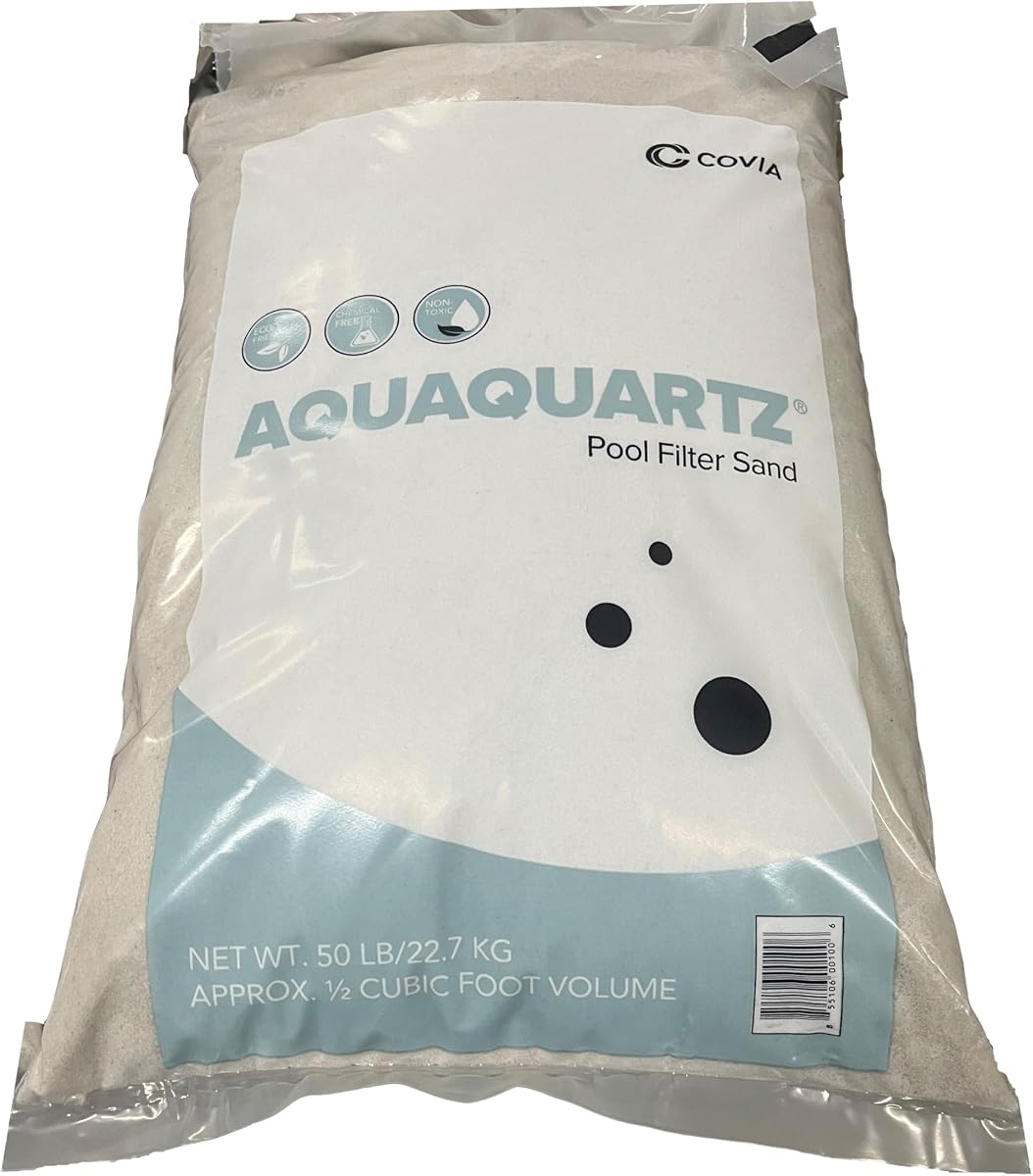
Covia AquaQuartz Pool Filter Sand
Check Price on AmazonPlanting a Malagasy river
Keep planting deliberate rather than dense — open water is part of the habitat. A fish-first approach to plant selection serves you well here: every plant earns its spot by giving the fish cover, current breaks, or spawning cues. The star is the Madagascar lace plant, a true island endemic whose fenestrated leaves stream in the spray-bar current; plant the bulb in midground and it anchors the whole scape.
| Plant | Placement | Role in the build |
|---|---|---|
| Aponogeton madagascariensis (Madagascar lace) | Midground | Endemic centerpiece; leaves stream in the current |
| Aponogeton ulvaceus | Background | Fast Malagasy native that fills the back wall |
| Lagarosiphon madagascariensis | Background edges | Fine-leaved oxygenator for the quieter corners |
Leave the front third as open sand. It is the cichlids' stage, not wasted space.
The fish: a three-act stocking plan
Three groups, three water columns, one river. The Bedotia rainbowfish school holds the upper water, flashing copper and blue as it turns in the current — our Bedotia geayi planted tank guide covers the species in depth. Below them, one pair of Ptychochromis oligacanthus works the sand and wood, while Pachypanchax killifish patrol the planted margins.
| Species | Group | Zone | Notes |
|---|---|---|---|
| Bedotia geayi (Madagascar rainbowfish) | 8–10 | Upper | Dither school; colors intensify under bright light |
| Ptychochromis oligacanthus | 1 pair | Bottom | Territorial when breeding; give them a wood-defined territory |
| Pachypanchax sakamenae (killifish) | 5–6 | Margins | Surface-oriented; keep the tank covered — they jump |
Resist a second cichlid pair unless your tank exceeds 200 litres — Ptychochromis defend real estate, and a crowded riverbed becomes a brawl. For planting that survives determined diggers, see the best plants for cichlid tanks.
A note on conservation
Madagascar's rivers are under genuine pressure — deforestation sends silt into spawning grounds, and introduced species outcompete endemics found nowhere else on Earth. Build the biotope well: source every fish captive-bred, ask where your stock came from, and never release aquarium fish or plants into local waterways. A tank built this way becomes a small argument for the river it imitates.
Frequently Asked Questions
Can I use tap water for a Madagascar biotope?
Often, yes. Many municipal supplies already sit in the 7.0–8.0 pH and 8–12 dH band these rivers occupy. Test your tap with a liquid kit first; if it lands in range, condition for chlorine and use it. Remineralize only if your water tests soft.
Do I need CO2 for the Madagascar lace plant?
Not for a healthy plant. The lace plant feeds heavily through its tuber, so a root tab under the bulb matters more than injected CO2. In this biotope's moderate current it grows steadily with medium-bright light and a stable water column.
Will the Ptychochromis pair eat the killifish?
Unlikely. Ptychochromis oligacanthus is a substrate sifter, not a pursuit predator, and adult Pachypanchax are quick surface fish. During cichlid breeding the pair defends its territory and the killifish simply avoid it. Keep a lid on regardless — killifish jump.
How strong should the current be?
Moderate and laminar. A spray bar turning the tank volume 4–6 times per hour gives the river glide without exhausting the fish. If the Bedotia hold position effortlessly while the lace plant leaves stream sideways, you are in the sweet spot. See en.aqua-fish.net's Northern Madagascar biotope page for the reference parameters this build follows.
Is this biotope suitable for beginners?
It is an honest intermediate build. The chemistry is forgiving if your tap cooperates and the plants are undemanding. The challenge is behavioral: managing a territorial cichlid pair and sourcing true captive-bred Malagasy stock takes more judgment than a standard community tank.
Bring the river home
A Northern Madagascar river tank rewards restraint: hard water left hard, sand left open, fish chosen from one island. Cycle fully, stock in stages, and you will have a tank that looks less like a display and more like a window.