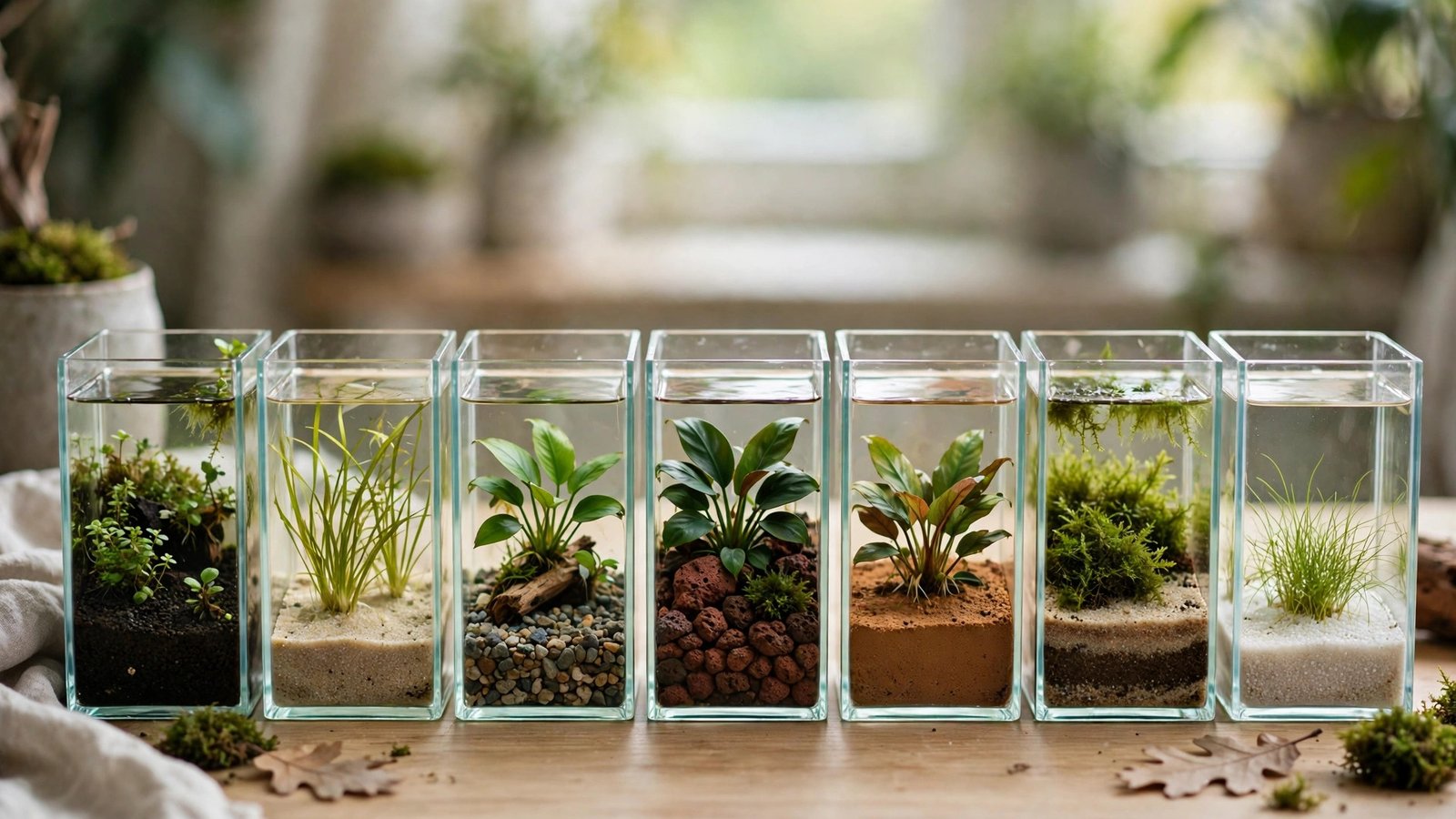
Most planted-tank failures start under the gravel, not above it. People spend $150 on rare stems, a $300 light, and CO2 — then bury everything in two inches of decorative river rock with zero nutrients, and wonder why the plants melt in a month. Picking the best substrate for planted tank success isn't about finding one magic product; it's about matching the substrate's chemistry and cost to your plants, your livestock, and how much maintenance you'll actually do. Below you'll find seven real options honestly compared — what each costs per gallon of tank, how long it lasts, and who should walk away from it.
The 7 options, side by side
Before the deep dives, here's the honest scorecard. Cost per gallon is based on the substrate needed for a 20-gallon tank with a 2–3 inch bed, in rough US retail prices. "Lifespan" means the useful nutrient/buffering life, not how long the material physically exists.
| Option | Cost per gallon | Nutrients | pH effect | Lifespan | Best for |
|---|---|---|---|---|---|
| Aquasoil (ADA Amazonia-type) | $5–$7 | Very rich (ammonia-rich start) | Buffers down to ~6.0–6.8 | 2–3 years | High-tech carpets and stems |
| Fluval Stratum-type | $4–$5 | Moderate (low ammonia start) | Buffers down to ~6.5–7.0 | 1–2 years before crumbling | Beginners, shrimp, low-tech |
| Inert gravel + root tabs | $1–$2 + tabs | None (tabs supply it) | Neutral | Permanent (tabs every 2–3 mo) | Budget low-tech, epiphytes |
| Coarse sand + root tabs | $1–$2 + tabs | None (tabs supply it) | Neutral | Permanent (tabs every 2–3 mo) | Bottom-dwellers + rooted plants |
| Pool filter sand | <$1 | None (tabs supply it) | Neutral | Permanent (tabs every 2–3 mo) | Budget builds, foregrounds |
| Calcined clay | <$1 | CEC boost, minimal raw nutrients | Neutral | 5+ years | Experienced low-tech, corydoras tanks |
| Dirted/capped soil | <$1 | Very rich for 6–12 months | Slight acidifying start | 1–2 years before depleting | DIY low-tech, Walstad-style |
1. Aquasoil (ADA Amazonia-type)
This is the benchmark everything else is judged against. Aquasoils are baked volcanic-soil granules loaded with organic nitrogen and minerals. They grow demanding carpets like dwarf hairgrass and Monte Carlo faster than anything else, and their pH buffering (~6.0–6.8) is a genuine advantage for soft-water plants and Caridina shrimp.
The catches are real. Fresh aquasoil leaches ammonia for 3–6 weeks, so you must fishless-cycle before stocking — see our guide to cycling through aquasoil's ammonia leach for the day-by-day routine. It also breaks down into mud after 2–3 years, at which point you rescape or cap it. If you want the full soil-vs-gravel debate unpacked, read aquarium soil vs gravel.
Who should avoid it: anyone with hard tap water who keeps livebearers or African cichlids — the substrate will fight your water chemistry constantly. Also skip it if you're not ready to water-change your way through the ammonia phase.
 ★4.7
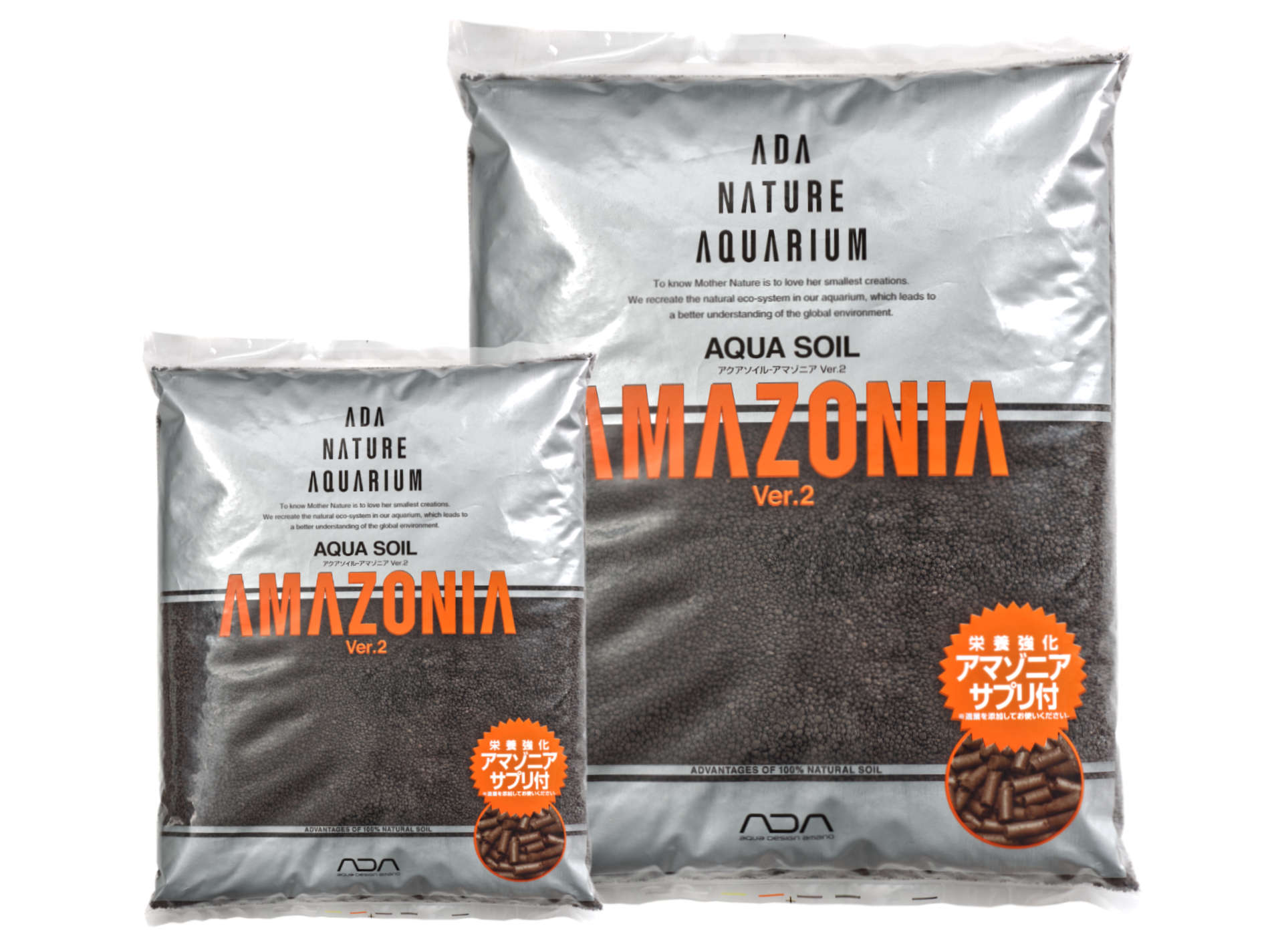
ADA Aqua Soil Amazonia Ver 2
Check Price on Amazon ★4.72. Fluval Stratum-type substrates
Stratum is the beginner-friendly middle child of the aquasoil family: it buffers pH gently, grows plants well, and leaches far less ammonia than Amazonia — many people stock within days. It costs roughly two-thirds of ADA per gallon of tank, making it the best-value "set it and forget it" substrate.
The tradeoff is longevity. Stratum granules are softer and start crumbling around the 12–18 month mark; by year two you'll notice it compacting and stirring up dust when you replant. If you're torn between the two big brands, our Fluval Stratum vs ADA Amazonia head-to-head breaks down the cost, growth rates, and lifespan differences.
Who should avoid it: scapers who constantly uproot and replant — each disturbance clouds the tank as granules degrade. High-tech growers chasing maximum carpet speed will get more from Amazonia.
3. Inert gravel + root tabs
Standard 2–3 mm aquarium gravel does absolutely nothing for plants — and that's the point. It never breaks down, never alters your water, and costs $1–$2 per gallon of tank. All nutrition comes from root tabs pushed into the bed every 2–3 months, which is a genuinely effective system for swords, crypts, and any root feeder.
Choose natural pea or river gravel over dyed novelty gravel; cheap coatings can chip, and bright neon colors fight your scape. If you're weighing this whole class of substrates, our complete guide to inert substrates covers gravel, sand, and clay options in one place.
Who should avoid it: carpet plants. Tiny grains can't hold runners, and tabs are hard to position under a dense Monte Carlo mat. Also avoid ultra-fine gravel (<1 mm), which compacts and suffocates roots.
4. Coarse sand + root tabs
Coarse sand (0.5–1 mm grains) is the substrate that pleases two masters: plants get a compactable bed that holds roots well, and bottom-dwellers like corydoras and kuhli loaches get a barbel-safe surface to sift through. Combined with root tabs, it's the best-value option for community planted tanks with livestock. The full sand-vs-gravel decision is covered in our sand vs gravel for planted tanks comparison.
The main risk is compaction. Sand finer than ~0.5 mm packs tight and can go anaerobic in deep beds — if you're tempted by play sand or blasting sand, check the best sand options for planted aquariums first to see which grades are proven safe.
Who should avoid it: anyone who hates maintenance — sand shows every speck of detritus, and you need to lightly stir the top layer monthly to prevent dead zones. Root tabs also migrate more easily in loose sand than in gravel.
5. Pool filter sand
The cheapest legitimate substrate in the hobby. Pool filter sand is graded 0.45–0.55 mm silica, pre-washed, and costs under $1 per gallon of tank — a 50 lb bag (~$12–15) covers one 20-gallon tank at a 2–3 inch bed. It looks natural, plants root fine with tabs, and its uniform grain size resists severe compaction better than play sand. Our deep dive on using pool filter sand in planted tanks covers rinsing, grades, and how it compares to aquarium-branded sand.
Who should avoid it: high-tech growers — no nutrients, no buffering, no CEC to speak of. You're buying a blank canvas; if you want the substrate to do chemistry for you, this isn't it.
6. Calcined clay
Calcined clay (brands like Turface) is baked montmorillonite clay with high CEC — it grabs nutrients from the water column and makes them available to roots, without altering pH or hardness. It costs under $1 per gallon, lasts 5+ years without breaking down, and has a natural reddish-brown look that suits biotope scapes. Read our calcined clay substrate guide for sourcing, rinsing, and dosing strategies.
The catch: it has almost no nutrition on its own. It shines as a nutrient sponge paired with liquid fertilizer or root tabs, but a low-tech tank with clay alone and no dosing will starve plants. It's also very light — strong filters or digging fish can send clouds of it into the water column.
Who should avoid it: beginners who won't dose fertilizers. Calcined clay punishes the "add water and wait" approach — pair it with a dosing routine or choose a richer substrate.
7. Dirted/capped soil
The Walstad method: 1 inch of organic potting soil (mineralized, no perlite or manure) capped with 1.5–2 inches of sand or fine gravel. Total cost is under $1 per gallon, and the soil's rich nutrient load grows low-tech plants explosively for the first 6–12 months with zero dosing. If you go this route, follow our guide to mineralizing topsoil for aquarium use — skipping mineralization is how most dirted tanks fail.
The risks are all upfront. Disturbing the cap releases soil into the water column, replanting is messy, and depleted soil can't be "re-tabbed" as easily as inert substrates. For a gentler way to get soil benefits under a clean cap, see capping aquarium soil with sand.
Who should avoid it: anyone who rearranges frequently, and anyone with diggers (cichlids, goldfish) — one determined fish will breach the cap and turn your tank into pea soup.
Choosing the best substrate for your planted tank: a decision framework
Stop comparing products in the abstract — choose by the tank you're actually running.
| Your situation | Best pick | Runner-up |
|---|---|---|
| High-tech (CO2 + strong light), carpets and stems | Aquasoil | Fluval Stratum |
| Low-tech community tank, easy plants | Coarse sand + root tabs | Inert gravel + root tabs |
| Caridina shrimp tank | Aquasoil (strongest buffering) | Fluval Stratum |
| Corydoras / loach tank | Pool filter sand + tabs | Calcined clay |
| Tightest budget, DIY mindset | Dirted + sand cap | Pool filter sand + tabs |
| Hard tap water, livebearers/cichlids | Inert gravel + tabs | Pool filter sand + tabs |
A note for shrimp keepers: buffering substrates are the only substrate-based way to hold pH in the 5.8–6.4 range Caridina need. Our best substrates for shrimp tanks guide goes deeper, and if your buffering ever exhausts and pH swings wildly, that's a pH crash — see our pH crash causes and fixes guide before it costs you livestock.
How deep should your substrate be?
Aim for 2–3 inches total: 1–1.5 inches at the front glass, sloping to 3–4 inches at the back for depth and stem-plant root runs. Anything under 2 inches won't anchor plants; over 4 inches of fine sand risks anaerobic pockets. To calculate exactly how many pounds your tank needs, use our how much substrate calculator guide — most 20-gallon tanks need 40–50 lbs, and that number is what turns a "$30 bag" into a "$120 scape" shock at checkout.
Frequently Asked Questions
Can I mix substrates in a planted tank?
Yes, and experienced scapers do it routinely — but layer, don't blend. Put nutrient-rich substrate in mesh bags or the back third where stems grow, and a natural sand foreground for aesthetics. Randomly mixing aquasoil with gravel gives you soil granules migrating to the surface and the worst of both. If you want soil benefits with a sand look, a proper sand cap is the tested method.
How deep should substrate be in a planted tank?
A total of 2–3 inches is the standard for most tanks: 1–1.5 inches at the front, sloping to 3–4 inches at the back for stem plants and visual depth. Carpeting plants do fine at 1.5–2 inches. Below 2 inches, plants won't anchor; above 4 inches of fine material, you risk anaerobic zones that release hydrogen sulfide when disturbed.
Do I need aquasoil to grow easy plants?
No — this is the hobby's most expensive myth. Anubias, Java fern, crypts, Amazon swords, and most stem plants grow perfectly in inert gravel or sand with root tabs and a basic liquid fertilizer. Aquasoil's speed advantage only matters for demanding carpets and high-light stems under CO2. Start with easy plants in cheap substrate, upgrade later if you catch the high-tech bug.
When should I replace my aquasoil?
Replace or refresh it when the buffering fades — typically 12–18 months in — if you keep soft-water livestock, or when the granules have visibly broken down into mud (2–3 years). Exhausted aquasoil can be kept going with root tabs and liquid fertilizer, but it will no longer buffer pH. Signs of exhaustion include pH drifting toward your tap water baseline and declining carpet growth.
Root tabs vs aquasoil: which is actually cheaper long-term?
Root tabs win on total cost over five years. A 20-gallon tank needs ~$15–20 in tabs per year, versus roughly $200–$280 in aquasoil over the same period including one replacement. Aquasoil wins on growth speed and convenience — no tabs to remember, built-in buffering. Our full root tabs vs aquasoil cost comparison runs the numbers year by year.
The honest answer: start with your water and your wallet
If you keep soft-water shrimp or run CO2 with demanding carpets, buy the aquasoil — it's the one place in this hobby where the expensive option is genuinely better. For everyone else, coarse sand or gravel plus root tabs grows 90% of popular aquarium plants at a tenth of the cost, and you'll never have to tear down a tank to replace it. Once you've chosen, keep it clean — how to clean substrate without uprooting plants will keep any of these seven beds healthy for years.