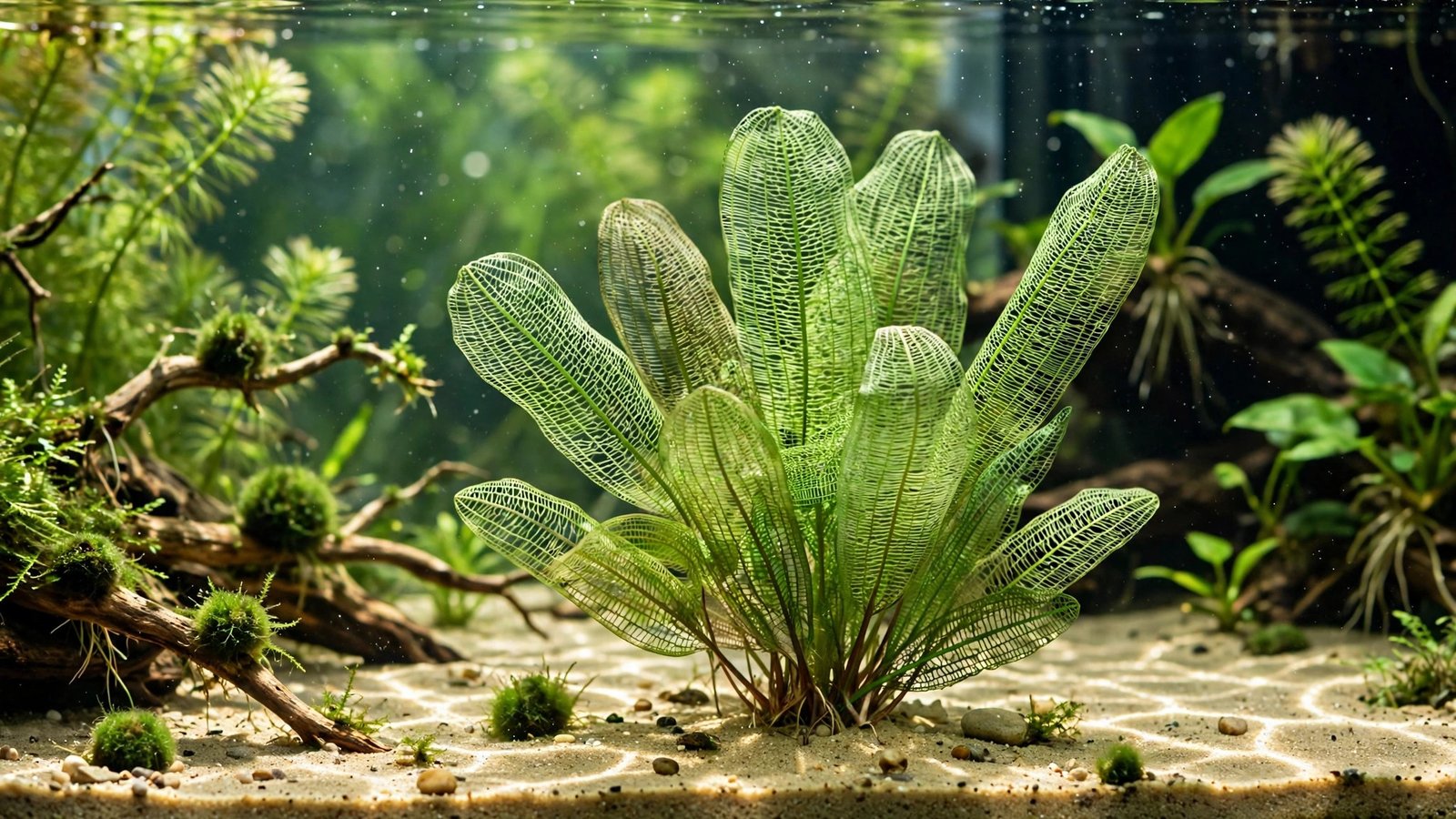
Most aquarists throw this plant away on the exact day it needs them most. After months of flawless growth, the lattice leaves suddenly yellow, melt, and vanish — and owners assume they killed an expensive bulb. They haven't. The bulb is doing what it evolved to do in Madagascar's seasonal rivers: going dormant. Mastering madagascar lace plant care starts with reading that cycle instead of fighting it.
The Dormancy Cycle: Why the Leaves Vanish
Every bulb carries a calendar from Madagascar's seasonal rivers. After 6–12 months, new leaves shrink, old ones yellow from the edges, and the canopy melts within weeks. Unearthed, a resting bulb stays firm and pale — firm means alive; squishy and foul means dead.
Three things trigger rest early: sustained heat above 26°C, very bright light that burns through the bulb's reserves, and — most avoidable — uprooting. An established bulb holds dozens of fine crown roots; tearing them out reads as seasonal change, and the plant sleeps. It's no fit-and-forget species: for plant-once-and-ignore, choose from the easiest aquarium plants for a beginner community tank and keep the lace plant for a dedicated display.
When rest begins, remove the bulb, rinse it in old tank water, trim dead leaves and roots, and nestle it in a cup of damp (not wet) sand. Store dark and cool for 8–12 weeks without weekly checks — drying out or rotting are the only real risks. Replant with fresh root tabs and expect a shoot within 1–3 weeks. Bulb-resting plants share this rhythm: red tiger lotus care covers a similarly dramatic annual die-back, and Aponogeton crispus care shows how the whole genus budgets energy through its bulb.
madagascar lace plant care: light, substrate and flow
The trap is too much light: aim for medium, roughly 30–50 PAR at substrate. Above 80 PAR, algae colonizes the lattice faster than any tissue-covered leaf — there's nowhere to scrub — and the bulb "over-metabolises," growing fast with short leaf lifespans. Bright light can even trigger the dormancy it was meant to prevent. A slightly shaded spot often grows the longest-lived plants; how PAR maps to real fixtures is covered in our complete guide to freshwater aquarium plants.
Substrate decides long-term success. The bulb sprouts on stored energy and grows beautifully for months even in plain gravel — then stalls when reserves run out. Feed the heavy root feeder: nutrient-rich aqua soil plus one root tab within 5–8 cm of the crown every 6–8 weeks. New leaves unfurl wider and hold longer within two weeks. The same schedule suits other big root feeders; Amazon sword care follows the identical rhythm, centered on a crown cluster instead of one bulb.
| Parameter | Target range | Notes |
|---|---|---|
| Temperature | 20–25°C (68–77°F) | Above 26°C shortens leaf life |
| pH | 5.0–7.5 | Soft, slightly acidic preferred |
| KH | 2–6 dKH | Keep low and stable |
| Light (PAR at substrate) | 30–50 | 80+ invites algae, short leaf life |
| CO2 | 0–25 mg/L | Helps, not required |
| Water flow | Moderate, steady | Prevents debris settling on the lattice |
| Root tabs | 1 tab / 6–8 weeks | Buried 5–8 cm from the crown |
Keep circulation steady and gentle — enough to sway the leaves and stop biofilm settling in the open grid. In stagnant corners algae films the leaf skeleton, and once it grips those thin veins you can't remove it without damage. A spray bar or lily pipe washing softly over the plant is ideal.
Planting and Placement
Press the bulb in so the bottom two-thirds is buried and the sprout tip sits at the soil surface — fully burying it invites rot. Choose the final position on day one: moving an established bulb almost guarantees a forced dormancy.
Treat it as a centerpiece: one plant spreads 25–30 cm wide with leaves arching 40–65 cm, so give it 20–25 cm of clear space where the light backlights the lattice — backlighting makes the grid glow. Keep the surface above it clear of floaters. Dwarf aquarium lily care uses the identical half-buried method, and Crinum thaianum care covers another dramatic bulb-form centerpiece.
Propagation From Bulb and Seed
Mature bulbs occasionally produce daughter offsets at the crown you can twist off once they have their own shoot tip — but it's unpredictable, so don't count on it.
The reliable route is seed. In warm, well-fed tanks it sends up a two-pronged flower spike, sometimes a meter tall, protruding from the water. If pollination succeeds, seeds develop along the spike — collect them once it browns and sow on damp nutrient-rich substrate under 2–3 cm of water, kept warm and humid. Germination takes 2–6 weeks; seedlings grow slowly for months. Contrast stem plants, where you snip and replant: Ludwigia rubin care shows how fast stem propagation fills a background versus this plant's patient seed cycle. Most aquarists propagate it once, for the pleasure, and buy new bulbs for fresh specimens.
Buying Tips: What to Look For
Buy the bulb, not the leaf show: it should feel hard like a small onion, with no soft spots and no sour smell. A squishy bulb is already rotting and rarely recovers. Bare dormant bulbs are cheaper and sprout in 1–3 weeks; tissue-culture cups are the safest buy — sterile, pest-free, usually already growing.
Expect two forms: the standard broad lattice reaching 50–65 cm, and the narrower henkelianus variety. Confirm which you're getting — a full-size form in a 45-cm tank becomes a floating-leaf problem within a year. Tropica's profile, quoted on the UK Aquatic Plant Society's Aponogeton madagascariensis page; the botanical profile of Aponogeton madagascariensis notes it was once over-collected in Madagascar, so buy cultivated stock.
Frequently Asked Questions
Is my Madagascar lace plant dying or just going dormant?
Check the bulb. Firm and pale with no foul smell means dormancy — trim dead leaves and roots, rest it in damp dark sand for 8–12 weeks, then replant. Squishy, discolored, or rotten-smelling means dead; remove it so decay doesn't foul the tank.
How long does the dormancy period last?
Typically 8–12 weeks, roughly once a year after 6–12 months of growth. Cool water (20–23°C), moderate light, and steady root feeding can delay or shorten the rest, but plan for it rather than fighting it. Expect the first new leaf within 1–3 weeks of replanting.
Does it need CO2 injection?
No — CO2 helps but isn't required. Growers succeed without it as long as the substrate is nutrient-rich and root tabs are regular. If you run CO2, 15–25 mg/L is plenty; the bulb's stored reserves do the early work of building the first canopy.
Are the holes in the leaves normal?
Yes — the lattice is the whole point. The leaves are a skeletal vein network with no tissue between. Worry instead about brown patches turning mushy, yellowing edges, or easily torn leaves — those signal algae, exhaustion, or approaching dormancy.
What temperature is too hot for a lace plant?
Treat 26°C as the ceiling. Above that, leaf lifespan shortens and the plant often blooms, then collapses into dormancy. The sweet spot is 20–25°C; in a tank that runs warm year-round, just budget for an earlier rest and a shorter growing season before the bulb sleeps.
Can I keep it in a small nano tank?
Not the standard form — a mature plant spreads 25–30 cm wide with leaves to 65 cm long, overwhelming anything under 90 liters. The narrow-leaf henkelianus variety is smaller but still substantial. Under 60 liters, choose a compact centerpiece instead.
Worth the Patience
No other aquarium plant looks like it. Backlit against dark hardscape, the lattice is living architecture — and the care is honest rather than hard: feed the roots, keep the water cool and moving, respect the rest. Stop treating dormancy as failure and it becomes one of the most dependable centerpieces in the hobby.