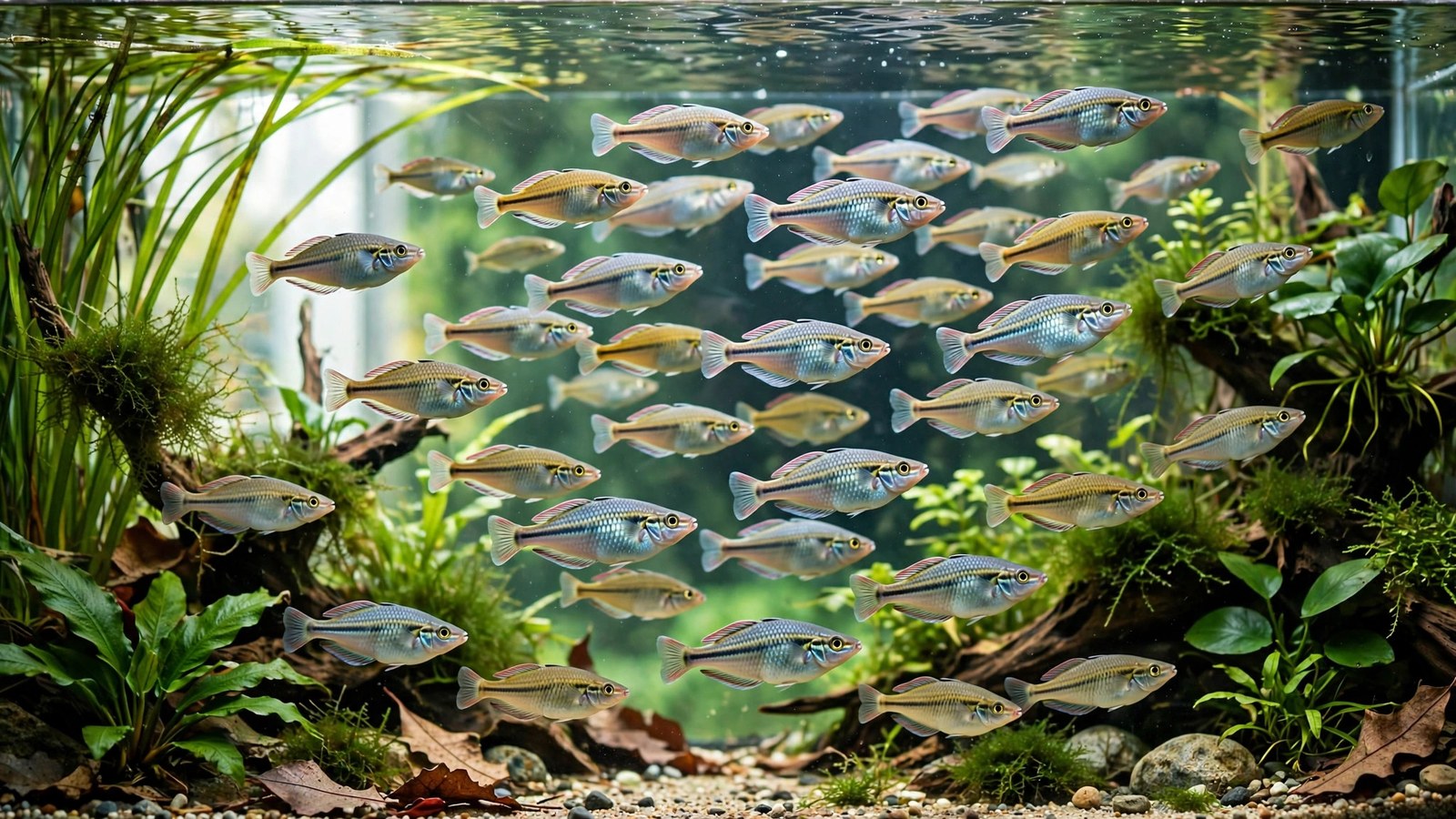
Most rainbowfish guides assume a warm, tropical tank — but Bedotia geayi, the Madagascar rainbowfish, comes from fast, oxygen-rich mountain streams and prefers life at 20–24 °C (68–75 °F). A madagascar rainbowfish planted tank therefore looks different: moderate-to-strong flow, open swimming room down the middle, plants massed along the sides and back, and a tight-fitting lid — because these fish are jumpers. Success starts with choosing plants with a fish-first mindset, matching species to the cooler, higher-flow conditions the fish actually need.
Setting Up a Madagascar Rainbowfish Planted Tank
The defining feature of a madagascar rainbowfish planted tank is temperature: these fish thrive at 20–24 °C, a few degrees below a typical tropical community. In most rooms a heater is optional; the bigger challenge is summer heat — a clip-on fan or keeping the tank away from sunlit windows matters more than heating. Aim for a filter that turns the tank over 6–10 times per hour with visible surface movement, like a canister or hang-on-back with the output aimed across the surface.
| Parameter | Target range | Notes |
|---|---|---|
| Tank volume | 30 gal / 110 L minimum | 55 gal (200 L) is better for a full school |
| Temperature | 20–24 °C (68–75 °F) | Cooler than most community tanks; watch summer highs |
| pH | 6.5–8.0 | Tolerant of a wide range; avoid extremes |
| Hardness | Soft to moderately hard | Stability matters more than exact values |
| Flow | Moderate to strong | Surface agitation keeps oxygen high |
| School size | 8 or more | Males color best in larger groups |
| Adult size | ~10 cm (4 in) | Males larger and more colorful than females |
Males develop a golden-bronze body with two dark lateral stripes and red-edged fins — the red tail behind their "red-tailed silverside" nickname — while females stay plainer. For the full species breakdown, the Madagascar rainbowfish species profile at Fish Laboratory lists the same 68–75 °F range and notes their mountain-stream origin.
Plants That Thrive in Cooler, Higher-Flow Water
Cooler water is a gift to plant keepers: most popular aquarium plants do as well at 20–24 °C as they do at tropical temperatures. What changes is the flow — delicate stem plants get battered in a current, so anchor the design on tough, flow-tolerant species. Java fern and Anubias tied to driftwood are the backbone: they shrug off current and stay out of the swimming lanes. Cryptocorynes carpet the foreground edges, Vallisneria curtains the back glass, and mosses on rocks and wood give the fish egg-scattering sites.
If you are still building your plant collection, start with these easy beginner plants for a community tank — nearly all tolerate this setup's cooler temperatures and moderate flow. Similar cooler-water rainbow setups, like the Celebes rainbow planted tank and the rainbow shiner planted tank, use the same backbone species and are worth studying for layout ideas.
Layout: Open Water Up the Middle, Planted on the Sides
Picture the tank in three lanes. The middle third stays completely open — substrate, no plants, nothing above mid-water — so the school can cruise together the way it does in open stream water. This is where the fish spend most of their time and where you will actually see them. The left and right sides get dense plantings from the glass inward: tall background stems, mid-height bushes, and wood or rock with attached ferns.
This arrangement does double duty: the open middle satisfies the schooling instinct, while the planted sides give shy individuals somewhere to retreat, break sight lines when males spar, and provide spawning cover. Run the current across the open lane rather than blasting the plants — the fish will swim against it in the middle while the side plantings sit in gentler eddies. A dark substrate makes the gold-red males pop; fine gravel or sand suits their stream origin.
Schooling, Tank Mates, and Feeding
Buy the school first and build around it. Eight is the real minimum; ten to twelve in a 55-gallon tank is where the display gets impressive — males flash at each other constantly, colors deepen, and the whole group settles instead of hiding. Feed a varied omnivore diet: quality micro-pellets or small flake as the staple, plus frozen daphnia, brine shrimp, and the occasional bloodworm. They feed readily from the surface and mid-water, so scatter food across the open lane where every fish can reach it.
Tank mates must share two things: the cooler temperature and peaceful temperament. Good company includes white cloud mountain minnows, hillstream loaches, cooler-water corydoras, and peaceful barbs — not tropical staples that want 26 °C. This is exactly why they pair poorly with warm-water rainbows like the Parkinson's rainbow planted tank community or the delicate threadfin rainbow planted tank, both of which run warmer. Keep the biotope honest and everyone stays healthier with less heater babysitting.
Frequently Asked Questions
Can I keep Madagascar rainbows with boesemani or praecox rainbowfish?
Not recommended. Bedotia geayi thrives at 20–24 °C, while boesemani, praecox, and other Melanotaenia species prefer 24–28 °C. A compromise temperature stresses both groups — the Madagascar fish run too warm and the tropicals too cool. Keep each lineage in its own setup at its preferred temperature.
Do Madagascar rainbowfish eat aquarium plants?
No. They are omnivores that graze on small invertebrates and algae, but they ignore healthy plants in aquariums. You may see them picking soft algae off leaves — harmless, and one more reason a planted tank suits them well. A well-fed school shows no interest in plants at all.
How many Madagascar rainbows should I keep?
Eight is the practical minimum. In a 30-gallon tank, 8–10 works; in a 55-gallon, aim for 10–14. Smaller groups hide more and color up less. Keep a rough balance of males and females so no single male gets relentlessly chased.
Can I run this tank without a heater?
In most homes, yes. If your room stays between 20–24 °C year-round, these fish need no supplemental heat — one of their main appeals. Add a heater only as insurance in cold rooms, set to 21–22 °C. Watch summer instead: sustained highs above 26 °C will stress them.
Why is a tight lid so important?
Madagascar rainbows are fast, easily spooked stream fish, and jumping is their instinctive escape response. Sudden light changes or a hand over the tank can send one flying. Cover every gap — including around filter and cord cutouts — or you will lose fish to the floor.
Should You Build This Setup?
If you want a rainbowfish tank without the heater, the Madagascar rainbowfish is one of the hobby's best-kept secrets: hardy, peaceful, beautiful in a big school, and perfectly happy in a cool, planted room-temperature aquarium. Give it open water, planted sides, good flow, and a lid — and a school of eight — and it will reward you for years.