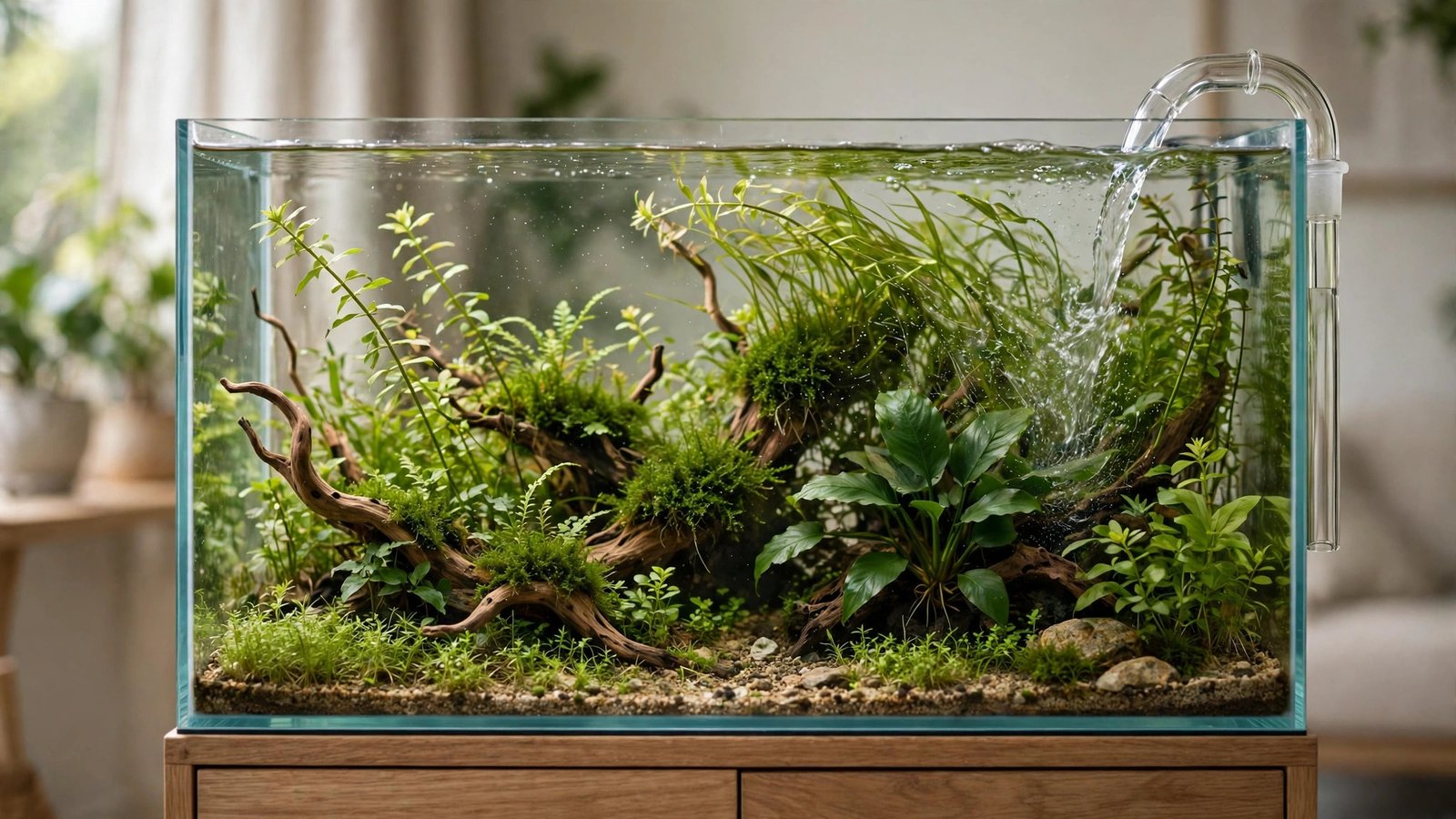
Good planted tank water flow circulation is the invisible backbone of a healthy aquascape. Plants can't move toward their nutrients, injected CO2 won't distribute itself, and detritus always settles exactly where you don't want it. Whether your filter hums along fine or you're fighting dead spots behind the hardscape, understanding how water should move through your tank fixes more problems than almost any fertilizer tweak.
This guide explains why circulation matters for plants, how to judge whether your tank has enough flow, how to position your outflow for full coverage, when to add a circulation pump, and how to keep flow comfortable for fish and shrimp. The guidance here is conservative — proven ranges used by experienced hobbyists for years, not extremes pushed by equipment marketing.
Why Planted Tank Water Flow Circulation Matters
In nature, moving water constantly refreshes the depleted layer around every leaf. Your aquarium must do the same at a smaller scale. Flow shapes four things that all connect.
Nutrient delivery
Every submerged leaf sits inside a thin, stagnant film of water. Without movement, a plant quickly absorbs the nutrients touching its surface and then waits on slow diffusion for more. Gentle, steady flow replaces that film continuously, so fertilizers in the water column actually reach the leaf. This matters most for heavy water-column feeders — stem plants, mosses, ferns — and it's why a well-circulated tank often grows better at identical dosing levels than a stagnant one.
CO2 distribution
If you inject CO2, flow is what turns one diffuser's output into tank-wide availability. Without current, plants near the diffuser get plenty while far ones run lean — the classic cause of patchy growth (lush on one side, stunted on the other) and of black beard algae outbreaks colonizing the CO2-starved zones. Always place your diffuser where the outflow current catches its output and sweeps it through the whole tank.
Dead spots and detritus
Every tank has still pockets: behind rocks, in corners, under hardscape overhangs. Detritus settles there, decomposes, and creates local organic spikes that feed algae and depress oxygen at night. Good circulation keeps waste suspended long enough for the filter to catch it and keeps oxygen even across the tank after lights-out.
Surface gas exchange
A gently rippling surface exchanges gases far better than a glassy-still film — oxygen in, excess CO2 out. A persistent protein slick on the surface signals poor surface movement, which is usually fixed by aiming some flow upward rather than by adding equipment.
How Much Flow Is Enough?
The standard measure is turnover: how many times per hour your filter and pumps move the tank's total volume. A 20-gallon tank with 200 gallons per hour of flow has 10x turnover.
Two caveats. First, rated filter flow is measured empty — real flow with media, hoses, and head height is often 30–50% less. Second, turnover says nothing about distribution. A high-turnover tank with the outflow aimed at the glass circulates worse than a moderate one with smart positioning. Use turnover as a starting range, not a guarantee.
Recommended turnover ranges
| Tank type | Target turnover (per hour) | Notes |
|---|---|---|
| Low-tech, no CO2 | 4–6x tank volume | Gentle steady flow is plenty; plants metabolize slowly without injected CO2. |
| CO2-injected, moderate light | 6–8x tank volume | Enough current to carry CO2 to every corner without uprooting stems. |
| High-tech, high light | 8–10x tank volume | High-demand systems need fast nutrient and CO2 delivery; watch livestock. |
| Shrimp or betta tanks | 4–6x tank volume | Favor gentle, well-distributed flow; always cover intakes. |
If your canister is rated 10x but runs full of media with long hoses, real turnover may be ~6x — right in the target zone. A canister filter chosen for planted tanks is the most common way to hit these numbers quietly, especially above 20 gallons.
The plant sway test
Numbers get you in the ballpark; your eyes confirm the result. Check every region of the tank:
- All stem tips should drift gently in one direction or sway lazily. Motionless plants in the far corner mean a dead spot, whatever your turnover number says.
- Mosses and ferns should flutter softly, not whip. Leaves pinned flat against wood signal excessive local velocity.
- Foreground carpets should ripple when viewed from the front. A still carpet under swaying midground stems means flow is skipping the bottom — angle the outflow down a touch.
- Fish should swim relaxed. Tetras fighting to hold station or shrimp clinging to glass instead of grazing mean local flow is too strong.
This five-minute check tells you more than any spec sheet. Run it in the corners, behind hardscape, along the front glass, and near the substrate.
Positioning Your Filter Outflow
How water enters the tank matters as much as how much moves. Most planted tanks use a lily pipe or spray bar, and the strategy is the same for both: build one coherent circulation pattern that reaches everywhere, not two competing currents that cancel out.
The classic end-to-end flow pattern
For a rectangular tank, put the outflow and intake at opposite ends:
- Outflow at one end, aimed slightly downward along the tank's length. The jet should push water from the surface-to-mid region toward the far end.
- Intake at the opposite end, near the substrate. Water that traveled the full length gets drawn down and back to the filter, rolling through the whole volume.
- CO2 source under the outflow. The diffuser output enters the flow right at the outflow so it rides the full circuit.
This pattern is forgiving and works from nano tanks to large displays. If you're still planning equipment, a first planted tank shopping list covers which pipe configurations suit common sizes.
Lily pipes vs spray bars
Lily pipes produce a gentle, wide, directional current and look elegant — but their stream is weak per unit of flow, so positioning matters more. Spray bars spread flow evenly across a wide front, forgiving in densely planted tanks but less pretty. Neither is universally better: lily pipes suit open aquascapes with one visible coherent current, while spray bars suit jungle-style tanks where flow must push through dense planting. A high-tech planted tank setup with dense stems often ends with a spray bar; minimalist layouts usually favor lily pipes.
Common positioning mistakes
- Aiming the outflow straight down — excavates aquasoil, uproots carpets, and leaves the rest of the tank still.
- Pointing it at the front glass — energy dies against the glass before reaching the tank's length.
- Intake and outflow side by side — filtered water short-circuits straight back in; the far end sees almost no turnover.
- Hardscape blocking the current — arrange rocks and wood so the flow passes beside or over them, not into a wall.
Circulation Pumps: When to Add One
A circulation pump (wavemaker/powerhead) only moves water — it doesn't filter. You need one when the filter alone can't fix a dead zone: typically in tanks 40 gallons and up, in tanks with complex hardscape, or when the sway test shows a motionless region no outflow adjustment reaches.
Size conservatively: a pump adding roughly 2–4x tank volume per hour on top of filter turnover. An oversized pump stresses livestock and is hard to dial out; a gentle one that fixes the dead zone is an easy win. Place it low near the dead zone, aimed so its stream joins the main pattern instead of fighting it. If you like automation, app-controlled planted tank setups make timed circulation easy — for example, stronger flow during the photoperiod when CO2 demand peaks, gentler at night.
A nano powerhead erases dead spots without blasting plants: Hydor Koralia Nano circulation pump.
Finding and Fixing Dead Spots
How to spot them
- Detritus always collects in one place — a corner or hollow that looks dusty no matter how recently you siphoned.
- Algae grows in one region only — black beard or staghorn algae in the still zone is a classic low-flow signature.
- One area grows poorly while the same species thrives elsewhere — with equal light, flow and CO2 distribution are the prime suspects.
Fixes, cheapest first
- Redirect the outflow toward the dead zone. This fixes most cases for free.
- Trim the blockage. Dense stem thickets are the most common flow killers — a heavy trim in front of the dead zone often restores flow overnight. Letting density creep up until circulation collapses is one of the classic beginner planted tank mistakes.
- Shift hardscape slightly to open a channel for the current.
- Angle flow deeper if the bottom is stagnant while the surface races.
- Add a small circulation pump as a last resort, not a first step.
Give the tank a few days after any change, then re-run the sway test. Dead spots sometimes move rather than vanish — that's progress; iterate once more.
Balancing Flow With Fish and Shrimp Comfort
Plants love current; livestock has opinions. Aim for a flow gradient, not uniform velocity: strong enough to serve plants, with calm pockets where animals rest.
Most community fish — tetras, rasboras, danios — handle the recommended ranges happily. Problems start with long-finned or weak swimmers (bettas, fancy guppies, angelfish) and shrimp, which get blown off grazing surfaces by direct jets. With these animals, stay at the low end of the ranges, use a spray bar to spread velocity, and keep at least a third of the tank calm behind plants or hardscape. A shrimp-focused planted tank setup has more detail on keeping flow shrimp-safe, including intake covers.
Watch behavior as your flow meter: fish that never leave one corner, or shrimp that only graze when pumps are off, are telling you daytime flow is too much. At the extreme low end, a no-filter planted tank setup shows how little current some stock needs to thrive.
Don't shut flow off at night
When lights go out, plants consume oxygen instead of producing it. Steady overnight flow keeps oxygen even across the tank and prevents the dawn dip that stresses fish in densely planted tanks. You can dial pumps back for calmer rest hours, but keep gentle flow and some surface agitation going — especially in heavily stocked tanks. Tanks that survive power outages show the extreme case: without circulation, oxygen stratifies and livestock suffers within hours.
Flow, Algae, and Maintenance
Flow and algae connect in both directions: too little flow invites algae, and sudden flow changes can trigger it.
Stagnant zones accumulate the organics algae feed on, while CO2-starved plants in still regions weaken. When thread or black beard algae appears in one area, check flow there before reaching for treatments — even the best algae eaters for planted tanks work best in well-circulated aquariums where algae is already on the back foot.
But don't overhaul flow suddenly. Plants and biofilms adapt to their flow regime — jumping from a gentle filter to a powerful one overnight can uproot carpets, flatten stems, and trigger algae as the tank re-equilibrates. Start low and raise flow over a week or two, and keep outflow position identical when you change filter media or automate water changes so the established pattern survives the upgrade.
Fold flow checks into routine maintenance: during water changes, glance at the sway-test regions, brush detritus off leaves, and trim anything blocking the outflow path. Stable planted tank water parameters plus even circulation are the two cheapest algae-prevention tools you own. If you follow a planted tank maintenance schedule, add "check circulation" every month or two — flow degrades silently as media clogs and plants grow in.
Frequently Asked Questions
How many times per hour should my planted tank's water turn over?
Aim for 4–10 times the tank volume per hour depending on tech level: 4–6x for low-tech tanks without CO2, 6–8x for CO2-injected setups, and up to 8–10x for high-light, high-demand systems. Remember rated filter flow is measured empty — real flow with media and hoses is typically 30–50% less, so factor that in rather than chasing the box number.
Can I have too much flow in a planted tank?
Yes. Excessive flow uproots carpet plants, flattens stems, stresses weak swimmers like bettas, and blows shrimp off grazing spots. Signs include plants permanently bent one direction, fish hiding constantly, and substrate erosion under the outflow. Reduce pump output, switch to a spray bar to spread the current, or baffle the outflow with plants or hardscape.
Where should I place my CO2 diffuser for best distribution?
Put the diffuser directly in the filter outflow's path so the current carries CO2 through the entire tank. Inline diffusers or reactors are ideal since the CO2 is already mixed into the outflow stream. Avoid calm corners or spots under the intake, where CO2 gets sucked straight into the filter instead of circulating.
Do I need a circulation pump if I already have a good filter?
Not always. In tanks under about 40 gallons with simple layouts, a well-positioned outflow usually provides complete circulation. Add a small pump when the sway test reveals a dead zone that outflow adjustments, trimming, and hardscape tweaks can't fix — most often in larger tanks or complex hardscapes. Start with a conservatively sized pump.
Why does algae keep growing in one corner of my tank?
Localized algae is a classic dead-spot symptom: the still corner collects detritus and gets little CO2, so plants weaken while algae colonizes. Redirect your outflow toward that corner, trim plants blocking the current, and check whether hardscape shields it. Fixing flow usually slows or stops the algae without chemical treatment.
Should I reduce flow at night?
Keep at least gentle flow overnight: with lights out, plants consume oxygen, and circulation prevents the pre-dawn oxygen dip that stresses fish in densely planted tanks. You can dial pumps back for calmer rest hours, but don't shut circulation off entirely — especially in densely planted or heavily stocked aquariums.
The Bottom Line
Water flow quietly decides nearly everything else in a planted tank: nutrient uptake, CO2 distribution, detritus management, oxygen levels, and algae pressure. You don't need expensive gear or extreme turnover — you need every region moving gently, every stem tip swaying, and livestock swimming relaxed. Build one coherent circulation pattern, verify it with the sway test, fix dead spots with positioning before purchases, and recheck monthly as plants grow in. Get the water moving right, and the plants do the rest.