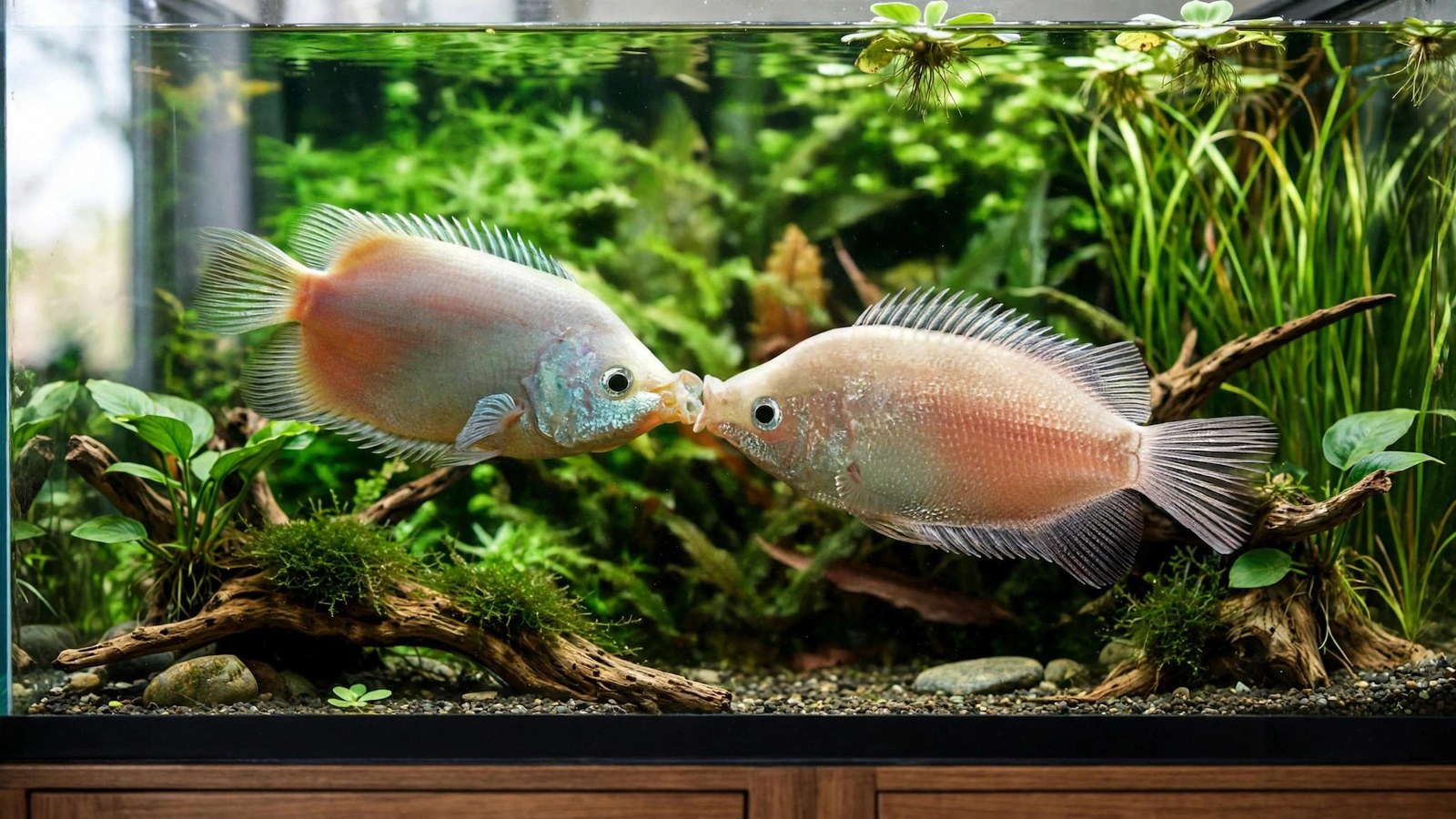
Most kissing gouramis arrive home as innocent two-inch juveniles — and most buyers never learn those babies grow into foot-long, lip-locking tank bulldozers within two years. That upgrade story is why a kissing gourami planted tank needs its own playbook: build for the adult, not the baby, and you get a personable, decade-long centerpiece. Build for the juvenile, and you get chewed plants, bullying, and a fish that outgrows its home in eighteen months.
Yes, kissing gouramis work in planted tanks — with 55 gallons or more and tough-leaved plants like Anubias and Java fern. Helostoma temminckii is sold at 2 inches but reaches 8–12 inches as an adult, making juveniles-in-nano-tanks the hobby's most common sizing mistake. The "kiss" is mouth-to-mouth territorial sparring, not romance — and those same scraping lips graze algae and diatoms off hardscape all day.
Why Kissing Gouramis Need Their Own Playbook
Juvenile kissers sit in the same store tanks as dwarf gourami setups, at the same size and price — so buyers assume similar care. It is not similar. Helostoma temminckii is one of the largest gouramis in the trade and triples in length in its first year. Most "aggressive kisser" stories are really stunted, stressed fish in tanks a third of the size they need.
The famous kiss is ritualized combat: two rivals press their fleshy, comb-toothed lips together and push. The same hardware they spar with scrapes algae, biofilm, and soft plant tissue off surfaces. In short: kissers are not plant-eaters by nature, they are plant-testers. Tough leaves survive the testing; soft leaves do not.
Designing Your Kissing Gourami Planted Tank
Think in thirds. Keep the front third open swimming space with sand or fine gravel, plant the back third densely, and use the middle third for sightline breaks — a driftwood piece wrapped in Anubias, a Java fern thicket — that cut sparring matches short. Floating cover is essential: water lettuce or frogbit dims the glare kissers dislike, soaks up nitrates, and gives nervous fish a ceiling. Leave a third of the surface open for gas exchange.
Tank size: the non-negotiable math
| Stocking | Minimum | Why |
|---|---|---|
| Single kisser | 55 gal, 4-foot | Swim length matters most for a 12-inch fish |
| Pair or trio | 75 gal | Room to retreat after a "kiss-off" |
| Kisser + community | 75–100 gal | Tank mates need their own territory |
Own a juvenile in a 20-gallon? Treat it as a grow-out and plan the upgrade now — rehoming an 8-inch kisser is far harder than upgrading.
Planting That Survives the Testing
Choose plants like furniture for a house with a large dog: sturdy, anchored, nothing delicate in reach. Soft stems — rotala, ludwigia, baby tears — are casualties. The shortlist below survives, and it overlaps heavily with the easiest beginner plants. For anything beyond this list, the planted tank plant guide is worth a read before you buy.
| Plant | Role | Why it survives |
|---|---|---|
| Anubias (barteri, nana) | Hardscape anchor | Leathery leaves; tie to wood, never bury the rhizome |
| Java fern | Midground walls | Tough, bitter leaves fish rarely graze twice |
| Hornwort | Background filler | Outgrows any grazing pressure |
| Amazon sword | Background focal | Thick leaves on a strong root system |
| Vallisneria | Back corners | Tough ribbons; runners recover from nips |
Water Parameters and Filtration
Kissers are forgiving, but a 12-inch fish in warm water produces a serious bioload. Aim mid-range and hold steady — stability beats a magic number. Change 30% of the water weekly without fail, and vacuum the open front third where detritus settles.
| Parameter | Target |
|---|---|
| Temperature | 75–82°F (24–28°C); keep 78°F+ for immunity |
| pH | 6.5–7.5, stable |
| Hardness | 5–12 dGH |
| Ammonia / nitrite | 0 ppm — non-negotiable |
| Nitrate | Under 40 ppm |
Filter for 4–6× hourly turnover but keep flow gentle — kissers come from slow, vegetated waters and build bubble nests. A canister with a spray bar aimed at the glass, or a pair of large sponge filters, gives biological capacity without a fire hose. Run two smaller heaters instead of one large one; redundancy matters with an irreplaceable centerpiece.
Feeding the Algae-Grazer
Wild kissers spend the day scraping biofilm and algae with those comb-like lip teeth, and yours will work your glass and driftwood the same way — many keepers leave some green algae on hardscape as enrichment. But grazing is a snack, not a diet. Feed quality sinking pellets as the staple, daily greens (spinach, zucchini, peas, spirulina wafers), and twice-weekly protein like bloodworms or daphnia. Skip protein-only diets — kissers get obese fast. Fast one day a week.
Tank Mates: Who Survives the Big Lips?
Kissers are peaceful toward other species — just enormous. The rule is size and speed, not temperament. Anything that fits in the mouth gets tested; anything slow and long-finned gets its fins lip-inspected. Good companions are robust and mid-sized: Congo tetras, black skirt tetras, rainbowfish, peaceful barbs, bristlenose plecos. Avoid tiny fish (neons become snacks), slow fancy fish (bettas, guppies), and aggressive cichlids.
Other gouramis are a mixed bag: pearl gouramis and honey gouramis get outcompeted at feeding time, while a blue gourami brings similar size with more attitude. One kisser as the sole centerpiece, plus a school of sturdy dither fish, is the most reliable formula.
Frequently Asked Questions
Do kissing gouramis actually kiss?
No — the "kiss" is ritualized sparring. Two rivals lock their fleshy, tooth-lined lips and push to establish dominance, usually after feeding. It is arm-wrestling, not romance. In a roomy planted tank with sightline breaks, matches stay brief and harmless; in cramped tanks they escalate into real bullying.
Will a kissing gourami eat my aquarium plants?
They mouth soft leaves and will destroy delicate stems, but rarely bother tough-leaved species. Anubias, Java fern, Amazon swords, and hornwort consistently survive. The trick is daily greens: a well-fed kisser mouths plants from curiosity, while a hungry one grazes them like food. Sturdy furniture for a large dog, not a flower bed.
What size tank does a kissing gourami really need?
One adult needs 55 gallons in a 4-foot tank; a pair needs 75 gallons. They sell at 2 inches and reach 8–12 inches, often within two years. If you cannot house a 55-gallon tank, choose a smaller gourami species instead — the fish will thank you.
Are pink kissing gouramis different from green ones?
Pink is a leucistic morph of the same species, Helostoma temminckii, and care is identical. The pink morph can be slightly less hardy from intensive line-breeding, so buy from a reputable source and quarantine new fish. Expect the same 8–12 inch adult size either way.
Can I keep them with small tetras?
Neons and other small tetras are a bad match — a full-grown kisser will eat fish that fit in its mouth. Choose tank mates over 2 inches that are fast and robust: Congo tetras, black skirt tetras, rainbowfish, and larger barbs. The kisser is peaceful; the risk is purely mechanical, big mouth meeting small fish.
How long do kissing gouramis live?
In a 55+ gallon planted tank with stable warm water and daily greens, 10–15 years is common; some reach 20. That is why the tank-size decision matters: you are housing a foot-long fish for over a decade. Buy the adult tank first, not the juvenile fish.
The Honest Verdict
A kissing gourami planted tank is a long-term commitment disguised as an impulse buy — and that is what makes it rewarding. Give this fish 55 gallons, tough plants, floating cover, and daily greens for a decade-plus companion with more personality than most fish twice its price. The Helostoma temminckii profile at Seriously Fish and FishBase's species entry confirm the sizing and behavior details worth checking before you buy. Buy the tank for the adult you will have in two years, and the kissing displays become the best show in your fish room.