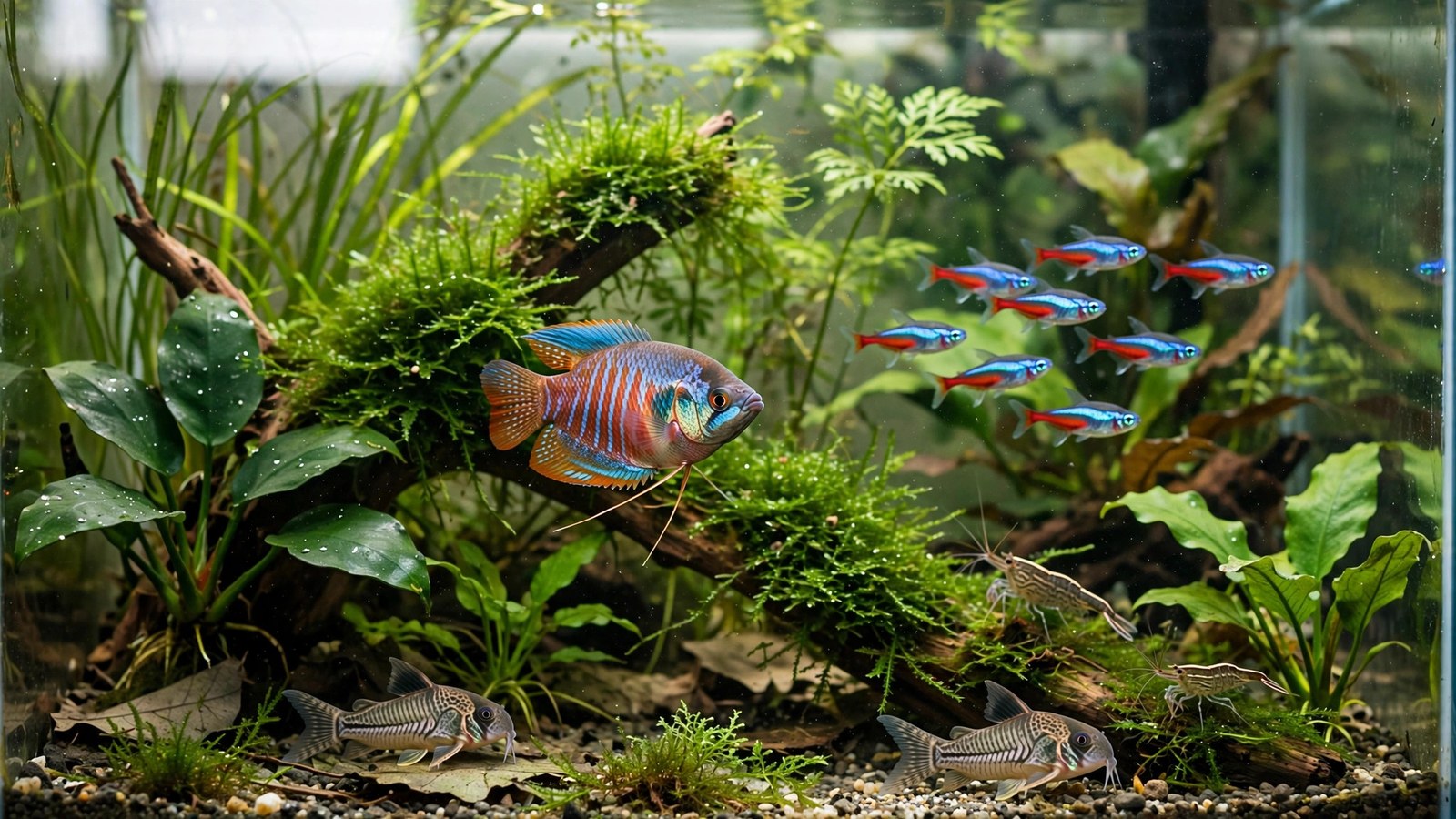
The dwarf gourami in the shop display tank and the one that fades in your tank within a year are almost never on the same trajectory — and the difference is rarely the fish. Most pet-store dwarf gouramis die early not from bad stock but from bare tanks: no cover overhead, bright light everywhere, nowhere to build a bubble nest. A proper dwarf gourami planted tank flips that script: floating plants overhead, filtered light, and a male blowing nests within weeks. Here's exactly how to build one — tank size, plants, water, tank mates, and feeding.
Plant selection drives everything else — start with our best aquarium plants for fish tanks guide for the hardy species that suit this setup.
Dwarf Gourami Planted Tank: Build Around Floating Cover
Dwarf gouramis (Trichogaster lalius) come from slow streams and rice paddies in India, where leaves and surface vegetation dominate. A bare tank is the opposite of what their instincts expect, and it shows: stressed fish hover in corners, refuse food, and fade to a muddy version of their shop colors. Floaters fix all of this — diffused light, overhead security, and anchors for bubble nests. A male that builds a nest is a male that feels safe: he eats, colors up, and displays.
Like bettas, dwarf gouramis are labyrinth fish that breathe air at the surface, which is why the plant picks for betta tanks transfer so well here — broad leaves near the surface, soft planting, calm water. Deciding between gourami species? Our honey gourami setup covers a smaller, even more peaceful alternative, and the sparkling gourami guide is the nano-tank version of the same playbook.
 ★3.9
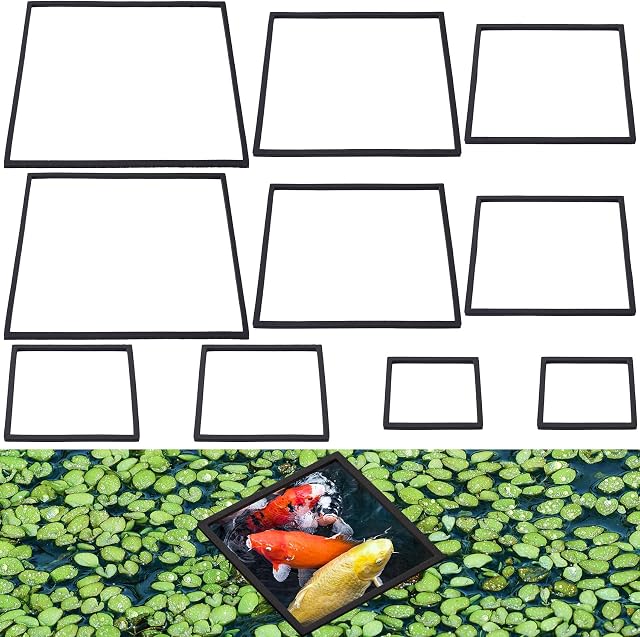
PAGOW Floating Plant Corral Rings
Check Price on Amazon ★3.9Tank Size, Shape, and Equipment
Fifteen gallons is the realistic minimum for a single male; a 20-gallon long is the sweet spot, with the footprint for a trio to establish zones without constant line-of-sight tension. Tall tanks waste the horizontal space gouramis actually patrol. Keep equipment simple and gentle:
- Filtration: a sponge filter or a hang-on-back on its lowest flow. Anything that ripples the whole surface shreds bubble nests.
- Heater: one adjustable 50–100W heater (for 15–20 gallons). Nights below 75°F bring lethargy and white patches.
- Lighting: low to medium intensity, 6–8 hours daily. The floaters will shade half the tank — that's the point.
- Substrate: dark fine gravel or sand. It makes their colors pop and hides detritus.
No CO2 is needed — choose undemanding plants and the tank practically runs itself, which is why it works so well as a low-tech planted tank.
Plants That Make Dwarf Gouramis Thrive
Build in three layers: floaters overhead (non-negotiable — cover 40–60% of the surface), midground plants for escape routes, and a low foreground as a grazing floor.
| Layer | Plants | Why gouramis love it |
|---|---|---|
| Surface | Frogbit, Salvinia minima, red root floater, dwarf water lettuce | Security overhead; anchors bubble nests; softens light |
| Midground | Anubias nana, Java fern, cryptocoryne wendtii | Resting leaves; sightline breaks |
| Background | Water sprite, hornwort, vallisneria | Soak up nitrates; thick cover |
| Foreground | Dwarf sagittaria, Monte Carlo | Open grazing floor without bare glass |
Plant densely from day one — roughly 70% coverage before the fish arrive, after cycling. Sparse "it'll grow in" aquascapes leave new gouramis exposed for weeks, which is when most beginner losses happen. Our floating aquarium plants for beginners guide covers growth rates and keeping floaters from smothering the surface.
Water Parameters and Maintenance
Dwarf gouramis are forgiving about chemistry but strict about stability — soft-to-moderately-hard, slightly acidic to neutral water, kept warm and clean:
| Parameter | Target |
|---|---|
| Temperature | 77–82°F (25–28°C) |
| pH | 6.0–7.5 |
| General hardness | 4–12 dGH |
| Ammonia / nitrite | 0 ppm |
| Nitrate | Below 20 ppm |
| Water changes | 25–30% weekly |
Match new water temperature within 2°F and pour it back gently — a cold splash or turbulent refill undoes a week of calm. Because floaters cover the surface, leave a gap under the lid (or use mesh): gouramis breathe warm, humid air, and a sealed cold lid can chill that air layer. Thin floaters weekly so gas exchange stays healthy and light reaches lower plants.
Tank Mates and Feeding
Dwarf gouramis suit peaceful communities — pick companions that won't fin-nip or outcompete them at the surface. For a 20-gallon setup:
- Schooling tetras — 8–10 ember tetras (see the ember tetra planted tank setup) or chili rasboras.
- Bottom dwellers — 6 pygmy corydoras (pygmy cory planted tank) or otocinclus.
- Snails and amano shrimp — safe picks; cherry shrimp may get picked off by a bold male.
Never house them with bettas, barbs, or larger cichlids — a betta-vs-gourami standoff ends badly, and barbs shred trailing fins. Two males need 30+ gallons with heavy planting, and even then it's a gamble; one male is the peaceful default.
Dwarf gouramis are surface feeders with small mouths. Feed twice daily, only what they finish in 2 minutes: a high-quality micro pellet or small floating granule as the staple, plus frozen daphnia, baby brine shrimp, or bloodworms 3–4 times a week to trigger spawning behavior and deepen color. Skip flake-only diets — flakes crumble, foul the water, and leave gouramis thin over months. A gourami that ignores food in a well-planted tank is almost always sick or bullied, not "just adjusting."
Frequently Asked Questions
How big a tank does a dwarf gourami need?
A single male needs at least 15 gallons; a 20-gallon long is ideal. A trio (one male, two females) also fits in 20 gallons. Ten-gallon tanks force constant proximity, which raises stress, washes out color, and makes males aggressive toward tank mates they would ignore in a bigger space.
Can dwarf gouramis live with bettas?
No. Both are territorial labyrinth fish that claim the surface, and a male betta and male dwarf gourami will fight until one is badly hurt. Even females cross-hassle. Want both? Run two planted tanks — the setup principles are nearly identical.
Why is my dwarf gourami hiding all the time?
It feels exposed: too few plants, too much light, strong current, or bullying tank mates. Check that 40–60% of the surface is covered and filtration is gentle. Still hiding after two weeks in a planted tank? Look for clamped fins, faded color, or white patches — it's likely sick.
What is dwarf gourami disease and how do I avoid it?
Usually dwarf gourami iridovirus (DGIV) — incurable and common in mass-farmed stock. Symptoms appear weeks after purchase: lethargy, color changes, appetite loss, skin lesions. Avoid it by buying from reputable breeders, quarantining 3–4 weeks, and never buying from a tank with dead or sick fish.
Do dwarf gouramis eat aquarium plants?
Healthy ones don't eat live plants — they nibble algae and biofilm off leaves, which is harmless and helpful. Chewed leaves usually mean snails, a pleco, or nutrient deficiency. They may tug floaters while building bubble nests, but plants recover fast.
Do I need CO2 for a dwarf gourami planted tank?
No. The plants they thrive with — anubias, Java fern, crypts, floaters, water sprite — grow fine without injected CO2, and CO2 gear adds surface turbulence that works against this fish. Spend the money on more plants and a good heater instead.
A dwarf gourami planted tank rewards you the way few beginner setups do: the day a male starts weaving a bubble nest under your frogbit, you know the tank is right. Keep the surface calm, the floaters thick, and the stocking honest — one male, peaceful company, quarantined fish — and this setup stays vibrant for years. Pair it with the Endlers planted tank for a second lively display.
Sources: the Seriously Fish profile for Trichogaster lalius on wild habitat, and Tropica's plant database for every plant's growth needs.