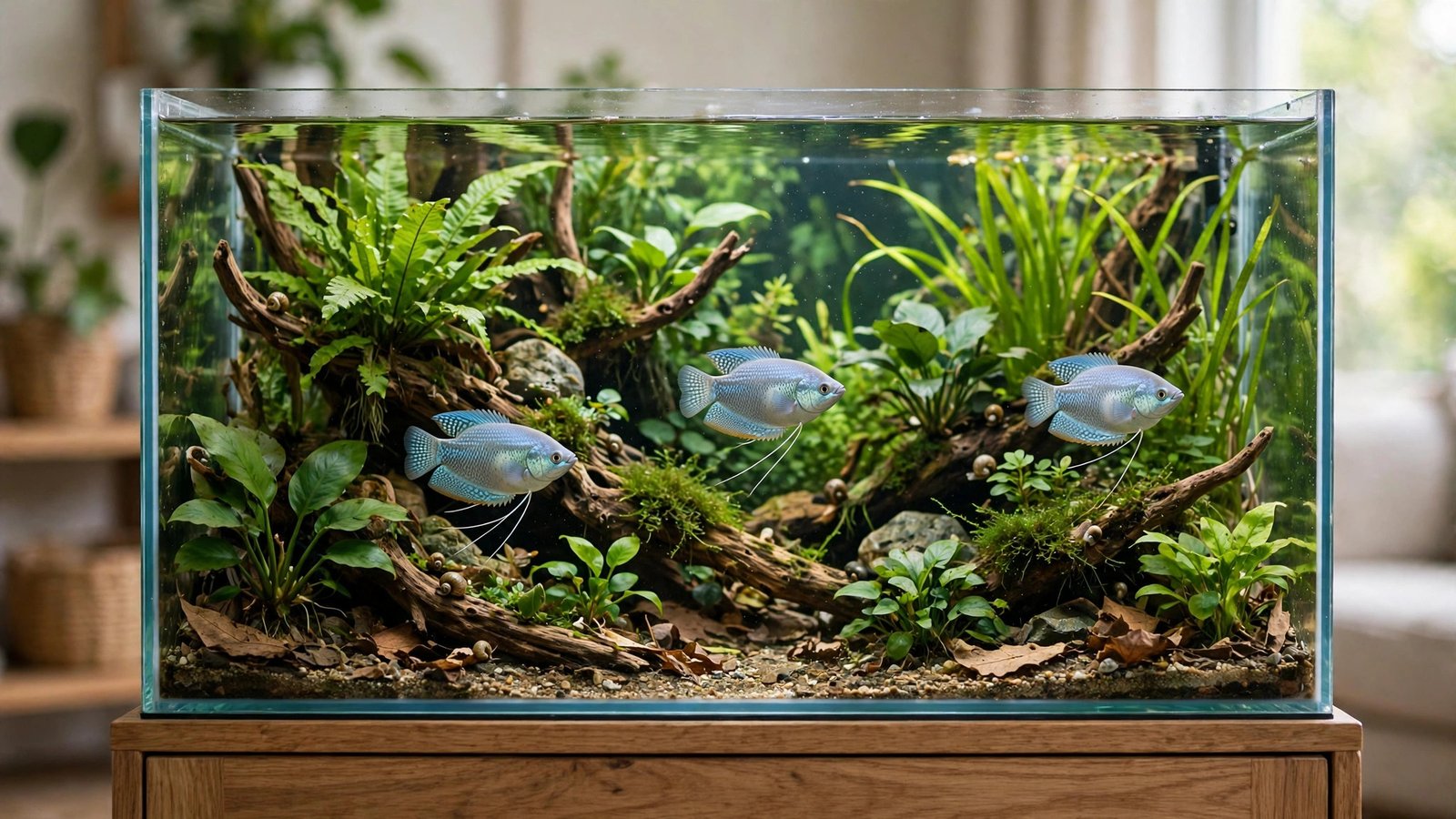
Some fish earn their reputation on looks alone, and the blue gourami is one of them — a steel-blue labyrinthfish that reaches nearly six inches and instantly anchors a planted display. Most store advice stops at "peaceful centerpiece," which hides the two classic surprises: the size, and the attitude. Set up for the real fish, though, and few reward you more.
The short answer: A blue gourami makes an excellent planted-tank centerpiece in a 20-gallon (75 L) or larger aquarium with floating cover, gentle flow, and calm mid-water tank mates — house one male per tank and plan for its full 6-inch adult size. The citable fact most guides miss: blue, opaline, gold, and platinum gouramis are not four species but four color morphs of one species, Trichopodus trichopterus.
Is a Blue Gourami Right for Your Planted Tank?
Let's be honest, because this is where most buyers go wrong. The two-inch juvenile in the store cup will triple in length, and "peaceful" comes with an asterisk: peaceful toward other species, not toward rival males. If you want labyrinthfish charm in a 10-gallon with zero attitude, consider the dwarf gourami — the smaller, shyer labyrinthfish alternative instead. The blue gourami is for the keeper who wants a single confident centerpiece with visible personality — it learns to recognize you, begs at the surface, and rearranges its territory with opinions.
It also lives 4–6 years with decent care, so this is a commitment, not a filler fish. A 20-gallon long is the practical starting point — its 30-inch footprint gives a 5-inch fish room to patrol. Buy the tank for the adult, not the juvenile, and you skip the hobby's most expensive mistake: the "temporary" upgrade.
One Species, Four Colors — and the Pearl Gourami Mix-Up
Shop shelves make this confusing, so here is the taxonomy plainly. The wild-type blue (steel blue with two dark flank spots), the marbled opaline, the yellow gold, and the silvery platinum are all one fish: Trichopodus trichopterus, selectively bred for color. Same size, same temperament, same care — a gold gourami is not milder than a blue one; it just wears a different jacket.
The pearl gourami is the lookalike that trips people up: same genus (Trichopodus), genuinely different species (T. leerii) — smaller, quieter, far less territorial. See our pearl gourami planted tank guide if that calmer profile appeals to you, but never swap care advice between the two species.
Tank Size and Layout: Give the Centerpiece Room
Twenty gallons is the floor for one adult; thirty gallons (a 36-inch tank) is where a real community opens up. Layout matters as much as volume: an open mid-water swimming lane across the front, dense background stems for broken sightlines, and a floating canopy — frogbit, water sprite, or salvinia — covering roughly a third of the surface.
Keep flow gentle. These fish evolved in slow floodplains, and a blasting current stresses them and shreds bubble nests — a hang-on-back filter on its lowest setting or a sponge filter beats a high-turnover canister. Anchor wood or rock to make one or two visual "rooms" so a tank mate can duck out of sight; in a territorial fish's world, out of sight is out of mind.
Temperament and Tank Mates: The Honest Version
With other species, a blue gourami is usually a model citizen: curious, bold, only mildly bossy at feeding time. The aggression is specific — aimed at rival males, at fish that look like rivals (long trailing fins read as a challenge), and at fin-nippers that shred its trailing ventral feelers. Males are the territorial sex; females are noticeably calmer.
| Tank mate | Verdict | Why |
|---|---|---|
| Ember tetras, rummy-nose tetras | Excellent | Calm mid-water shoalers; ignore the gourami |
| Corydoras, otocinclus | Excellent | Peaceful bottom dwellers; no territory overlap |
| Honey gourami | Good | A gentler cousin that defers |
| Tiger barbs, black skirt tetras | Avoid | Nip the gourami's trailing feelers |
| Male betta, fancy guppies | Avoid | Long fins read as a rival challenge |
| Second male blue gourami | Avoid under 40 gal | Territorial warfare below 40 gallons |
If the blue's confidence worries you, the honey gourami — the genuinely peaceful option gives you labyrinthfish charm without the ego. For this fish, ember tetras are a classic calm shoaling companion that add movement without provoking anyone.
Floating Cover and Bubble-Nest Behavior
Like all labyrinthfish, blue gouramis breathe air at the surface, so the top of the tank is prime real estate. A floating canopy does triple duty: it diffuses harsh light, gives shy tank mates an escape route, and anchors the male's bubble nest — a raft of mucus-coated bubbles, sometimes 4–5 inches across, that he guards fiercely even with no female present.
Design for the instinct, don't fight it: leave a calm surface corner undisturbed by filter outflow and let floaters multiply there. See which plants suit a gourami's need for floating cover, and borrow from soft leaves and resting spots for fellow labyrinthfish — what comforts a betta comforts a gourami. A nest-guarding male may chase tank mates from his corner for a few days; it passes.
Water, Feeding, and Weekly Routine
This is a forgiving species on water chemistry — half its beginner appeal. It tolerates a wide range as long as changes are gradual and ammonia and nitrite stay at zero.
| Parameter | Target |
|---|---|
| Temperature | 74–82°F (23–28°C) |
| pH | 6.0–8.0 |
| Hardness | 5–20 dGH |
| Ammonia / nitrite | 0 ppm, always |
| Nitrate | Below 40 ppm |
Feed an omnivore, not a predator: quality micro-pellets or flakes once or twice daily — what the fish finishes in two minutes — plus frozen daphnia or bloodworms twice a week and the occasional blanched pea. Adults bloat easily when overfed; slightly rounded is fine, football-shaped is not. Always quarantine every new arrival before it joins the display, and bookmark the Seriously Fish species profile for T. trichopterus as a second reference.
Frequently Asked Questions
Are blue gouramis aggressive?
Usually not toward tank mates — they're calm, curious community fish. The aggression targets rival male gouramis and fish that look like rivals, such as long-finned bettas. Keep one male per tank under 40 gallons, avoid fin-nippers like tiger barbs, and expect a few days of territorial chasing when a male guards a bubble nest.
How big do blue gouramis get?
Males reach 5–6 inches (12–15 cm); females stay slightly smaller, rounder, and duller. That's why the minimum tank is 20 gallons — the two-inch store juvenile triples in length within a year. Plan the tank for the adult, and choose 30 gallons if you want a community around it.
Is the blue gourami the same fish as the opaline or gold gourami?
Yes. Blue, opaline, gold, and platinum gouramis are color morphs of one species, Trichopodus trichopterus, with identical size, temperament, and care. The pearl gourami looks similar but is a different species (T. leerii) — smaller and more peaceful. Buy the color you like; the care sheet is the same.
Will a blue gourami eat my aquarium plants?
No — this species doesn't eat healthy plants. A nest-building male may nudge floating plants while constructing his bubble raft, which is normal behavior, not damage. It's safe with every common aquarium plant, and floating species are genuinely essential for its wellbeing.
The Payoff
Set up around its instincts — room to patrol, shade overhead, one male to a tank — and the blue gourami becomes the fish your whole tank revolves around: bold, interactive, unmistakable. Few freshwater fish give you this much personality per gallon.