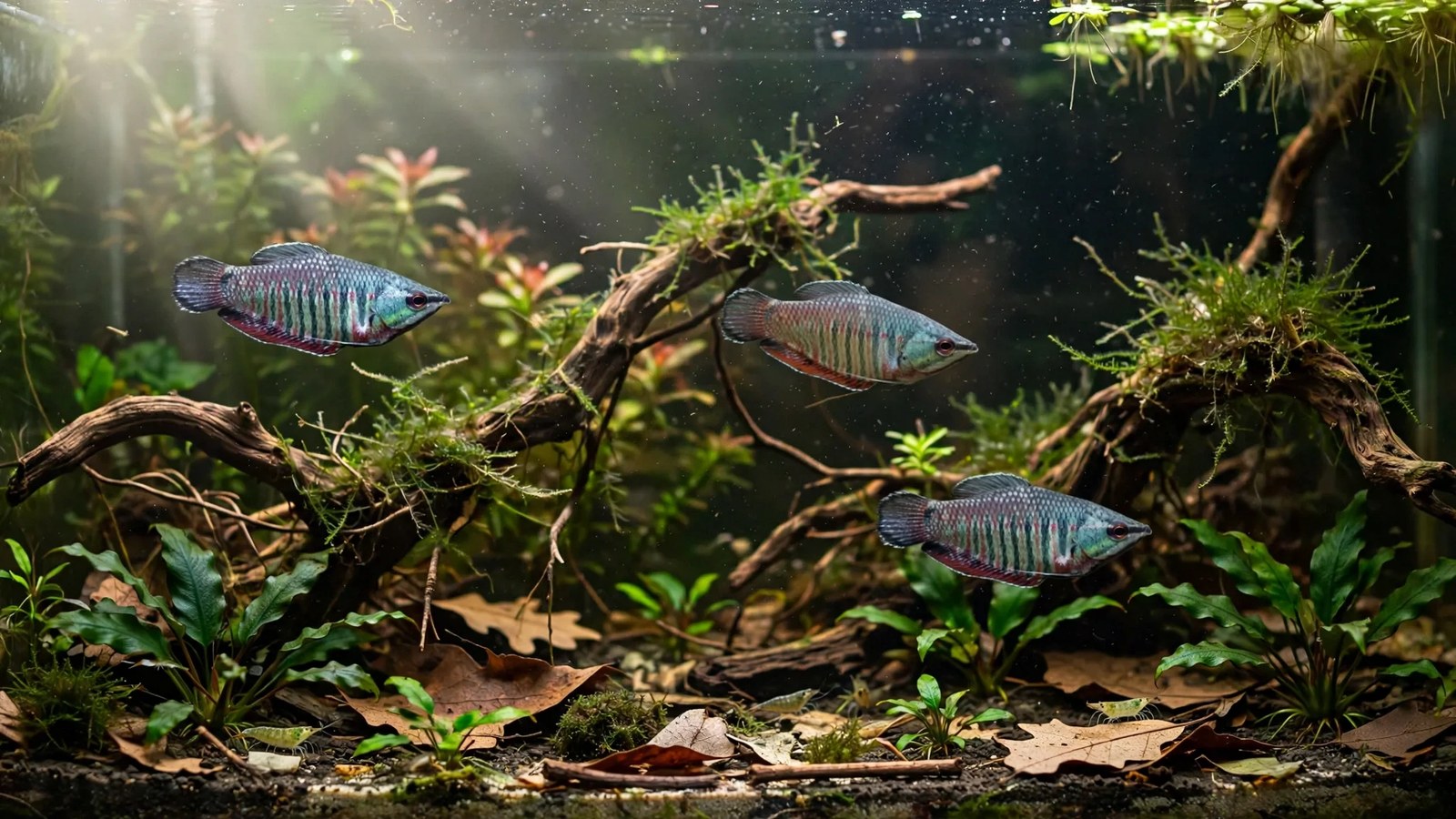
Most gouramis blow bubble nests. The samurai gourami doesn't — the male gathers the eggs into his mouth and carries them for two weeks, refusing food. A samurai gourami planted tank recreates the Bornean peat swamps this shy, ruby-striped fish calls home: blackwater stained dark with tannins, pH near 4.5, dim light filtering through floating plants.
The short answer: A samurai gourami planted tank is a dim, leaf-littered blackwater setup at pH 4.0–5.0, 76–79°F, and 10–20 gallons, planted with Cryptocoryne and Microsorum. The male is a paternal mouthbrooder — he holds the eggs 12–14 days without eating, unlike bubble-nesting gouramis.
Samurai Gourami Planted Tank Setup: The Mouthbrooder's Blackwater Blueprint
You already know fish-first plant selection for aquariums matters, but samurai gouramis flip the logic: this tank is designed around chemistry, not scaping. In the wild, Sphaerichthys vaillanti lives in Bornean peat swamps where water can read below pH 4.0 — your plants must tolerate near-zero carbonate hardness and near-darkness.
That distinction matters at the shop. Three fish share the blackwater-gourami shelf: the samurai (S. vaillanti), mouthbrooder with red-brown checkerboard stripes; the chocolate gourami (S. osphromenoides, see our chocolate gourami planted tank guide), larger and plain brown; and licorice gouramis (Parosphromenus spp. — our licorice gourami planted tank), cave-spawning bubblenesters half the size.
Tank Size and Peat-Swamp Layout
Use 10 gallons for a pair, 15–20 for a group of five or six — and groups are strongly recommended. A lone pair in a bright tank hides and stops eating; a group in a small, dim, structured tank forages openly and shows full red striping.
- Substrate: 1–2 inches of fine dark sand. Light gravel keeps them pale and timid.
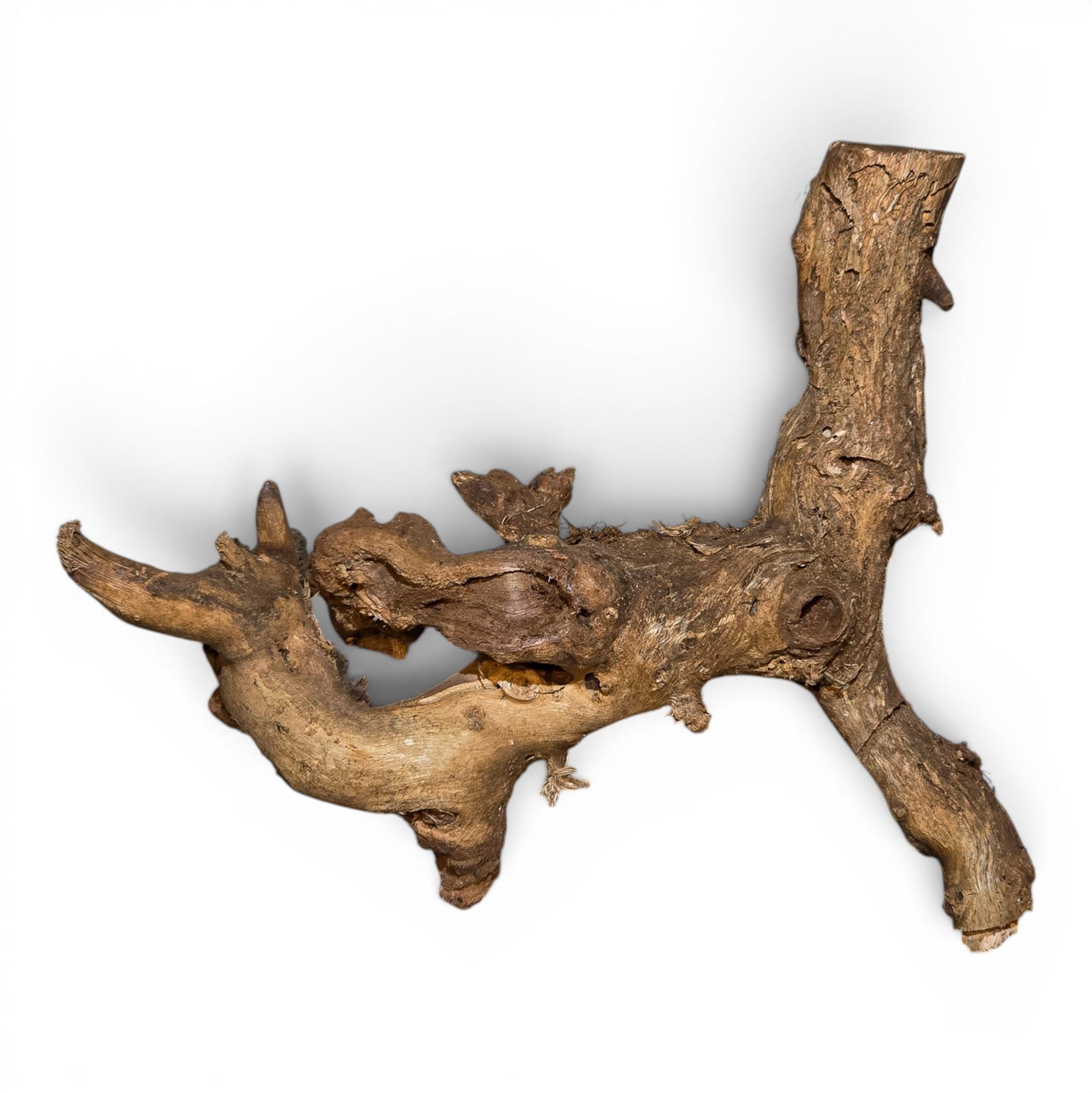
- Driftwood: two or three pieces of spider wood or Malaysian driftwood to break sightlines. Boil 30–45 minutes first so it sinks.
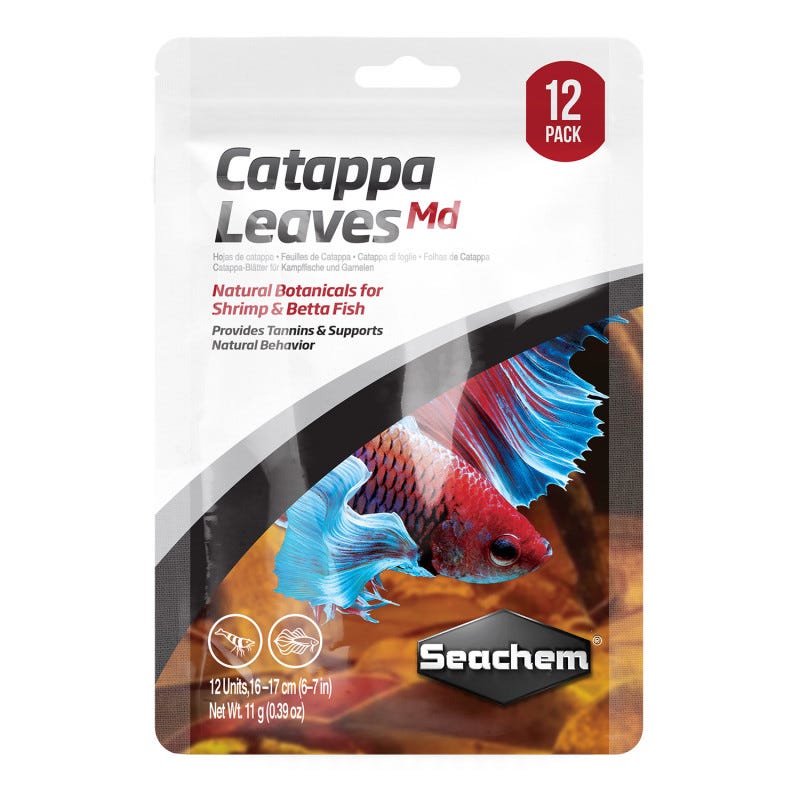
- Leaf litter: 10–15 catappa leaves plus a handful of oak or beech leaves per 15 gallons, replaced every 4–6 weeks — chemistry and foraging ground, not decoration.
- Hides: one coconut hut or clay cave per male among the roots — males without a claimed cave rarely breed.
 ★3.9
Fluval Mopani Driftwood
Check Price on Amazon ★3.9The Peat-Swamp Water Recipe
This is where most keepers fail: tap water at pH 7.5 is lethal over time. Their immune system evolved for acidic, nearly sterile water; at neutral or alkaline pH, Saprolegnia fungus colonizes skin and gills.
| Parameter | Target | How to get there |
|---|---|---|
| pH | 4.0–5.0 | RO water + catappa leaves + alder cones |
| GH / KH | 1–4 dGH, 0–2 dKH | RO remineralized to 40–80 ppm TDS |
| Temperature | 76–79°F (24–26°C) | Adjustable heater; avoid swings over 2°F |
| Tannins | Visible tea-color stain | Leaves, cones, driftwood; top up monthly |
| Water changes | 10–15% weekly | Match temperature and pH exactly |
For 15 gallons: RO water at about 60 ppm TDS, 12 catappa leaves, 8 alder cones, cycle 3–4 weeks before the fish arrive. Filter gently — a sponge filter or baffled hang-on-back. This is a low-tech planted tank setup by nature: no CO2, no high light.
 ★4.8
Seachem Catappa Leaves 12-pack
Check Price on Amazon ★4.8Plants for Dim, Acidic Water
Forget carpets and red stems. The peat-swamp palette is rhizome plants, slow crypts, and floaters that tolerate pH 4–5 and 20–30 PAR.
- Microsorum pterotoides (narrow-leaf Java fern): tie to driftwood, never bury the rhizome. Handles near-darkness without melting.
- Anubias barteri var. nana: attach to wood in dim corners; broad leaves double as courtship perches.
- Cryptocoryne wendtii 'Brown': plant around wood bases. Expect 1–2 weeks of melt; new leaves emerge adapted to the water.
- Salvinia minima or Amazon frogbit: floating cover is mandatory. A 50–70% canopy diffuses light into the dappled gloom these fish need.
Plant sparsely. They forage through open leaf-litter zones as much as they hide — a tank packed with stems suppresses the behavior you bought the fish to watch.
Feeding: Frozen and Live, Skip the Flakes
These are micro-predators — most stare at dry flakes with indifference, so plan a frozen and live menu from day one:
- Frozen daphnia — the staple. A pea-sized cube thawed in tank water, 2–3 times daily, finished in 2 minutes.
- Frozen baby brine shrimp and microworms — rotation for variety and conditioning pairs.
- Live baby brine shrimp — hatch weekly for peak color and courtship.
New arrivals often fast 3–5 days — normal settling. If a fish still ignores live daphnia after a week, check pH and light before reaching for medication; appetite is a water-chemistry readout here.
Tank Mates
Peaceful to the point of being bullied — no fin-nippers, no boisterous feeders, nothing that outcompetes them:
| Species | School size | Why it works |
|---|---|---|
| Chili rasbora (Boraras brigittae) | 10–12 | Same Bornean blackwater origin; dither fish that coax gouramis out |
| Phoenix rasbora (Boraras merah) | 8–10 | Identical water needs, peaceful |
| Kuhli loach (Pangio kuhlii) | 5+ | Nocturnal, ignores the gouramis; needs sand to burrow |
| Otocinclus | 6+ | Gentle algae crew, soft-water tolerant |
Skip shrimp colonies — they hunt shrimplets — and skip bettas. Our sibling setup, the rainbow shiner planted tank, covers another peaceful schooling option.
Breeding: Paternal Mouthbrooding
With healthy groups and the right water, breeding often happens unprompted: the male's throat swells, he stops eating, and 12–14 days later he releases free-swimming fry, usually at night.
Leave the brooding male in the main tank; moving him usually ends the brood. Fry take newly hatched baby brine shrimp immediately — far easier to raise than licorice gourami fry. A male that broods twice in quick succession needs 3–4 weeks of heavy live-food feeding and rest, or chronic brooding shortens his life.
Common Mistakes
- Neutral or alkaline water. Anything above pH 6.0 invites fungal infections — the single biggest killer of this species.
- Bright light, no cover. Open, brightly lit tanks wash out their color and cause permanent hiding — always keep a floating-plant canopy.
- Keeping a lone pair. They are group fish; six in a dim 20-gallon is dramatically easier than two in a bright 10-gallon.
- Feeding only flakes. Most refuse dry food outright; if they won't eat, suspect water or light, not the food brand.
Frequently Asked Questions
Are samurai gouramis bubble nesters?
No — the male is a paternal mouthbrooder. He collects the eggs in his mouth after spawning and carries them for 12–14 days without eating. This separates them from bubble-nesting gouramis like bettas and honey gouramis, and from licorice gouramis, which are cave-spawning bubblenesters.
What pH do samurai gouramis need?
Target pH 4.0–5.0, GH 1–4 dGH, KH 0–2 dKH. These Bornean peat-swamp specialists evolved for acidic, nearly sterile water. Above pH 6.0 they become highly susceptible to fungal infections like Saprolegnia — the most common cause of death in captivity.
Can they handle bright light?
Not happily. Keep light at 20–30 PAR at the substrate with a 50–70% floating-plant canopy of frogbit or Salvinia. Bright open tanks wash out their red striping and cause chronic hiding and appetite loss. Use low-light plants like Anubias, Java fern, and Cryptocoryne.
What do samurai gouramis eat?
Frozen and live micro-foods: daphnia as the staple, plus baby brine shrimp, microworms, and finely chopped bloodworm. Most refuse dry flakes entirely. Feed small portions 2–3 times daily, and offer live baby brine shrimp weekly to trigger peak color and courtship behavior.
Why is my male not eating?
He may be mouthbrooding — a brooding male holds 20–60 eggs for 12–14 days with a distended throat and cannot eat. If the water is pH 4–5 and courtship happened recently, leave him alone. If no spawning occurred and fasting exceeds a week, check parameters and light.
Your Peat-Swamp in Miniature
A samurai gourami planted tank rewards the keeper who respects the water first and the scape second. Dark, acidic, and leaf-strewn, with one of the hobby's most remarkable parenting behaviors. If you want an easier gourami that takes dry food, see our honey gourami planted tank guide. For authoritative species details, see the Seriously Fish samurai gourami profile and the Tropica plant database for the low-light species listed above.