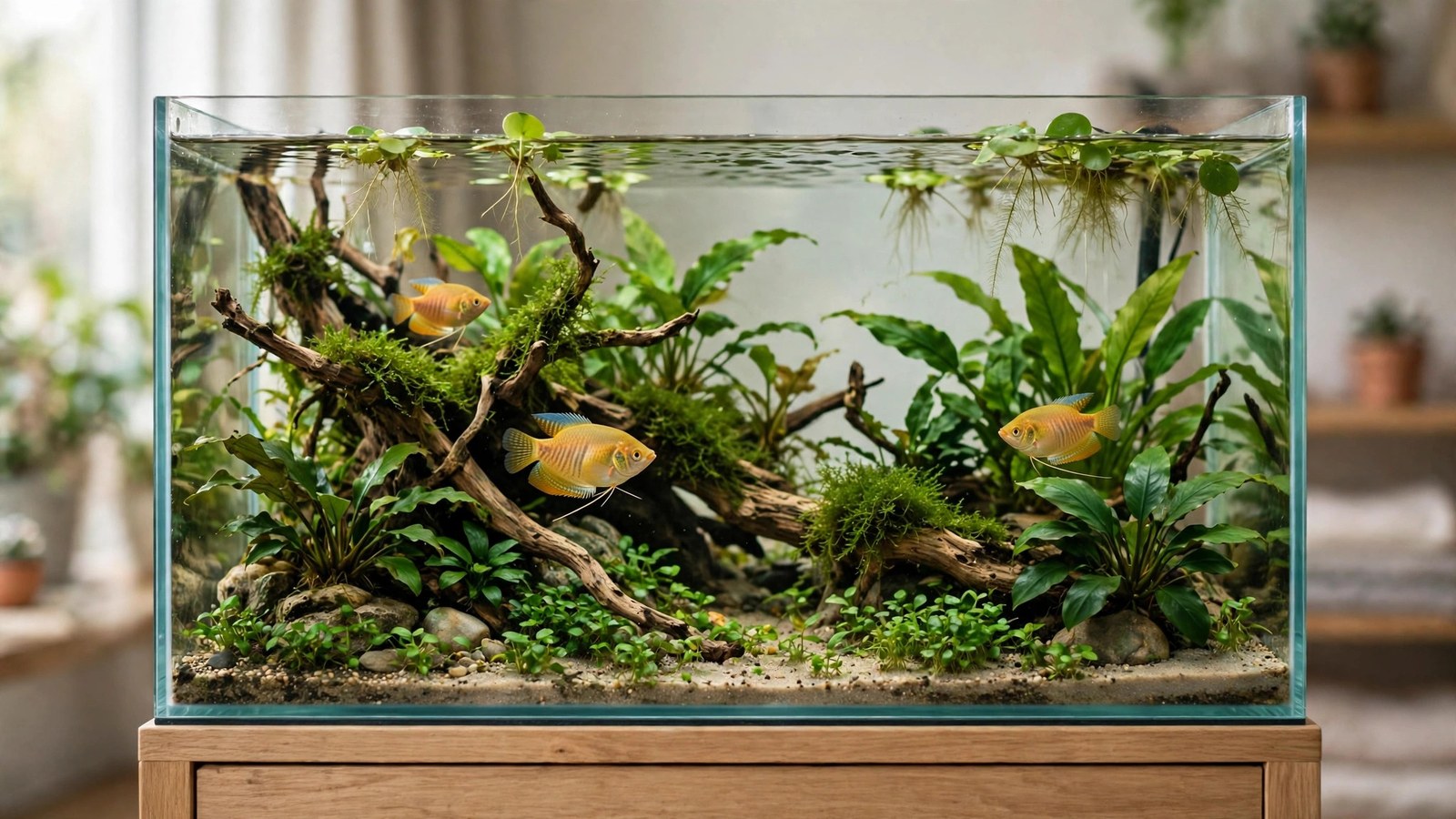
Most people meet gouramis through the dwarf gourami — and discover its baggage: iridovirus worries, bickering males, females that vanish into the plants. The honey gourami (Trichogaster chuna) is the reset button: barely 2 inches, genuinely peaceful, glowing sunset-amber when males court. A honey gourami planted tank plays straight to this fish's instincts — still water, dense greenery, and floating plants where a male can weave his bubble nest undisturbed.
For context on peaceful community options — from ember tetras to dwarf cichlids — see our guide to the best schooling fish for planted tanks.
Setting Up Your Honey Gourami Planted Tank: Size and Layout
A single honey gourami thrives in a 10-gallon tank, but pairs do noticeably better with more floor space. Choose a 20-gallon long for a pair or trio: the extra footprint lets the male claim a nest corner while the female retreats into dense planting — the exact dynamic that keeps aggression near zero. Favor length over height; tall "show" tanks waste the horizontal territory these fish actually use.
Scaping follows one rule: open swimming room in the front third, dense planting behind it. Layer Cryptocoryne wendtii, Anubias, and Vallisneria in the back two-thirds, and keep one surface corner glassy-calm — that is where the male will build. Our nano planted tank ideas collection shows small-tank layouts that translate directly to a honey gourami home.
Water Parameters: Warm, Soft, and Still
Wild honey gouramis live in slow ponds, ditches, and flooded fields across India and Bangladesh. Replicate that: warmth, gentle chemistry, almost no current.
| Parameter | Target range | Notes |
|---|---|---|
| Temperature | 77–82°F (25–28°C) | Stability matters more than the exact number |
| pH | 6.0–7.5 | Slightly acidic to neutral |
| Hardness | 4–15 dGH | Acclimate gradually to harder tap water |
| Ammonia / nitrite | 0 ppm | Fully cycle the tank first — no exceptions |
| Nitrate | Under 20 ppm | Weekly 25% water changes, even with plants |
| Flow | Minimal | Sponge filter or baffled outflow; near-zero surface ripple at the nest corner |
As labyrinth fish they breathe surface air, so a tight-fitting lid is mandatory — cold room air chills the air they gulp. Our planted tank water parameters reference covers the testing routine that keeps small tanks stable.
Floating Plants and Bubble-Nest Behavior
This is the heart of the setup. A male gulps air, coats each bubble in saliva, and builds a floating raft anchored to plant roots or floating leaves. Eggs go into the nest, the male guards them, and fry hang in the bubble mat on their yolk sacs. Without floating cover, most males never attempt a nest — and attempts on a bare surface disintegrate within hours.
Cover 50–70% of the surface. Frogbit and water lettuce grow dangling roots that males love as nest anchors; salvinia is the fast-growing workhorse for new tanks. Our roundup of the best floating aquarium plants for betta tanks applies almost one-to-one here — bettas and honey gouramis want the same canopy for the same reasons. For gourami-specific planting below the surface, see our guide to aquarium plants for gourami tanks.
Plant the midground for broken sightlines so a guarded female can retreat — a stem thicket between them drops tension to nothing. Keep the front open to watch the courtship: the male's throat flushes amber, he fans his fins, and the female spirals with him to the nest.
Tank Mates: Small, Calm, and Short-Finned
Honey gouramis are genuinely peaceful — they ignore shrimp and snails and rarely bother even tiny tank mates. The risk runs the other way: nippy or hyperactive fish will harass them into hiding. Safe picks include ember tetras, chili rasboras, pygmy corydoras, otocinclus, and cherry shrimp (expect some shrimplet losses; adults are fine).
Skip tiger barbs, serpae tetras, and most danios — fast nippers that shred the gouramis' trailing pelvic fins — and skip large or territorial centerpieces too. For the next size class up, see our planted angelfish tank setup and planted rainbowfish tank guides. For a nano centerpiece with more attitude, compare our planted betta tank setup.
Stocking: Male, Female, or Pair?
Males are slimmer with a pointed dorsal and flush amber with a dark throat patch when courting; females are rounder and paler. Buy juveniles in a group of 4–6 and let pairs form, or ask the shop for an established pair.
- Solo fish: ideal for a 10-gallon community; zero breeding drama, full personality.
- Proven pair: the classic choice — expect bubble nests within weeks in a well-planted tank.
- One male, two females: best in a 20-gallon long; his courtship splits between them so neither gets exhausted.
To raise fry, leave the male with the nest and remove the female after spawning. Feed free-swimming fry infusoria for the first week, then baby brine shrimp.
Feeding: Small Mouths, Varied Diet
Tiny upturned mouths are built for picking insects off the surface: feed micro pellets or crushed flake daily, plus frozen daphnia or baby brine shrimp two or three times a week — the frozen foods visibly deepen the male's amber color. Offer only what vanishes in two minutes, and use the feeding ring so food stays where you can see it.
Low-Tech or High-Tech?
Low-tech is arguably better here: the dense, slightly wild growth — frogbit overhead, crypts in the midground — is the habitat these fish evolved for. A decent LED on a timer, root tabs, weekly liquid fertilizer, and a sponge filter grow everything this scape needs. Our low-tech planted tank setup guide has the full equipment list.
Frequently Asked Questions
Are honey gouramis good for beginners?
Yes — among the most beginner-friendly centerpiece fish available. They tolerate a wide pH range, eat readily, stay small, and forgive minor mistakes. The two real requirements are a fully cycled tank and a tight lid. They are far hardier and more peaceful than dwarf gouramis.
Do honey gouramis need an air stone?
Not for oxygen — as labyrinth fish they breathe surface air directly. A gentle air-driven sponge filter is still the best filtration choice, but turn the airflow down until the surface barely moves. Strong bubbling destroys bubble nests and stresses these still-water fish.
Will honey gouramis eat cherry shrimp?
Adults are almost always safe; newborn shrimplets are fair game, as with nearly any fish. In a densely planted tank with moss and floater roots, enough babies survive to sustain the colony.
How do I get honey gouramis to breed?
Condition a pair with frozen foods for two weeks, hold the temperature near 80°F, and cover most of the surface with floating plants. The male builds his nest within days. After spawning, remove the female — the male guards the eggs alone. Feed free-swimming fry infusoria first, then baby brine shrimp.
Can I keep a single honey gourami alone?
Absolutely. A lone honey gourami is calm, interactive, and often becomes the most personable fish in a nano community, learning to greet you at feeding time. Solo keeping sidesteps all breeding-related aggression entirely.
Bringing It All Together
A honey gourami planted tank succeeds on restraint: modest size, gentle flow, warm stable water, a ceiling of floating green. Get those four right and the fish handle the rest — amber courtship colors, bubble-nest architecture, unhurried patrols through the stems. Give a male his quiet corner, and within a month you will see why experienced keepers call the honey gourami the best gourami, full stop.
For authoritative species data, the Seriously Fish profile of Trichogaster chuna documents wild habitat and water chemistry in detail, and Tropica's Salvinia natans care page covers one of the best floating plants for bubble-nest tanks.