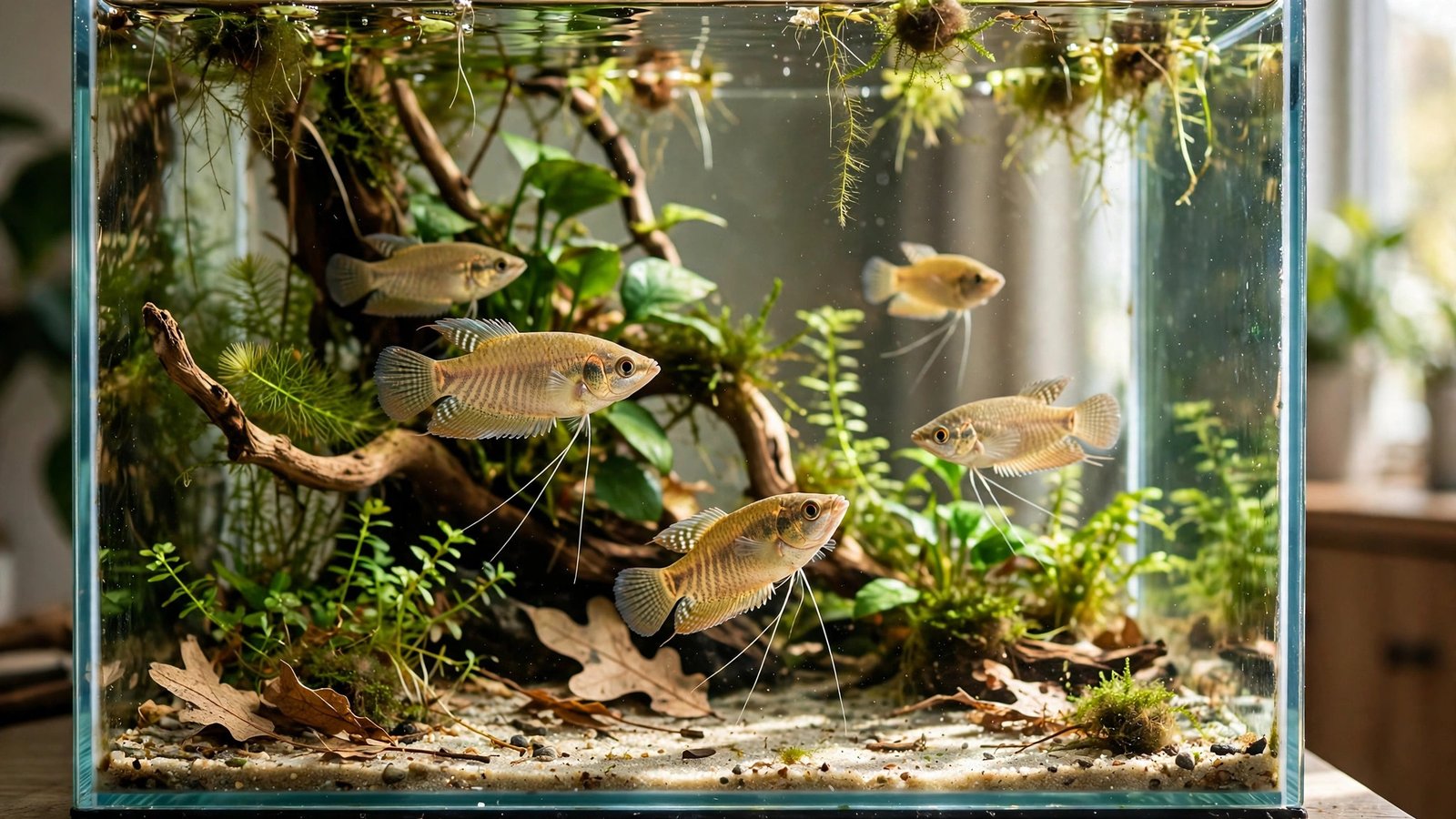
Sit beside your tank at night, lights off, and you may hear it: a soft, rhythmic grunt-grunt-grunt, like someone tapping a tiny drum underwater. That's a male croaking gourami guarding a bubble nest. A croaking gourami planted tank talks back to you — and that sound tells you whether your fish are thriving or merely surviving.
Setting Up Your Croaking Gourami Planted Tank
Croaking gouramis (Trichopsis vittata) come from slow, vegetation-choked waters in Southeast Asia — rice paddies and swamp pools where the surface is a mat of floating leaves. Copy that ceiling: cover 60–70% of the surface with frogbit, water lettuce, or red root floaters. This floating canopy is non-negotiable — it anchors bubble nests and gives males the security to croak.
Use fine dark sand, and keep flow gentle — a sponge filter or a canister aimed at the glass works best. Add a small driftwood branch, leave the front third open as a courtship "stage," and keep lighting soft (20–30 PAR at substrate); the floating canopy diffuses it naturally. The lightly planted aquarium setup approach suits croaking gouramis perfectly — no CO2 required. For species ideas, our overview of the best aquarium plants for a fish tank covers hardy low-light picks that pair well with gouramis.
Water Parameters for Croaking Gouramis
Stability beats perfection — match your source water rather than chasing numbers with chemicals.
| Parameter | Target range | Notes |
|---|---|---|
| Temperature | 76–82 °F (24–28 °C) | Raise to 80–82 °F to trigger spawning |
| pH | 6.0–7.5 | Stability matters most |
| GH | 4–12 dGH | Soft to moderately hard |
| KH | 2–8 dKH | Stabilizes pH |
| Ammonia / nitrite | 0 ppm | Cycle fully first |
| Nitrate | Under 30 ppm | Change 25–30% weekly |
| Surface | Still | Baffle filter outflows |
As labyrinth breathers, they gulp air directly — keep the air above the tank warm with a tight-fitting lid (males jump during courtship). Avoid open-top tanks in cool rooms.
Best Plants for a Croaking Gourami Tank
Think in layers: a floating ceiling for nests, a dense midground forest for retreats, and a few foreground tufts. Cover at least 60% of the footprint so each fish can break line of sight.
| Plant | Layer | Why it works |
|---|---|---|
| Amazon frogbit | Floating | Long roots shelter nests |
| Water lettuce | Floating | Broad leaves = stable nest anchors |
| Red root floaters | Floating | Feathery roots; excellent nest cover |
| Java fern | Midground | Tough; fish weave between leaves |
| Anubias nana | Midground | Slow, broad leaves for territorial markers |
| Vallisneria | Background | Tall curtain along the back glass |
| Cryptocoryne wendtii | Foreground | Low rosettes; won't crowd swimmers |
Leave small gaps between floating-plant islands for bubble nests. Our guide to floating plants for beginners covers more species that thrive in gourami tanks.
 ★3.9
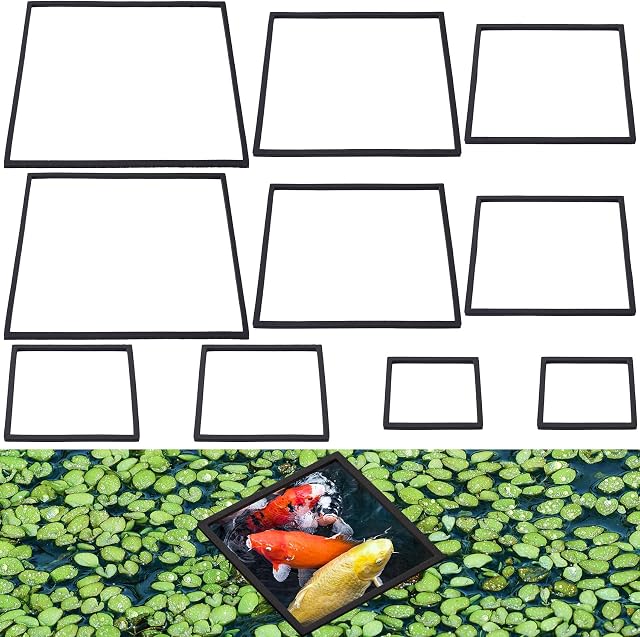
PAGOW Floating Plant Corral Rings
Check Price on Amazon ★3.9Feeding Croaking Gouramis
Feed twice daily, only what they finish in two minutes: frozen daphnia, baby brine shrimp, or chopped bloodworms, rotated with a quality micro pellet on alternate days. Flake-only diets leave them pale and listless within a month; well-fed males show deeper throat color and croak more. Skip one day a week to aid digestion.
Tank Mates and Group Size
Buy five or six, not a pair — in a group they squabble harmlessly, males display, and crucially, they croak. A single male usually stays silent. Females are smaller and rounder-bellied; males grow longer, pointed dorsal and anal fins.
Good tank mates: ember tetras, chili rasboras, pygmy corydoras, otocinclus, and peaceful shrimp. Avoid fin-nippers like tiger barbs and fast danios — both stress croakers into hiding. Compared with the sparkling gourami planted setup, croaking gouramis are bigger (6–7 cm vs ~4 cm), hardier, and calmer toward tank mates. Compare our honey gourami planted tank guide if you're weighing species.
Breeding: Bubble Nests and Croaking Males
Breeding is where this species earns its name. The male builds a bubble nest under a floating leaf, then courts: body quivering, fins flared, croaking in rhythmic bursts of three to six grunts — produced by snapping specialized pectoral-fin tendons. Courtship croaking is louder than the warning grunts males aim at rivals.
After the embrace, the male spits the floating eggs into the nest and guards it for 2–3 days until fry hatch. To raise fry, move him and the nest to a shallow grow-out tank: infusoria the first week, then baby brine shrimp. In planted tanks, a few fry sometimes survive in the floating roots.
Male croakers are gentler than dwarf gouramis at spawning, but if two males nest in a tank under 30 gallons, remove one — bubble-nest wars stress both.
Health and Troubleshooting
Well-kept croakers are hardy. Quarantine newcomers for two weeks. Ich shows as salt-like specks after temperature swings — treat it with heat (86 °F for 10 days) before reaching for medication; fin rot usually follows torn fins from sharp decor.
The most common "problem" is silence. If adult males aren't croaking, check four things: floating cover above 50% of the surface, temperature at 76 °F or higher, a still surface, and at least five fish. Fix those and most groups call within two weeks. Thick floating-root mats are the best "medicine" for nervous croakers.
Croaking vs. Sparkling Gourami: Which to Choose?
The two Trichopsis cousins get confused constantly. Croaking gouramis (T. vittata) reach 6–7 cm, live 4–5 years, croak audibly from across the room, and settle into community tanks. Sparkling gouramis (T. pumila) stay around 4 cm, croak too softly to notice, and suit species-only nanos. Want an audible centerpiece group? Croaking gouramis. Running a 10-gallon species tank? Sparkling fits better.
For taxonomy and recorded vocalizations, see Seriously Fish's Trichopsis vittata profile.
Frequently Asked Questions
Can you really hear croaking gouramis outside the tank?
Yes — from several feet away in a quiet room. It's a rapid grunt-grunt-grunt, like a tiny motorboat, usually first noticed at night. Sparkling gouramis make the same sound but too quietly to hear, which is why the croaking gourami is famous for it.
What size tank do croaking gouramis need?
A 20-gallon (75 L) tank is the realistic minimum for five or six fish — males need bubble-nest territories of roughly 30 cm each, and a 30-gallon lets two males nest without friction. Skip 10-gallons: the fish fit, but the social behavior you're buying them for doesn't.
Why is my male croaking gourami not croaking?
Silence almost always traces to environment: floating cover under 50%, water under 76 °F, surface current, a group under five fish, or bullying tank mates. Fix those and most males call within two weeks. A lone male in a community tank rarely croaks.
Are croaking gouramis good community fish?
Yes — they're among the calmest gouramis, ignoring shrimp and snails and rarely harassing tank mates. Pair them with small, peaceful species like ember tetras, chili rasboras, or pygmy corydoras. Avoid fast, nippy fish like tiger barbs or large danios, which stress croakers into silence.
How do croaking gouramis make the croaking sound?
Males rapidly tense and release specialized pectoral-fin tendons — a "pectoral mechanism" unique to this genus. Each croak is a burst of 3–6 grunts. Males croak to court females, defend bubble nests from rivals, and occasionally when startled. Females croak too, but rarely and quietly.
How long do croaking gouramis live?
With stable water and a varied diet, expect 4–5 years. Longevity improves in groups with floating-plant cover, where stress stays low. The most common life-shortening mistake is cold water: a heater drifting into the low 70s invites ich and sluggish appetites.
Set up the floating canopy, keep the surface still, and give them a proper group — your tank will reward you with the hobby's most charming soundtrack. Once you've heard that first courtship grunt at night, no silent tank quite satisfies.