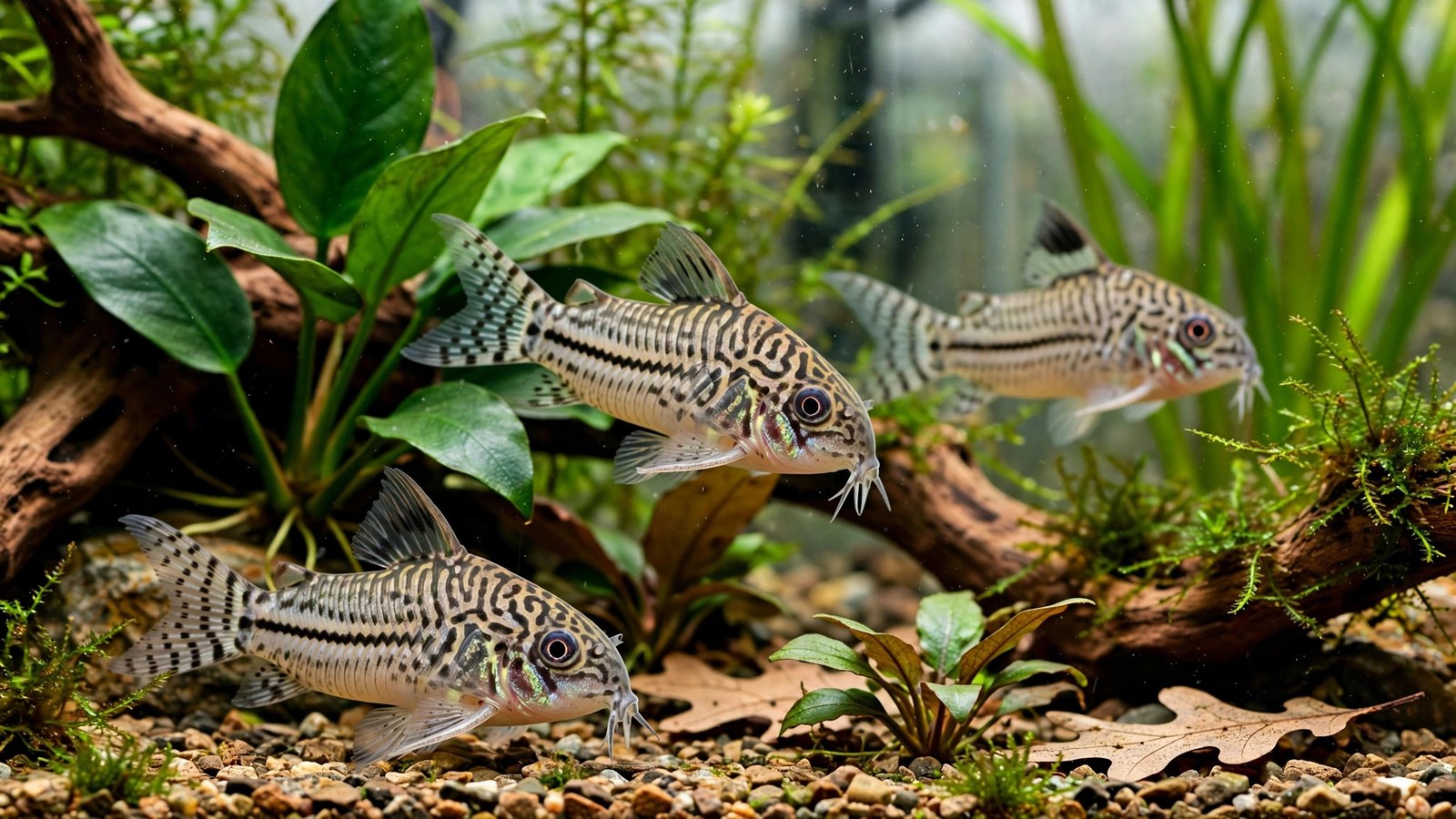
Walk into almost any fish shop and you'll see a tank labelled "julii cory" — and almost certainly, the fish inside is wearing someone else's name. The large majority of spotted corydoras sold under that label are actually the false julii, Corydoras trilineatus, a close look-alike. The good news: whichever of the two you bring home, the planted tank that makes them thrive is exactly the same — and this guide builds it, and teaches you to spot the imposter, in one sitting.
How do I set up a planted tank for julii cory? Give a school of 6+ a 20-gallon planted tank with fine sand, water at 72–79 °F and pH 6.0–7.5, and gentle flow. Plant the back and sides, but leave open sand lanes in front for foraging. Feed sinking pellets plus frozen foods — they are not tank cleaners. Tell true julii from the false julii (C. trilineatus) by pattern: true julii shows fine isolated spots; the false julii has a larger reticulated pattern with a dark zigzag stripe along its flank.
Identifying a julii cory: true julii vs. false julii
The mislabelling is not a scam — it's inertia. True Corydoras julii comes only from the Rio Parnaíba system in northeastern Brazil, is rarely exported, and stays around 2 inches with fine isolated spots, a shorter head, and a rounded snout. The fish sold as "julii" is almost always Corydoras trilineatus: a ~2.5-inch Amazon fish with a bolder reticulated pattern and a dark zigzag stripe along its flank. If your fish has that stripe, you've met the imposter — and our false julii (trilineatus cory) identification guide gives the full side-by-side.
| Feature | True julii (C. julii) | False julii (C. trilineatus) |
|---|---|---|
| Native range | Rio Parnaíba, northeastern Brazil only | Amazon basin, widespread |
| Adult size | ~2 inches | ~2.5 inches |
| Pattern | Fine, isolated small spots | Reticulated pattern + dark zigzag flank stripe |
| Head shape | Shorter head, rounded snout | Longer, more pointed snout |
| In the trade | Rarely exported | Nearly all "julii" sold in shops |
Everything below applies to both — but once you know the field marks, you'll never be fooled by a shop label again.
Julii cory planted tank setup: water and substrate basics
Sand is not optional here — it is the whole foundation. Corydoras sift fine sand through their gills as they forage, and their barbels are sensitive instruments, not decoration. Rough gravel wears barbels down and invites infection. Lay 1.5–2 inches of soft, inert sand such as pool filter sand — deep enough for plants, shallow enough to avoid anaerobic pockets.
| Parameter | Target |
|---|---|
| Temperature | 72–79 °F (76 °F is a comfortable middle) |
| pH | 6.0–7.5 — stability matters more than perfection |
| Hardness | Soft to moderate (2–12 dGH); avoid very hard water |
| Filtration | Gentle and well-cycled: sponge filter or baffled hang-on-back |
| Flow | Low to gentle — strong current stresses bottom dwellers |
| Ammonia/nitrite | 0 ppm — cycle the tank before stocking, no exceptions |
Keep nitrate under 20 ppm with a 30% weekly water change. Bottom dwellers live close to the mulm layer, so they feel water quality more acutely than mid-water fish. For the full testing routine behind these numbers, see our guide to planted tank water parameters.
Planting the tank: open lanes up front, jungle behind
Plant the back and sides instead: shaded cover to retreat into, open sand to work through. This is exactly the approach behind a lightly planted aquarium setup: enough greenery for water quality and shelter, with the hardscape left quiet.
Favour rooted, broad-leaved species that tolerate corydoras traffic — fine carpets get uprooted within a week of enthusiastic foraging. Anubias tied to driftwood in the midground, java fern on the back hardscape, Cryptocoryne wendtii clusters along the sides, and vallisneria as a background curtain all work. Corydoras prefer dappled shade to bright light, so a low-tech planted tank setup suits them perfectly: moderate light, a root tab per plant cluster every 6–8 weeks, no CO2 required.
Feeding julii cory: they are not your tank cleaners
Feed sinking pellets or wafers as the daily staple, dropped in the open lanes, plus frozen bloodworms or daphnia two to three times a week.
Feed after lights out once or twice a week. Corydoras turn fully active at dusk, and a night feeding guarantees food reaches them before tetras strip the water column. Watch their bellies: a well-fed school looks plump, and females in good condition grow noticeably rounder than males.
Tank mates and the planted community
Julii cory are peaceful to the point of being unnoticeable as tank mates — they neither nip nor compete, but they can be shy with large, boisterous neighbours. Stock calm mid-water fish: small tetras, rasboras, honey gouramis, peaceful livebearers. Other corydoras share the bottom happily — a panda cory group or an emerald cory community follows the same sand-and-lanes playbook, as long as each species keeps its own school of 6+.
Frequently Asked Questions
Do I need to know which species I have to care for them?
No. Care for true julii and false julii is near-identical — same temperature, pH, sand, foods, and schooling needs — so husbandry never hinges on the ID. The ID is hobby knowledge: satisfying, and it stops you paying premium "wild julii" prices for a fish that almost certainly isn't one.
Can julii cory live on smooth gravel instead of sand?
Not recommended. Even rounded gravel does not let corydoras sift substrate through their gills the way sand does, and barbel wear builds up over months before you notice. Switching to fine sand costs one afternoon and one bag of pool filter sand — and a school usually resumes foraging within a day.
How many julii cory should I keep in a 20-gallon tank?
Six at minimum, eight to ten if the tank is mature and well filtered. They forage, rest, and tumble as a group — the social behaviour is the whole reason to keep them. A 20-gallon footprint holds ten comfortably alongside a small school of peaceful mid-water fish.
Are julii cory safe with shrimp and snails?
Yes with adult shrimp and snails. Julii cory ignore nerite and mystery snails and generally leave adult cherry shrimp alone. Newborn shrimplets are small enough to be eaten opportunistically, so a breeding shrimp colony does best with dense moss or plant cover where babies can hide.
Do julii cory need high light or CO2-injected plants?
No — they prefer the opposite. They feel most secure under a canopy of leaves, so low-tech plantings of anubias, java fern, crypts, and vallisneria suit them perfectly. Skip high-light carpeting plants: corydoras foraging will uproot them within a week.
That is the whole playbook: an honest ID, fine sand, open lanes, and food that reaches the bottom. Set it up this way and your julii cory — true or false — will spend their days tumbling across the sand together, whiskers working, in plain sight of the room.