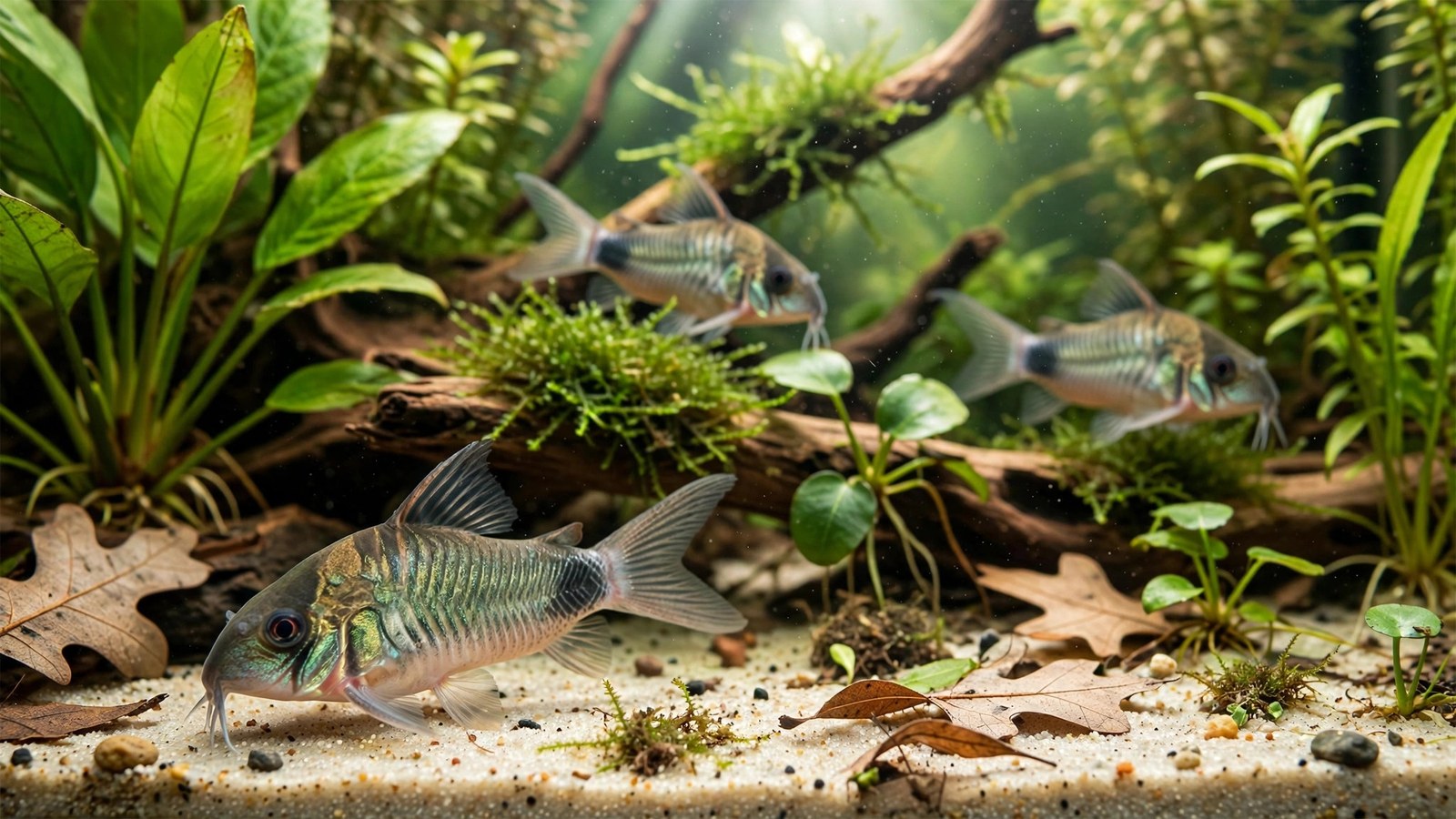
Every cory keeper remembers the moment a "small" emerald cory hit three inches and kept growing. The emerald cory (Brochis splendens) is the giant of the cory world — a three-to-four-inch armored catfish with a green-gold shimmer that dwarfs the bronze cory, the most common large cory. That size changes the setup: a shoal of giants needs real bottom space, deep sand, and a planting plan that survives serious digging.
Keep an emerald cory school of six or more in at least a 30-gallon planted tank with fine sand, 72–79°F water, and pH 6.0–7.5. Give them driftwood hides and deep-rooted plants they can't bulldoze, and feed sinking pellets or wafers plus frozen foods every day — they are not algae eaters and will not clean your tank. The field ID trait: Brochis splendens carries 10–12 dorsal-fin rays versus 6–8 in true Corydoras, which is why taxonomists keep it in its own genus.
Brochis or Corydoras? The Name on the Bag
Store labels almost always read "Corydoras splendens". Taxonomists have shuffled the genus back and forth between Corydoras and Brochis over the years — so the current classification is Brochis splendens. Both names describe the same fish, and you'll see both in shops for years to come.
The quickest way to confirm you've got an emerald cory is the dorsal fin. Emeralds carry 10–12 dorsal-fin rays on a tall, sail-like dorsal — juveniles are even traded as "hi-fin cory" for it — while true Corydoras carry only 6–8. If you're unsure what you bought, the Brochis splendens species profile has clear ID photos and ray counts.
More important than the genus debate: the emerald cory is not the same fish as the bronze or albino cory. Bronze and albino corys are both Corydoras aeneus — two color forms of one species. Emeralds are a separate, larger species that shoal with their own kind.
| Trait | Emerald cory (B. splendens) | Bronze cory (C. aeneus) |
|---|---|---|
| Adult size | 3–4 inches | 2.5–3 inches |
| Dorsal-fin rays | 10–12 | 6–8 |
| Minimum group tank | 30 gallons | 20 gallons |
| Genus | Brochis (current) | Corydoras |
Setting Up an Emerald Cory Planted Tank
The honest minimum for a school of six is a 30-gallon tank — some retailers recommend 40 for full-grown adults, and they're not wrong. Footprint matters more than volume: aim for at least 36 inches of tank length so six four-inch catfish have uninterrupted foraging lanes. A tall 30-gallon column tank gives a shoal of emeralds almost nothing to work with.
Substrate comes next, and there is no compromise here: 1.5–2 inches of fine, smooth sand. Emeralds sift mouthfuls of sand through their gills all day, using sensitive barbels to taste for food. Sharp gravel files those barbels down until the fish can't locate food properly — the single most common slow-burn health failure in cory tanks.
Plant around their digging, not through it. Emeralds are enthusiastic excavators — a freshly planted stem forest won't survive one night of shoal foraging. Tie rhizome plants (anubias, Java fern, Bucephalandra) to driftwood and rock, and plant deep-rooted swords 3–4 weeks before the fish arrive so roots anchor. Driftwood arches double as the shaded hides every emerald shoal needs. If you're new to planting, a lightly planted aquarium setup is enough to start, and a low-tech planted tank suits emeralds perfectly — they prefer gentle light anyway.
Water Parameters and Feeding
Emeralds are forgiving about chemistry as long as it's clean and stable: 72–79°F, pH 6.0–7.5, soft-to-moderate hardness (2–15 dGH). They occasionally dart to the surface for a gulp of air — normal facultative air-breathing, not low oxygen. What they won't forgive is an uncycled tank or nitrate creep: ammonia and nitrite at zero, nitrates under 20 ppm, via stable planted-tank water parameters and weekly 25–30% water changes.
| Parameter | Target |
|---|---|
| Temperature | 72–79°F (22–26°C) |
| pH | 6.0–7.5 |
| General hardness | 2–15 dGH |
| Ammonia / nitrite | 0 ppm |
| Nitrate | Under 20 ppm |
Now retire the myth: emerald corys are not algae eaters or "cleaner fish." They're foraging omnivores needing deliberate feeding every day — sinking pellets or wafers as the staple, rotated with frozen bloodworm or daphnia 2–3 times a week. A shoal left to survive on leftovers slowly starves; it's the most common cause of premature emerald deaths, and entirely preventable.
Shoals, Shrimp, and Tank Mates
Six is the floor, not the goal. In groups of six to eight, emeralds forage in loose formation, rest together under wood, and show the synchronized behavior that makes them worth keeping. Smaller groups turn shy and nocturnal, hiding for weeks. Buy the whole school from one shipment — a same-batch school settles in days instead of weeks.
Tank mates should be peaceful community fish that won't outcompete bottom feeders — tetras, rasboras, and calm gouramis all work. The smaller julii cory and sterbai cory share the emerald's water preferences, though they form their own separate shoals rather than one mixed group.
Shrimp need an honest answer. Emeralds are safe with larger shrimp like amanos. But a four-inch catfish vacuuming the substrate will eat newly hatched shrimplets it finds. A densely planted tank lets a cherry colony persist — but run your breeding operation in a separate tank.
Frequently Asked Questions
Is the emerald cory the same fish as the bronze or albino cory?
No. The emerald cory is Brochis splendens; bronze and albino corys are both Corydoras aeneus — two color forms of one smaller species. Bronze and albino aeneus shoal together, but emeralds are a separate species that shoal only with their own kind. Dorsal-fin rays tell them apart: 10–12 on an emerald, 6–8 on a bronze.
How many emerald corys should I keep together?
Keep at least six — most references recommend six to eight. Small groups turn shy, hide constantly, and stress. Six four-inch adults is exactly why the tank minimum is 30 gallons: buy the whole school from one shipment, and they'll settle into natural shoaling within days.
Will emerald corys eat algae or clean my tank?
No. Emerald corys are foraging omnivores, not algae eaters or "cleaner fish." They can't survive on leftovers or tank algae — a shoal fed that way slowly starves. Feed sinking pellets or wafers daily, plus frozen bloodworm or daphnia two to three times a week, and you'll have healthy fish for a decade or more.
Are emerald corys safe with cherry shrimp?
Mostly. Adult cherries and larger shrimp like amanos coexist with emeralds without trouble. But a four-inch substrate vacuum will eat tiny newborn shrimplets it finds. In a densely planted tank, a cherry colony usually persists because babies hide in the moss — but breed shrimp in a separate tank if shrimplet survival matters to you.
How long do emerald corys live?
Ten years or more is well documented, and some keepers report considerably longer. The hardiness is real but conditional: fine sand, clean stable water, a full shoal, and real daily feeding unlock the decade-plus lifespan. Treat the purchase as a long-term commitment, not a starter-fish experiment.
Should the label say Brochis splendens or Corydoras splendens?
Brochis splendens is the current name — taxonomists have moved the genus between Corydoras and Brochis over the years, which is why older labels read Corydoras splendens. Both names describe the same fish. Trade labels will catch up slowly — don't let either name stop you buying a healthy fish.
An emerald cory shoal sifting across deep sand under planted driftwood arches is one of the great sights in freshwater fishkeeping — a slow, glittering patrol that only works when the tank was built for them from the start. Give them the footprint, the sand, the shoal, and the food, and you'll get a decade of it.