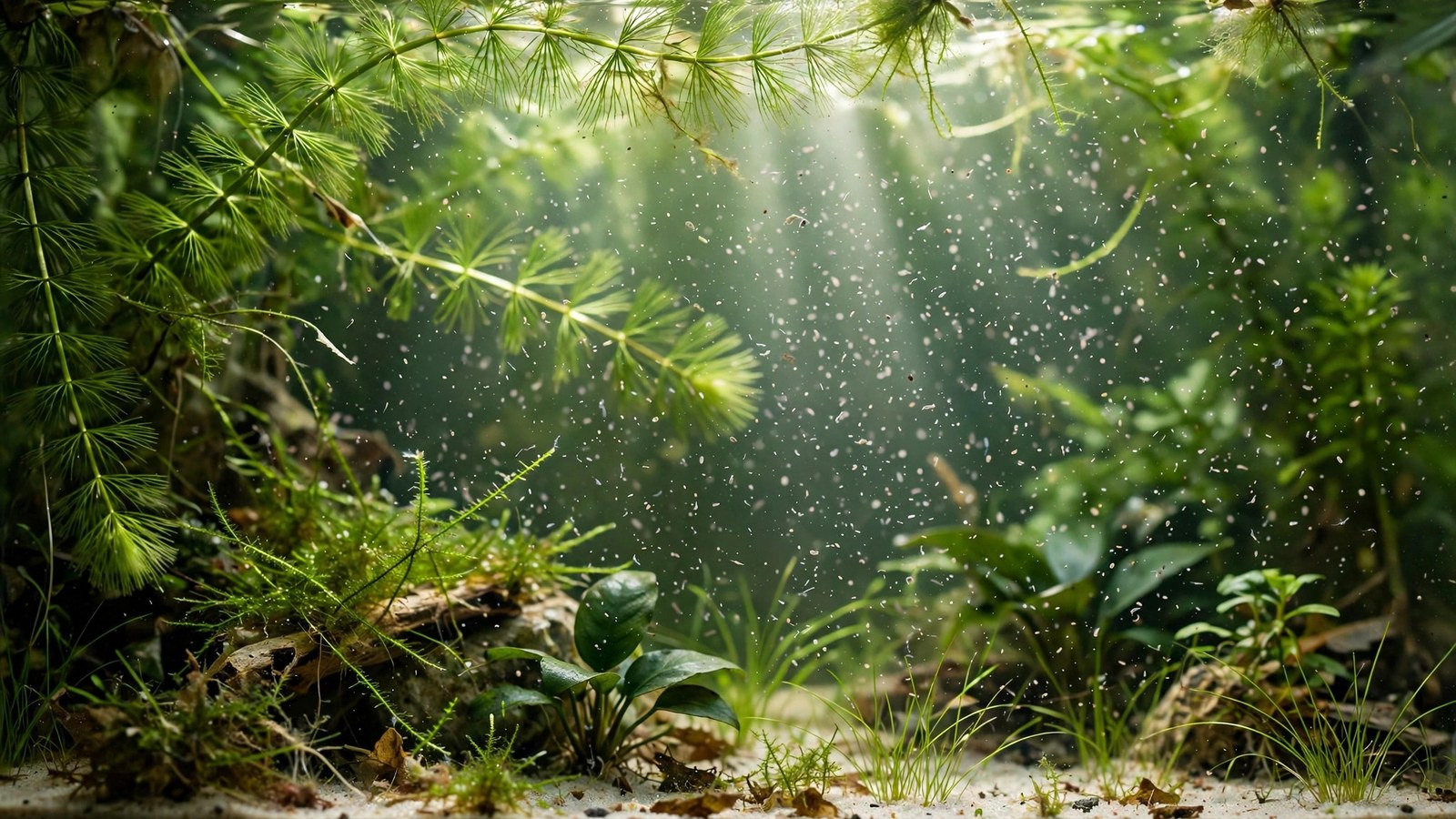
Most newly hatched aquarium fry die in their first week — not from disease, but from starvation. Their mouths are too small for baby brine shrimp, and powdered fry food fouls the water faster than they can eat it. Setting up an infusoria culture a week before your eggs hatch solves the problem for almost nothing: a jar, a lettuce leaf, and patience give you a bloom of living, 50–200 µm prey your tiniest fry can actually swallow.
Why Fry This Small Need Microscopic Food
When a tetra, betta, or gourami fry finishes its yolk sac, its mouth is a fraction of a millimetre wide — but a baby brine shrimp nauplius is roughly 400–500 µm long, several times too big. The fry lunges, fails, and starves within days.
Infusoria fits because it is made of single-celled organisms like Paramecium, Stentor, and Vorticella in the 25–300 µm range — small enough to swallow whole and soft enough to digest instantly. Research on guppy fry found infusoria-fed fry survived and grew significantly better than unfed controls, and measured roughly 58% protein and 32% fat by dry weight, with omega fatty acids and vitamin C. Because these organisms reproduce by binary fission — doubling every few hours in warm water — a healthy culture replenishes itself while the fry graze.
If you are building a full live-food pipeline for your breeding projects, bookmark the broader daphnia culture guide too. Daphnia sits several steps further up the feeding ladder, but it is the live-food hub every serious fry raiser eventually returns to.
How to Start an Infusoria Culture
You need one clean glass jar (1–4 litres), water from an established tank or dechlorinated tap water, and one or two wilted lettuce leaves — or a small handful of clean, pesticide-free hay. Rinse the jar, fill it with the tank water, drop in the lettuce, and cover the mouth loosely with muslin or a coffee filter held by a rubber band. The cover keeps insects out while letting air in.
Set the jar where it gets bright indirect light at 24–28°C — a warm windowsill with no direct sun, or near a radiator in winter. Then leave it alone. The first thing that grows is not infusoria at all: it is a bacterial bloom feeding on the decaying leaf, and that bacteria is exactly what the infusoria will eat.
The Cloudiness Timeline: Knowing When It Is Ready
The single most useful skill in culturing infusoria is reading the jar. Here is the day-by-day pattern in a healthy culture:
| Day | What you see | What is happening |
|---|---|---|
| 1–2 | Slight haze; leaf softens | Bacteria colonise the decaying leaf |
| 3–4 | Milky-white cloudiness, mild odour, maybe a surface film | Bacterial bloom peaks — infusoria begin feeding on it |
| 5–7 | Water clears to pale straw | Infusoria grazed the bacteria down — culture at peak, ready to feed |
| 10–14 | Very clear water; leaf skeleton remains | Culture crashing — start the next jar |
No microscope? Shine a flashlight through the jar in a darkened room on day 5 or 6. A drift of tiny specks swirling in the beam means your culture is alive and booming. You can also draw some water into a clear glass and let it settle — a faint living haze confirms infusoria are present.
How to Feed Infusoria to Your Fry
Once the fry are free-swimming and the yolk sacs are gone (usually day 2–4 after hatching), feed little and often. Draw 20–50 ml of culture water with a turkey baster or pipette and trickle it into the fry tank two to four times a day. The organisms are invisible individually, so you dose by volume, not by counting.
Watch the fry bellies. Well-fed fry show a faint fullness in the gut — a pale line along the abdomen — and hunt in the water column rather than resting on the bottom. If the fry tank water itself turns cloudy, you are overfeeding: cut the dose and do a gentle water change. Keep the fry tank on gentle, fry-safe filtration — see the sponge filter vs HOB comparison — and add a live-plant refuge from the easiest aquarium plants for a beginner community tank, since fry graze infusoria off leaves before they take food from open water.
The Fry Feeding Ladder: What Comes After Infusoria
Infusoria is step one, not the whole journey. As fry grow, move up one rung at a time, offering the larger food while the smaller one is still available:
| Fry age | Primary food | Size |
|---|---|---|
| Days 1–7 (post yolk sac) | Infusoria | 25–300 µm |
| Days 7–14 | Microworm culture or vinegar eel culture | ~1–2 mm |
| Day 10 onwards | Freshly hatched baby brine shrimp | ~400–500 µm |
| Week 3 onwards | Grindal worms, then sieved daphnia | 1–3 mm |
The transitions overlap on purpose. Offer microworms from day 5 alongside the infusoria so the fastest-growing fry find them early, and start your baby brine shrimp hatchery a day before you expect fry to be big enough — a 24-hour hatch lets you time the first feeding precisely.
Frequently Asked Questions
Do I really need to start the culture before the eggs hatch?
Yes — at least 5–7 days ahead. The bacterial bloom must peak and then be grazed down by infusoria before the culture is usable, and you cannot rush that cycle. Start the jar the day you see eggs, and the food will be ready when the fry are.
Can I buy infusoria instead of culturing it?
They exist, but they are unreliable — live cultures ship poorly, and many bottles arrive dead or dormant. A home jar culture costs nothing, blooms fresher and denser, and once you have seen the cloudiness cycle once, you can repeat it on demand.
My culture smells bad and the water went black. Is it ruined?
Start over. A healthy jar smells faintly earthy at worst during the bacterial peak, then clears. A foul or black jar means the wrong bacteria took over — usually from too much organic matter, animal matter, or no airflow. Use less leaf, cover loosely, try again.
How do I harvest infusoria without polluting the fry tank?
Draw water from mid-depth with a pipette, avoiding the surface film and bottom sludge. Feed 20–50 ml a few times daily, and skip a feeding if the fry tank water looks hazy. Small, frequent doses keep both the culture and the fry tank healthy.
Which fry actually need infusoria, and which can skip it?
Tiny-mouthed fry need it: bettas, gouramis, tetras, rasboras, danios, rainbowfish, and most small egg-layers. Livebearers like guppies and platies, and larger cichlid fry, are born big enough for microworms or baby brine shrimp from day one and can skip infusoria entirely.
How long will one culture last?
About 10–14 days of productive feeding from peak, then it crashes as the bacteria run out. Run a rolling system: start a new jar every 5–7 days so a fresh peak is always coming online as the old culture fades. Two jars are enough for most home breeding setups.
Feed the Smallest Fry First
Infusoria culture is the cheapest live food in the hobby — and the one that saves more first batches than any other. Start a jar this week, even before you plan a spawning. Build your breeding tanks on the principles in our aquarium plants for fish tanks guide: fry that graze among the leaves eat better, hide better, and survive better.