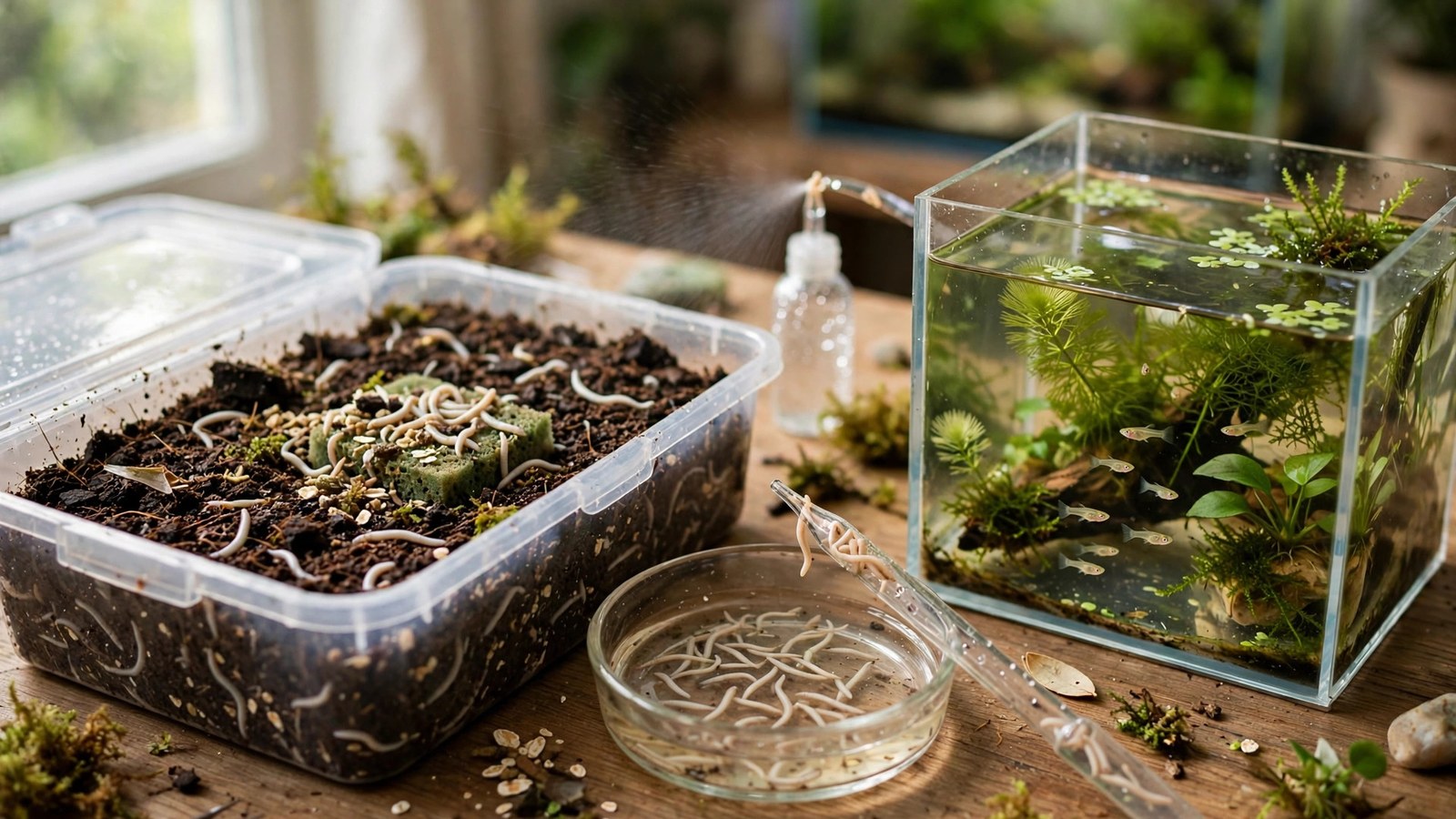
Most fry do not die from disease — they fade because their first foods are too big for their mouths. A grindal worm culture fixes that with one shoebox-sized tub on a shelf: a self-renewing colony of soft, half-inch Enchytraeus buchholzi worms that stay alive and wriggling in freshwater for hours, triggering the strike response even in shy fry. This guide walks you through setup, feeding, harvesting, and crash prevention.
One orientation first: grindal worms are soil-dwelling segmented worms — a different organism from daphnia (tiny crustaceans raised in green water) and microworms (nematodes raised on oatmeal). Each has its niche, as the comparison table below shows.
How to start a grindal worm culture in 7 days
You need a plastic shoebox or takeaway tub (2–3 litres) with a lid, coconut coir or plain peat moss, a spray bottle of dechlorinated water, and a grindal worm starter culture — sold by aquarium clubs and online sellers; a tablespoon of wriggling worms is enough to seed a new box.
Add 5–6 cm of bedding, moistened until it holds together in a squeezed fist without dripping. Use coir or peat free of fertilizers and pesticides — garden potting soil is risky, as slow-release fertilizer pellets can poison the culture. Spread the starter worms in the middle, lay a clean piece of glass or clear plastic flat on the bedding, and poke a few needle-sized holes in the lid. Keep the tub dark at 20–26 °C.
- Day 1: Set up bedding, seed the culture, and sprinkle a tiny pinch of food on one corner, dampened with a few drops of dechlorinated water.
- Days 2–4: Add a fresh pinch daily only if yesterday's food is gone. Lift the glass to check — worms gather in milky patches beneath it.
- Days 5–7: The colony visibly expands. Keep feeding daily and mist the bedding to stay damp.
- Weeks 2–3: The plate underside crawls with worms — start light harvesting.
- Week 4+: Full production; one healthy tub feeds a batch of fry daily.
A culture turns a shelf corner into live food for the fish in your planted tank, and fry raised on live food outgrow powder-fed fry. For the planted environment to match, the complete freshwater aquarium plants guide covers plants that give fry cover and grazing surfaces.
Grindal worms vs. other live fry foods
No single live food covers every stage of fry development:
| Live food | Organism | Size | Raised on | Best for |
|---|---|---|---|---|
| Grindal worms | Soil-dwelling segmented worm | Up to 10–13 mm | Damp peat or coir | Fry over ~10 mm; bottom feeders |
| Microworms | Nematode | 1–2 mm | Oatmeal mush | Newborn fry — see our microworm culture guide |
| Daphnia | Swimming crustacean | 0.2–3 mm | Green water or yeast | Mid-water fry — see our daphnia culture guide |
| Baby brine shrimp | Saltwater nauplii | ~0.4 mm | Saltwater hatchery | Newly hatched fry — see our DIY baby brine shrimp hatchery |
| Vinegar eels | Nematode | 1–2 mm | Vinegar + apple | Surface-feeding fry — see our vinegar eel culture guide |
Most breeders run two cultures in parallel: microworms for the first days after free-swimming, then grindals as the fry grow. The worms' constant wriggling provokes strikes from fry that ignore still particles.
Feeding your culture: what works and how much
Grindal worms eat almost any starchy or protein-rich food. From most to least productive: crushed dry cat kibble, baby cereal, ground fish flakes, rolled oats, and soft cooked vegetables like pumpkin. Higher-protein foods drive faster breeding — crushed flake or kibble noticeably outperforms plain oatmeal.
Feed one small pinch daily in the same corner, dampened with a few drops of dechlorinated water, and add more only after yesterday's portion has disappeared. A pea-sized pinch suits a new culture; a mature one may take a teaspoon. Uneaten food rots and sours the bedding — restraint beats generosity. University culture guides, such as Ohio State's grindal worm notes, stress the same moisture rule: damp like a wrung sponge, never flooded.
Harvesting grindal worms for your fry
Lift the glass plate, rinse the clinging worms into a cup of tank water, and deliver them with a dropper. Or wipe the lid underside with a damp soft brush and swirl the brush in the cup. A fine-mesh sieve or tea strainer is handy for rinsing a large harvest without losing worms.
Worms stay alive in freshwater for a day or more, so they keep working the tank long after feeding — uneaten worms do not rot instantly like dry food. Feed what your fry clear in a few hours. The one pollution risk is bedding carried in with the worms, so always rinse them first. The classic aquarium live-foods write-up on grindal worms notes one healthy culture can feed around a hundred small fish.
 ★4.6
Pawfly 4" Aquarium Shrimp Net
Check Price on Amazon ★4.6Preventing culture crashes
Four things kill cultures: drying out (mist when the surface lightens), heat (reproduction stalls near 30 °C — keep tubs off warm tank lids in summer), mites (tiny white or brown specks on the bedding; rescue by dropping worms in water for 15 minutes — mites float, worms sink — then seed a fresh tub), and age (cultures naturally fade after 4–6 months).
The fix for all four is the same discipline: run two tubs and seed the second from the first every 2–3 months. You will never be without worms. If you are conditioning new fish on live food before they join the main tank, give new arrivals the same calm start — a quarantine tank with plants lowers their stress while they eat.
Feeding amounts: how much to give your fry
Grindal worms suit fry from about 10 mm long: guppy and endler fry, betta fry from their second week, killifish, corydoras, and small tetra fry. Offer a rice-grain-sized clump per dozen fry, two to three times a day, and watch. A real feeding frenzy means the amount is right; worms lingering after an hour means you fed too much.
For fry under 10 mm, start with microworms or vinegar eels and graduate to grindals as mouths grow. Mixing live foods through the grow-out weeks gives steadier growth than any single food alone.
Frequently Asked Questions
How long does a grindal worm culture take to produce?
Expect light harvesting at 2–3 weeks after seeding, and full production around week 4, at 20–26 °C. A generous starter shortens the wait. Below 18 °C everything slows, so move the tub somewhere warmer if production lags. Patience in week one pays off later.
Do grindal worms pollute the aquarium?
Barely. The worms live in freshwater for a day or more, so uneaten ones keep wriggling instead of rotting like dry food. The real risk is transferring soil into the tank — always harvest from a glass plate and rinse worms in tank water first.
Can I culture grindal worms without soil?
Coconut coir is the modern substitute and works as well as peat moss, with fewer pest issues. Some breeders use stacked damp sponges for easy harvesting, though colonies stay smaller. Avoid garden soil — fertilizers and pesticides can kill a culture within days.
Why is my culture crawling with tiny white mites?
Grain mites are the most common grindal pest, arriving with food or bedding. A few are harmless; an infestation competes with the worms. Drop worms in water for 15 minutes — mites float, worms sink — then seed a fresh tub in a different spot.
Are grindal worms better than microworms for fry?
They serve different stages. Microworms are 1–2 mm and suit newborn fry with tiny mouths; grindals reach 10–13 mm and are far more visible, triggering stronger feeding responses in fry over about 10 mm. Most breeders run both, switching as the fry grow.
One tub, endless live food
A grindal worm culture is the closest thing fishkeeping has to a perpetual feeder: one shoebox, a pinch of cereal a day, and your fry get live food for months. Start the tub this week, seed a backup by month two, and the hardest part of raising fry — getting them to eat — largely takes care of itself.