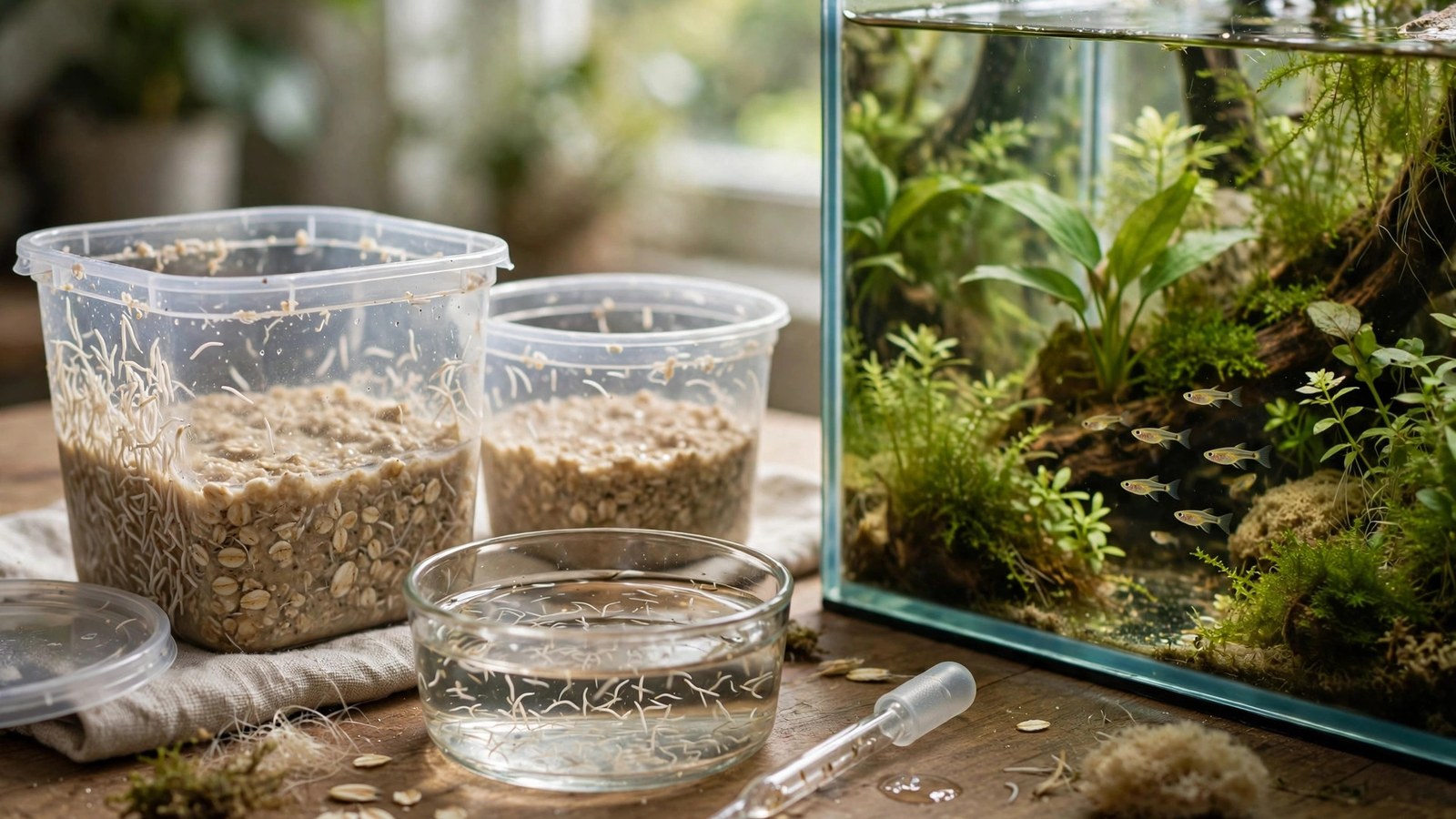
Newly hatched betta fry starve in tanks full of "first foods" that simply won't fit in their mouths. A thriving microworm culture aquarium setup hands you a self-replenishing supply of tiny, wriggling live prey that fry instinctively chase — and once you learn the oatmeal recipe and the climb-the-walls harvesting trick, you'll spend five minutes a week producing thousands of them.
Why Fry Need Live Food This Small
Most failed spawnings don't fail for dramatic reasons. The eggs hatch, the parents did their part, and the fry fade over their first week because the food — even "fine" fry powder — is too large or ignored entirely. Newborn fry respond to movement; a motionless crumb may as well be gravel. Match your feeding to a proper setup — see our breeding tank setup guide for fry survival — and the rest gets dramatically easier.
Microworms fill a very specific gap in the live-food ladder. Infusoria works for the first days but is labor-intensive at scale. Baby brine shrimp are superb — pair this culture with a DIY baby brine shrimp hatchery for the next stage — but newly hatched betta, killifish, and guppy fry often can't tackle nauplii in their first days. Microworms bridge that gap.
Setting Up Your First Culture in 10 Minutes
Microworms evolved in decaying plant matter, so they thrive in humble conditions — no heater, no air pump, no filter.
- Pick a container. Any shallow plastic tub with a loose-fitting or ventilated lid works — a 500 ml deli cup is ideal. Shallow, wide cultures outproduce deep ones.
- Mix the medium. Spoon 3 level tablespoons of plain rolled oats into the container and add 2–3 tablespoons of dechlorinated water — a thick paste, not soup. Skip instant packets with sugar and flavorings.
- Add the yeast. Sprinkle a pinch (about 1/8 teaspoon) of active dry yeast over the surface. Too much yeast ferments violently and crashes the culture early.
- Inoculate, cover, and wait. Smear a teaspoon of starter culture — live microworms plus a blob of their medium — across the surface (source it from a fellow breeder, fish club, or online seller). Cover with a lid that has a few air holes and park the container at 20–25°C out of direct sunlight; heat above 28°C will kill the culture.
By day 3–5 you'll see a shimmering film of worms on the walls; by day 7–10 the culture hits full production. Feed fry in a stable tank — a top-off routine that keeps water level steady matters when fry count on daily feedings.
Microworm Culture Aquarium: The Weekly Maintenance Rotation
Every microworm culture follows the same arc: it blooms, peaks, then crashes as waste accumulates and the medium acidifies. The trick isn't preventing the crash — it's outrunning it with staggered backups. A healthy microworm culture aquarium feeding program runs on rotation, not on a single tub.
| Day | Culture stage | Your job |
|---|---|---|
| 0 | Inoculated | Set up; date the lid |
| 3–5 | First worms visible | Light harvesting |
| 7–14 | Peak production | Harvest daily — this feeds the fry |
| 7 (weekly) | Fresh tub started | Start one new culture |
| 21–28 | Crash zone | Retire it; don't revive |
| Ongoing | Rotation | Keep 3–4 tubs, one week apart |
The math is simple: start one new tub every Sunday from your best culture and you'll always have a tub in its day-7–14 prime. Label each lid with the start date — three identical beige tubs are indistinguishable by week two.
Harvesting: The Climb-the-Walls Trick
At peak, worms crawl up the inside walls above the medium line — seeking oxygen as the food zone gets crowded. Swipe your clean fingertip or a small soft paintbrush along the walls above the medium, then swish it in a cup of tank water and squirt the resulting cloud near the fry with a pipette. They'll dart after the wiggling specks within seconds.
Harvest once or twice daily; each wipe pulls hundreds to thousands of worms, and the culture replaces them overnight at peak. Keep the tank water pristine — our prefilter sponge guide shows how to make any filter fry-safe so leftovers don't get sucked into an intake.
Signs Your Culture Is Crashing
A crashing culture telegraphs its decline. Learn the signals and you'll retire tubs on schedule instead of discovering the problem when fry start looking hungry.
- The smell. Healthy cultures smell faintly of bread and beer. Sour, vinegar, or rotten odor means the medium has acidified — the culture is done.
- Mites. Tiny white or tan dots crawling on the lid and medium are grain mites, a classic oatmeal-culture pest. Quarantine or discard the infested tub — you have backups.
- Dark, compacted medium. When the oats turn dark brown and hard, the food is spent. No amount of added yeast brings it back.
Are Microworms Safe for Fry?
Yes — completely. Panagrellus redivivus is a free-living soil nematode, not a parasite. It cannot infect a fish, and uneaten worms simply die and decompose in aquarium water within a day or so. Feed only what fry can eat in a few minutes, and as they grow they'll graduate naturally to baby brine shrimp and crushed flake.
One environmental note: microworms add no bioload and no disease risk from wild-caught live foods. They're ideal for delicate fry in planted rearing tanks — see our easiest aquarium plants for beginners and the best aquarium plants for betta tanks (betta fry are the classic microworm feeders). For filtration, check whether planted tanks need an air stone before adding one to a fry tank, and consider the Hamburger matten filter — a fry-safe classic.
Frequently Asked Questions
How long does it take for a microworm culture to start producing?
About 3–5 days at 20–25°C before worms visibly coat the walls, and 7–10 days to peak daily production. Cooler rooms add a few days; anything above 28°C stalls or kills the culture. Start your first tub at least 10 days before you need to feed fry.
How many fry can one microworm culture feed?
A single peak culture in a 500 ml tub comfortably feeds one medium spawn of 50–100 fry daily, with each harvest yielding hundreds to thousands of worms. Large spawns of 200+ fry will need two or three peak tubs running. When in doubt, start an extra backup — oat cultures are cheap.
Can I use instant oatmeal or flavored oats for the culture medium?
Stick to plain rolled or old-fashioned oats. Instant and flavored packets contain sugar, salt, and flavorings that ferment badly and crash cultures early. A bag of plain porridge oats from any grocery store works perfectly and costs almost nothing per culture.
Why do my microworms smell bad?
A healthy culture smells faintly of bread or beer. Sour, vinegar, or rotten smells mean the medium has acidified and the culture is crashing — retire it and rely on your backups. This usually happens around day 21–28, or earlier if you used too much yeast or too little ventilation.
Do microworms harm the aquarium or cause disease?
No. Panagrellus redivivus is a free-living, non-parasitic nematode that cannot survive in aquarium water for long, and uneaten worms decompose within a day. It poses no disease risk to fish, unlike wild-caught live foods such as tubifex that can carry parasites.
Start Before the Spawn
A bag of oats, a pinch of yeast, a starter blob, and ten minutes buy you a month of live food for the tiniest fry. Set up the rotation when you condition your breeders, harvest with the wall-wipe trick at peak, and retire tubs at day 28. For a deeper look at the species itself, see the overview of Panagrellus redivivus.