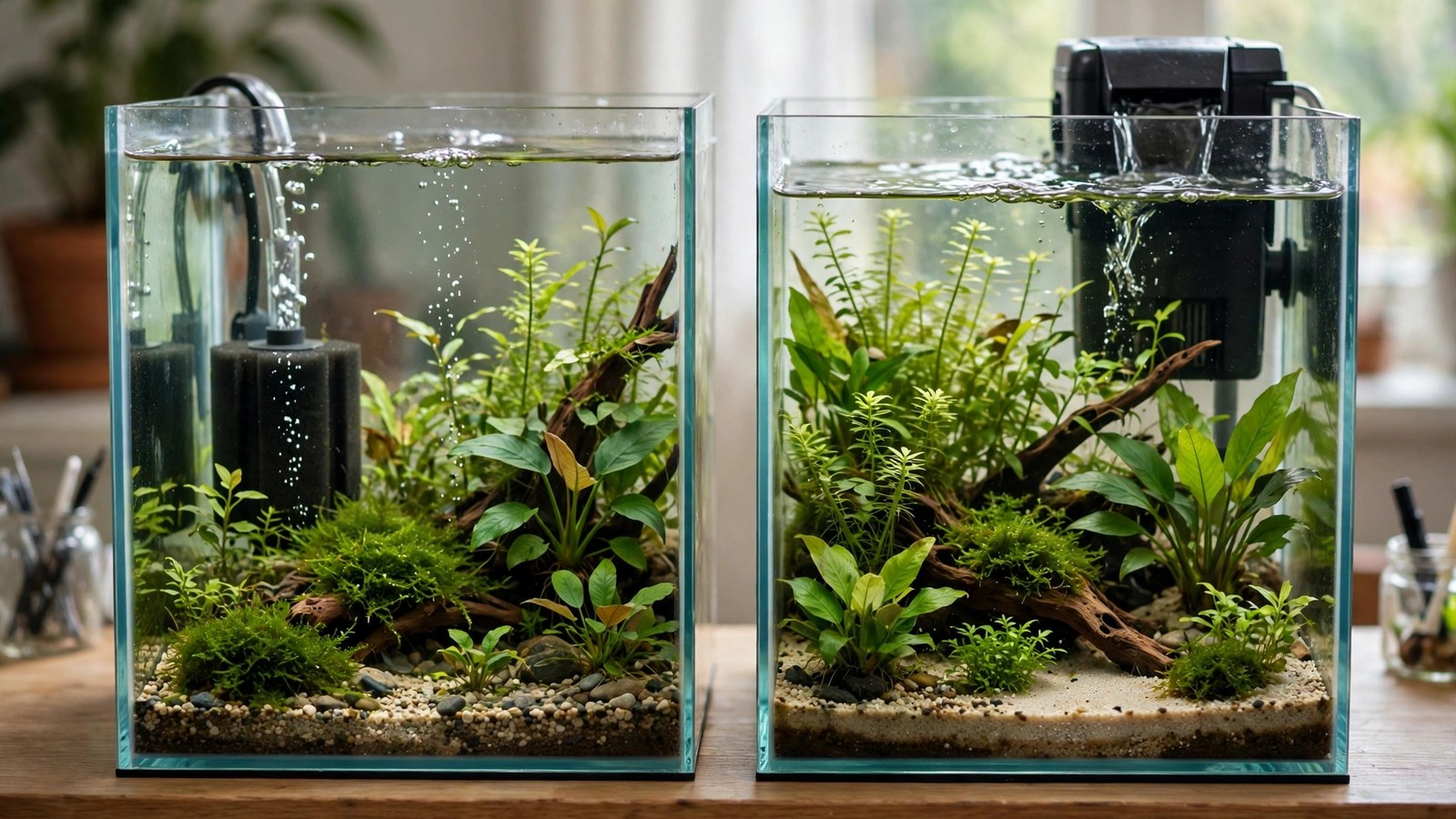
The costliest mistake in planted tanks isn't the wrong plant — it's the wrong filter, working quietly against everything your plants need for six months before you notice. If you're weighing a sponge filter vs HOB planted tank decision, the answer isn't "whichever is cheaper." Filtration interacts with CO2, nutrient distribution, and flow in ways fish-only tanks never face. Here's how to choose right the first time.
Sponge Filter vs HOB Planted Tank: At a Glance
A sponge filter is an air-driven foam cylinder that sits inside the tank — water drawn through the porous sponge feeds a bacteria colony that converts ammonia to nitrite and then nitrate, the biological process described in ThinkFish's overview of biological filtration. A hang-on-back (HOB) filter sits on the tank rim, pulls water up through an intake tube, and drops it back as a waterfall. Design your scape and filtration together with our complete freshwater aquarium plants guide rather than bolting a filter onto a finished layout.
| Criteria | Sponge filter | HOB filter |
|---|---|---|
| Biological capacity | Excellent — huge colonized 3D foam volume | Good to weak — limited cartridge space; upgrade by adding foam media |
| Mechanical polishing | Modest — catches coarse debris | Excellent — fine pads polish water crystal-clear |
| Flow strength | Gentle, adjustable via air valve | Moderate to strong, fixed-ish; some models adjustable |
| CO2 interaction | Minimal — no surface waterfall | Surface agitation strips injected CO2, raising gas costs |
| Shrimp / fry safety | Best-in-class — no intake | Needs a prefilter sponge on the intake |
| Noise | Air pump hum + bubbling | Motor hum + trickling water |
| Typical cost (10–20 gal) | $20–40 incl. air pump | $30–60 |
| Best for | Shrimp tanks, breeding tanks, low-tech nanos | High-tech CO2 tanks (with media mods), crystal-clear community tanks |
Biological Capacity: Sponges Punch Above Their Price
Bacteria colonize every square millimeter of available surface. A sponge's entire foam body becomes one large colony, outperforming cartridge-style HOBs at ammonia processing because the bacteria live through the foam's depth, not just on a thin cartridge surface. For lightly to moderately stocked planted tanks, that's hard to beat for the price.
HOBs are limited by whatever fits in the filter box. The stock disposable cartridge holds little usable media, but the hang-on-back filter setup for planted tanks swaps cartridges for cut-to-fit coarse foam and ceramic rings, transforming biological performance. Judge any filter by its permanent media volume, not the box marketing — and see our canister filter guide for planted tanks when your stocking outgrows either option.
Flow, Surface Agitation, and Your CO2
Plants need CO2 delivered to their leaves; HOBs need surface agitation to look like they're working. That waterfall return churns the surface, and every ripple accelerates CO2 off-gassing. In an injected tank, that means more gas burned for the same dissolved CO2 — visible on the refill schedule. Lowering the outflow to the waterline or baffling it helps, but the physics remain.
Sponge filters, dialed down via an air valve, create almost no surface disturbance and spread CO2 and fertilizer gently without flattening stems or uprooting fresh carpet plantings. If you're running low-tech rather than injected CO2, our low-tech planted tank setup pairs naturally with a sponge's quiet, steady circulation. One caveat: 40+ gallon tanks often need a HOB or powerhead alongside the sponge so nutrients reach every corner.
Livestock Safety: Shrimp and Fry
If you keep cherry shrimp or breed livebearers, this category isn't close. HOB intakes are notorious shrimplet vacuums, and even fine factory guards only reduce the loss. The standard fix is a prefilter sponge on the HOB intake — effective, but it clogs first and needs regular rinsing.
Sponge filters are the default in breeding and shrimp rooms: no intake to harm anything, fry can graze on the sponge surface, and gentle flow never pins weak swimmers. And for Hamburg matten filter fans: the matten is effectively a whole wall of sponge — shrimp-safe with bio capacity for larger tanks.
Noise, Cost, and Maintenance Reality
Sponge filters need an air pump, so budget for that: a reliable small pump plus a quality sponge lands around $20–40 for a 10–20 gallon setup, versus $30–60 for a HOB. Running costs are trivial either way. Where they genuinely differ is noise profile and maintenance. Air pumps hum and bubbles gurgle — quality pumps on a foam pad run nearly silent, cheap ones rattle. HOBs produce motor hum plus the waterfall trickle many people like, until low water levels turn the trickle into a splash.
Squeeze a sponge in old tank water every 2–4 weeks (alternate sides on double sponges so you never rinse the whole colony at once). HOBs need the intake kept clear, the impeller cleaned every few months, and media rinsed — with the golden rule of never cleaning all media on the same day. For context on filter styles beyond these two, compare our guides to sumps for planted tanks and undergravel filters in planted tanks.
Which Should You Choose?
- Shrimp tank, breeding tank, or betta nano (5–20 gal): sponge filter, no contest. Safety, gentle flow, and bulletproof bio capacity for a few dollars.
- Low-tech planted community tank: sponge filter is the calm, economical default; add a small HOB only if you crave polished, sparkling water.
- High-tech injected-CO2 aquascape: HOB with custom foam media (and a prefilter sponge on the intake) — or a hybrid: HOB for polishing plus a sponge for bio backup.
- Heavily stocked 40+ gallon planted tank: HOB as the workhorse, ideally paired with a sponge; or step up to a canister filter.
Notice the pattern: the "loser" in each scenario gets better the moment you add the other. Filtration doesn't have to be monogamous — the best filter is the one you actually maintain. Keep the media permanent, rinse it gently in old tank water, and your plants will reward the stability.
Frequently Asked Questions
Can I run a sponge filter and a HOB filter together?
Absolutely — it's one of the most reliable setups in the hobby. The HOB handles mechanical polishing while the sponge carries a permanent biological colony that survives even if you clean the HOB media too aggressively. You get redundancy: one filter can fail without crashing the tank.
Will a HOB filter really strip CO2 from my planted tank?
Yes, measurably so. The waterfall return churns the surface, and agitated water equilibrates with air — which holds far less CO2 than you inject. In high-tech tanks this raises gas consumption and can starve plants. Lowering the outflow to the waterline reduces the loss; sponge filters avoid the problem almost entirely.
Which sponge filter size do I need for a 20-gallon planted tank?
A single large or dual-sponge filter rated for 20–40 gallons on an adjustable air pump is the standard choice. Planted tanks run lower stocking than fish-only tanks, so rating conservatively is fine. For tanks over 40 gallons, use two sponges at opposite ends to keep flow and nutrients circulating.
Do planted tanks with heavy plant loads even need a filter?
Plants absorb ammonia and nitrates, but they can't replace circulation and bacterial stability — especially with fish present. Filterless "Walstad-style" tanks exist but are finicky and lightly stocked. For 99% of keepers, a simple sponge filter gives far more stability for a few dollars.
Which is quieter for a bedroom tank: sponge filter or HOB?
It depends on the hardware. A quality air pump on a foam pad is nearly silent; a cheap pump hums annoyingly. HOBs add motor vibration plus trickling water, which some find soothing and others find maddening. In general, a good pump plus a sponge is the quieter bedroom option.
The Calm Way to Decide
Strip away the brand wars and the choice is straightforward: sponges give you biology, safety, and CO2-friendly calm for almost nothing; HOBs give you polishing power and media flexibility at the cost of surface agitation and intake risk. Match the filter to livestock first, CO2 second, budget third.